- Ex archivis
- From the archives.
- Ad fontes
- To the sources.
- Scripta manent
- What is written remains.
Wall chart, chronicle and audiobook
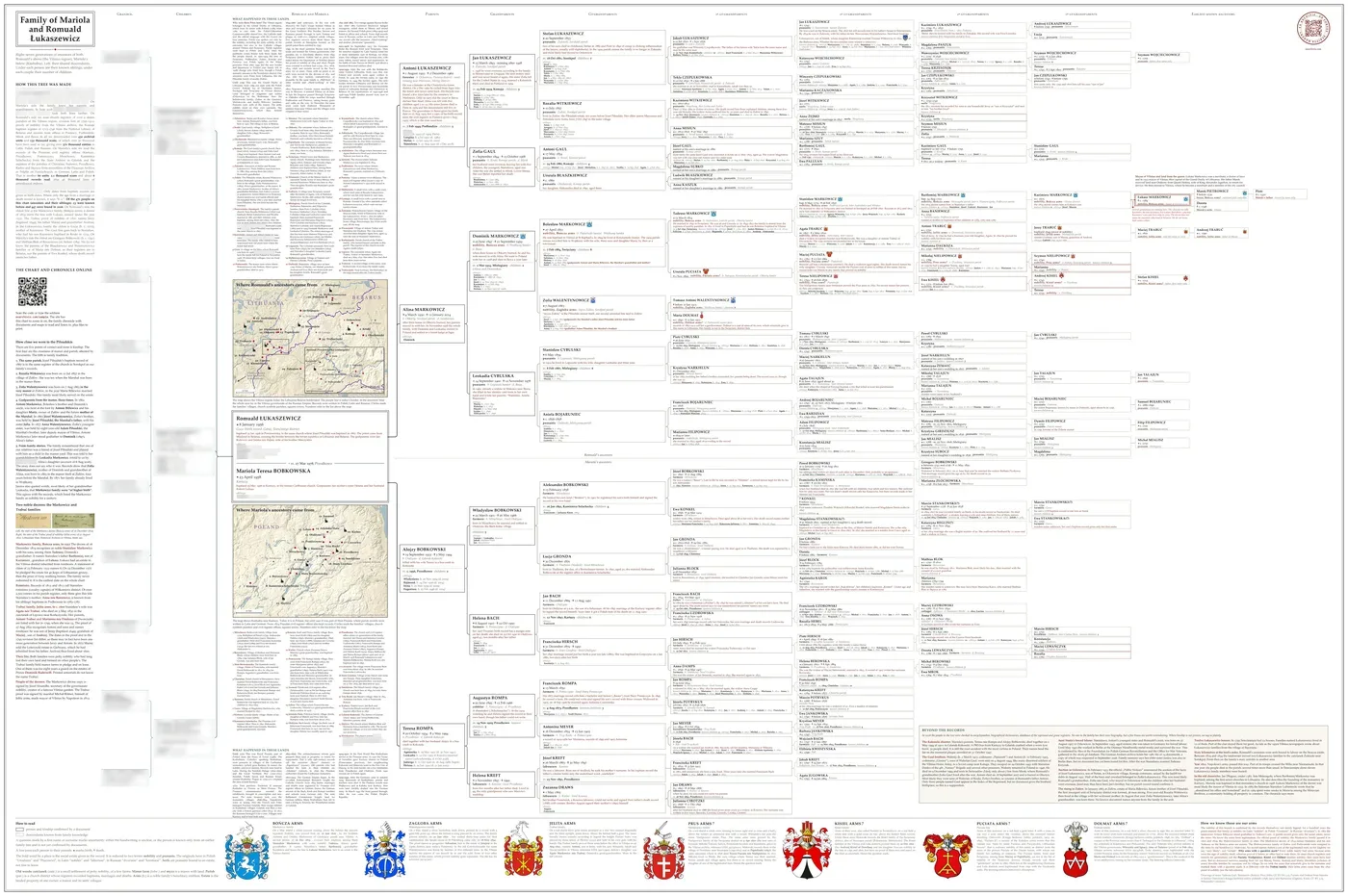
Family tree wall chart (PDF file)
A PDF file with the family tree, a map of the family's places and a description of the lands the family comes from. Prepared for printing in sizes up to A0. You order the print yourself at any print shop.
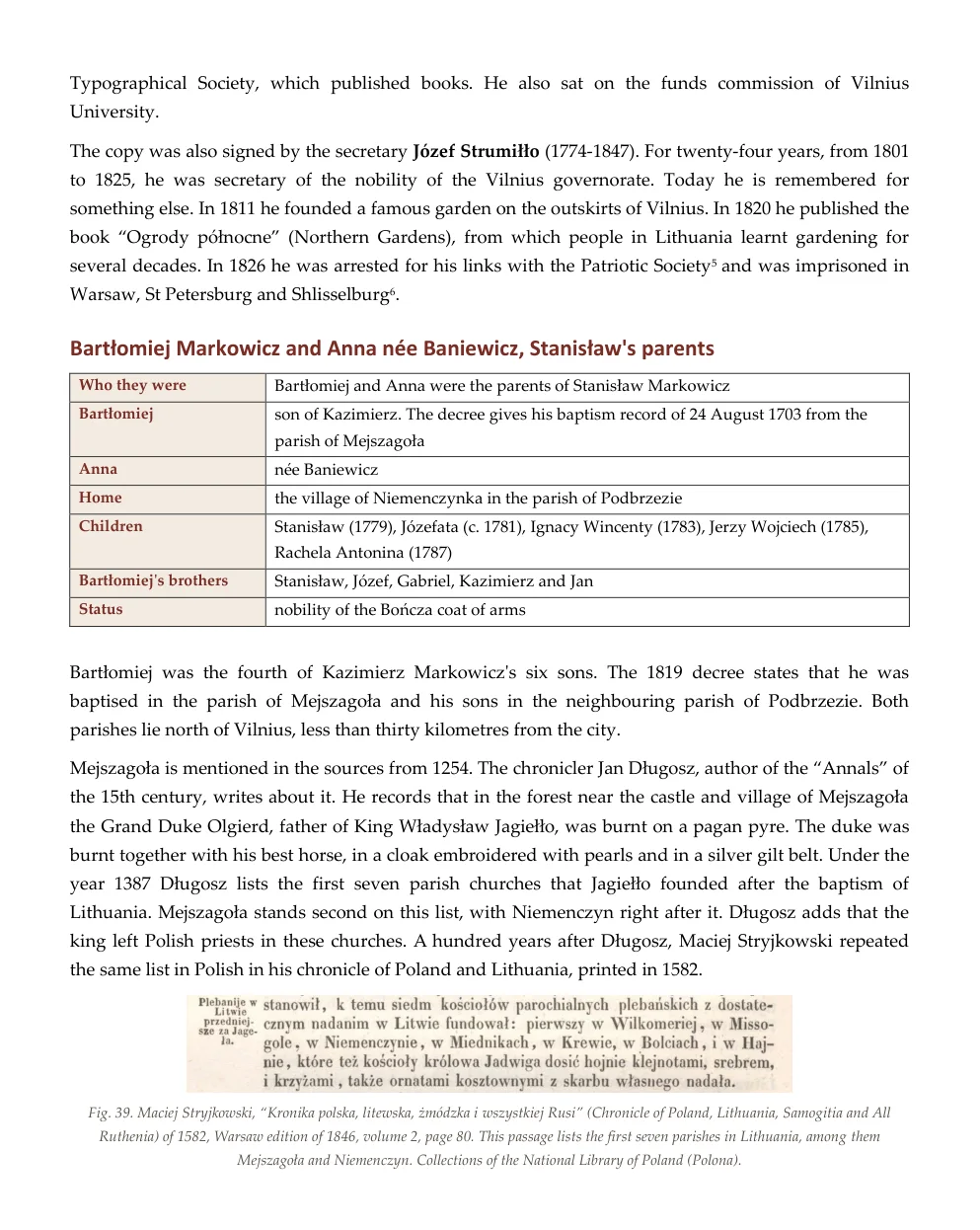
Family chronicle (PDF file)
A book about the family, generation by generation. Each fact comes with a clipping of the record, the original text and a translation. Separate chapters describe the lands the family comes from. There is also a map of the family's places with a description of each. You receive a PDF file to read and print.
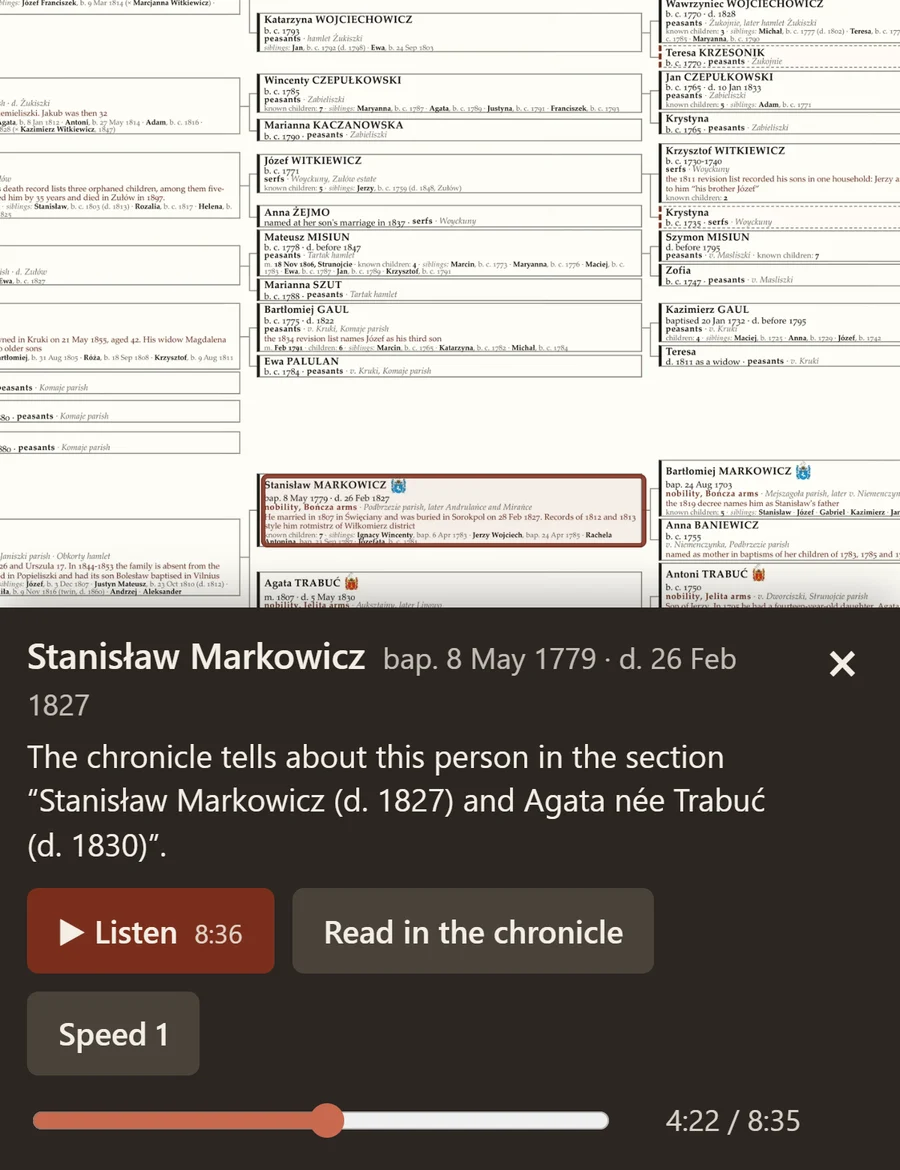
Audiobook of the chronicle
The whole chronicle read aloud, chapter by chapter, to listen to on a phone.
This is the full set a family receives: a chart you can zoom, a chronicle to read plus recordings to listen to. As this is a showcase edition, details of living people are blurred in it.
See how we work
A short film: how a baptism record from 1889 becomes a family tree chart, a family chronicle and an audiobook.
Every fact is shown with its document
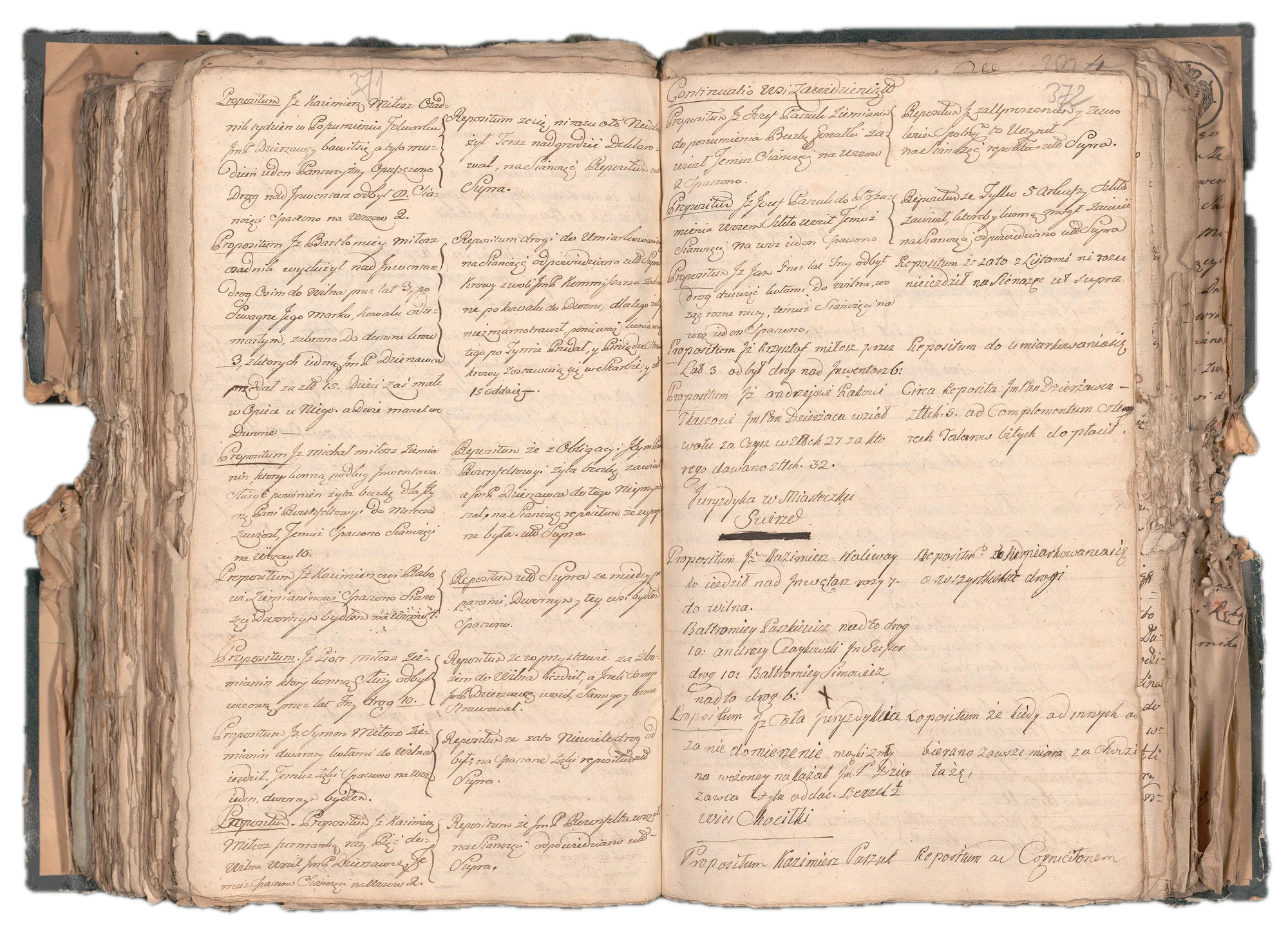
This is how a single fact appears in a chronicle. The example: the baptism record of Jerzy Wojciech Markowicz from 1785. The archive reference stands below, so anyone can open the same scan in the archive and check our work.

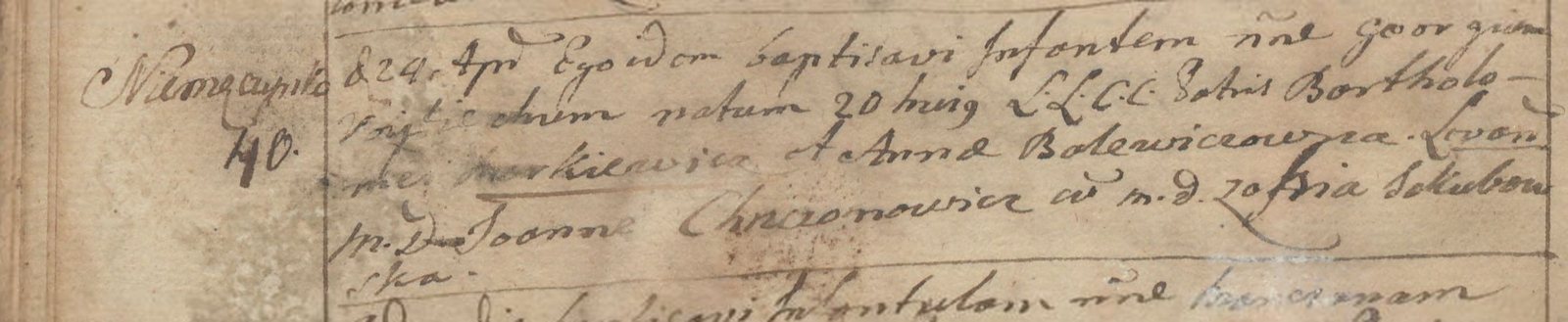
Aprilis d 12. 1785. […] Niemczynka. 40. d 24. Apr. Ego idem baptisavi Infantem nne Georgium Woyciechum natum 20 huius LLCC Patris Bartholomei Morkiewicz et Anne Bolewiczowna. Levan. M.D. Joanne Chrzczonowicz cu M.D. Zofia Sekulowska[?].
Heading: 12 April 1785. Village of Niemenczynka. Entry 40. On 24 April I, the same priest, baptised a child named Jerzy Wojciech, born on the 20th of this month, son of the lawfully married Bartłomiej Markowicz and Anna Baniewiczówna (the priest spelled the surnames Morkiewicz and Bolewiczowna). The godparents were the honourable Jan Chrzczonowicz and the honourable Zofia Sekułowska (surname uncertain).
Stories from the archives
Short films about people we found in the records. Every fact comes with its archival reference.
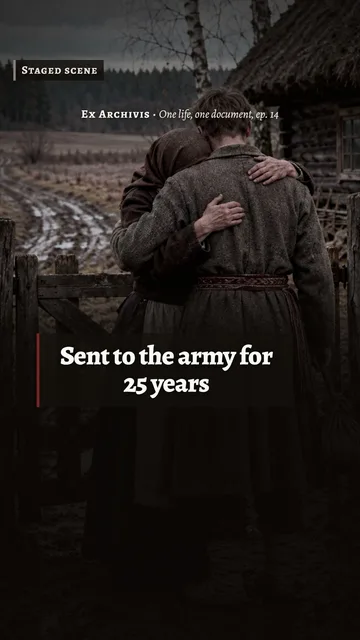 Sent to the Tsar's army for 25 years. A Polish village census, 1811
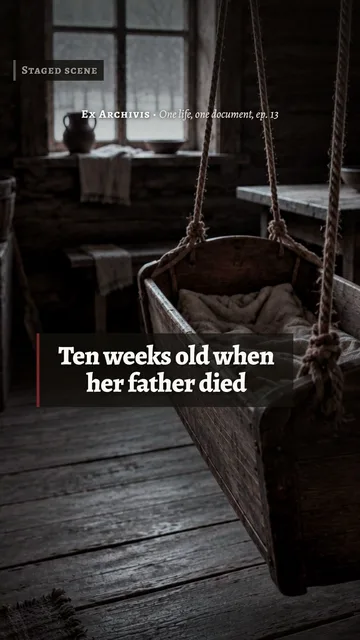 A soldier's daughter was ten weeks old when he died. Polish parish records, 1866
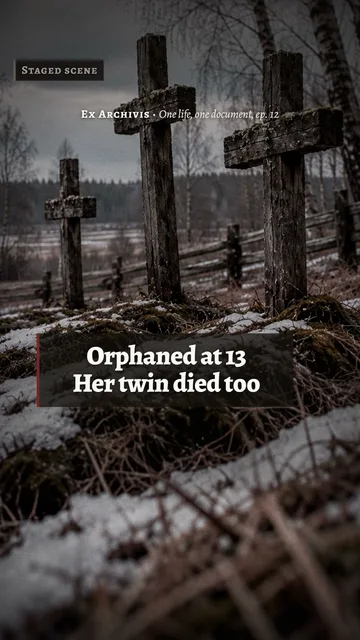 She was 13 when she lost both parents
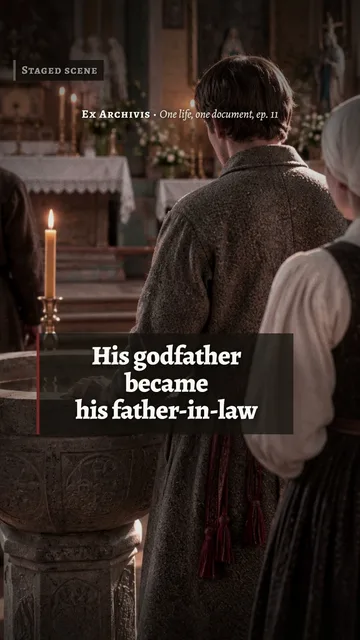 He held him at his baptism, then gave him his daughter. Sorokpol and Kiemieliszki, 1816 and 1848
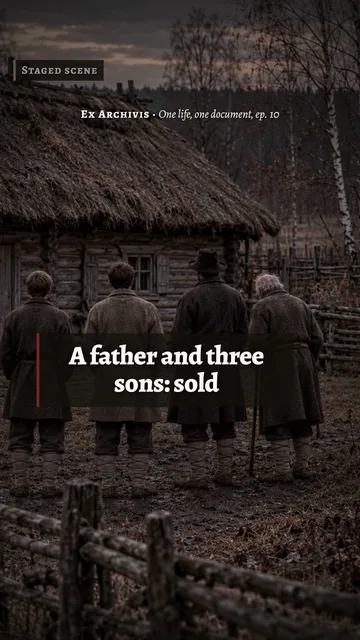 A father and three sons sold. Komaje, 1805
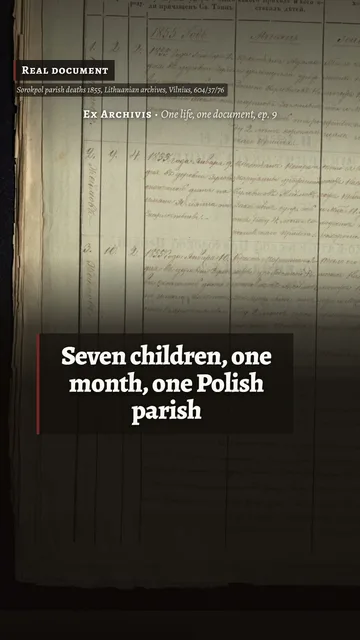 Seven children in one month. Zułów, 1855
All stories Follow us: YouTube, TikTok, Instagram, Facebook, LinkedIn
Price
A fixed price for the set. No hourly billing. We search further only when you ask us to.
First assessmentfree
You tell us what you know about the family: surnames, places, approximate dates. Before you pay anything, we reply in a few sentences which sources survive for your parishes, how far back they reach and what can be expected.
Wall chart, chronicle and audiobook1,490 USD
We begin with the earliest ancestors you know and work backwards through the registers of your parishes, reading up to 3,000 pages of sources. You receive:
- a PDF file of the family tree wall chart with a bespoke map of your family's places and a description of the lands where your family lived
- the family chronicle as a PDF, with a clipping, the original text and a translation next to every fact
- an audiobook to listen to on a phone
- a tree with everything we found and a written list of the sources
- a report at the end: what we went through and how much, what is left to check and who else could be traced
- one round of your corrections, included in the price
You pay in two parts of 745 USD: one at the beginning and one when the chronicle is delivered. If halfway through it turns out there is not enough material for a chronicle, we stop. You then pay the first part only and receive the tree, the records with translations and the wall chart file. We do not guarantee results, because they depend on which registers survived.
A further block of work390 USD
If the report shows it is worth going further, a further block covers 1,000 pages of sources. Before the block we tell you what can realistically be checked and who could be traced, but we do not guarantee results. After the block you receive a report. The chart, the chronicle and the audiobook are updated with what we found.
Further rounds of changes90 USD per round
The first round of your corrections is included. Each further round costs 90 USD, with a new recording. A round is one list of changes sent in one message. Our own mistakes are always corrected free of charge.
Records only, for a citizenship casefrom 120 USD
When you need only the documents for the authorities: one record for 175 USD or a chain of records covering two to three generations for 590 USD. We deduct the chain from the price of the wall chart, chronicle and audiobook if you order them later. A copy from a Polish register office we order for you under your power of attorney: 170 USD on paper posted to you abroad by insured and tracked mail. Delivered in Poland it costs 120 USD. Official fees are included in both prices. An apostille for use abroad costs 40 USD extra.
A further block is charged whether or not it brings a new generation. The chart, the chronicle and the audiobook come in English or in Polish at the same price.
How our work differs
Price
With most genealogists Billing by the hour, from 46 to 129 USD per hour. Packages for ten hours of research or for two to three generations cost 699 to 1,290 USD. With hourly billing you learn the final amount at the end.
With Ex Archivis One fixed price for the whole set: wall chart, chronicle and audiobook, 1,490 USD. You know it before we start.
Documents
With most genealogists A report listing the records found, with copies of the documents.
With Ex Archivis Next to every fact a clipping of the document, the original text, a translation and the archive reference. Anyone can check our work.
Scope
With most genealogists As many sources as fit into the hours paid for. 1,490 USD buys about 12 to 32 hours of work.
With Ex Archivis We read up to 3,000 pages of sources for your parishes, entry by entry. The report says what we went through and how much, what we checked with no result and what is left to check.
What stays
With most genealogists A research report.
With Ex Archivis A family tree chart, a family chronicle with a description of the ancestral lands, a map of the family's places with descriptions plus a recording. On the screen version of the chart you can click a person and listen to their story.
What the comparison rests on: the published price lists of four firms that research Polish records for clients abroad, read in October 2026. The hours for 1,490 USD are worked out from their rates.
Before you write
Parishes whose registers we have read: Komaje (Kamai), Mielegiany (Mielagėnai, Mielagenai), Podbrzezie (Paberžė, Paberze) near Vilnius, Sorokpol (Powiewiórka, Pavoverė, Powiewiorka, Pavovere), Strunojcie (Strūnaitis, Strunaitis), Święciany (Švenčionys, Swieciany, Svencionys), all parishes. Archives and registers we have worked with
Where we search
Parish registers are the beginning. When they end or stay silent, we go further.
- Parish registers: baptisms, marriages and deaths, in Latin, Polish, Russian and German.
- Census lists and revisions: the inhabitants of villages and estates, house by house.
- Nobility files: the proofs and decrees in which a family demonstrated its descent.
- Court and mortgage records: disputes, pledges, purchases and sales of land.
- Old newspapers and yearbooks: official and court notices that name a family or a village.
- Wartime sources: the Arolsen Archives with documents on prisoners and forced labourers of the Second World War, casualty lists, registers of the repressed.
- Armorials and early chroniclers. Chroniclers are authors such as Jan Długosz and Maciej Stryjkowski, who in the 15th and 16th centuries wrote down the history of the country, its families and its places. Sometimes they mention the village or the family of your ancestors.
- Source editions: wills, parish visitations and other documents that historians have prepared and published in print.
For every finding we state where it comes from.
Honest about results
The further back we go, the more registers are lost and the more often the answer is “not in this source”. That is still a result: it closes a lead and saves the next spend.
The lines of a family do not go back evenly. One breaks off at a lost register, another reaches the 18th century. Before we start we agree with you which lines matter most. We begin with those.
- We do not promise a number of generations, because that depends on which registers survived. We promise what depends on us: every fact will have a source.
- We do not assign coats of arms by surname. Nobility goes into your tree only when a document links your family to a proof of nobility.
- An age stated in a record is treated as an approximation, not as a date of birth.
Languages and regions
Everything is delivered as files. We do not print or post anything. We work with sources in Latin, Polish, Russian and German. We know best the Vilnius region (the former Święciany and Vilnius districts, today in Lithuania and Belarus), Kashubia, Dobrzyń Land and the Lublin region.
About the showcase edition
This is the family of the founder of Ex Archivis. We started with their story.
The showcase edition is the complete chronicle of one family, more than 300 pages, together with the chart and the recordings. Details of living people are blurred in it. Where a reading is uncertain we say so plainly.
Tell us where the family comes from
A few sentences are enough. We will reply with which sources exist and where it makes sense to begin.
The first assessment is free. We reply in English and in Polish.
Prefer a normal email? Write to
info@exarchivis.com