Sent to the Tsar's army for 25 years. A Polish village census, 1811
In December 1811 a clerk listed the men of the Lutów estate in Sorokpol parish, in the Vilnius region of old Poland-Lithuania. In the village of Woyckuny, five of them carry the same note: “zdany w rekruty”, handed over as a recruit, in 1797, 1801, 1809, 1810 and 1811. Three brothers from one house lost their father in 1796. Two of them were later taken into the army and the third was moved to another village. Service in the Tsar's army lasted twenty-five years. Did someone in your family go to war and never come back?
The historical background
Twenty-five years.
From 1793 that was how long a recruit served in the Tsar's army. For most of the eighteenth century it had been for life. A young man taken at twenty could come home in his mid-forties, if he survived every war.
A recruit had to be between 20 and 35 and at least 63 inches tall. In peacetime the army took one or two men out of every five hundred. In wartime, up to five out of every hundred.
The village decided who would go by drawing lots or by an agreed list. Lords often skipped the lots and handed over the men they wanted to be rid of: troublemakers and idlers. Some peasants maimed themselves to avoid service. If caught, they were driven through a gauntlet of five hundred soldiers with whips and then sent to the army anyway.
In fourteen years Woyckuny, a village left with fifteen men and boys in 1811, gave five of them to the army. The census does not say if any of them came back.
Documents shown in the film
These are the real archive scans you see in the film. Each one has its archive reference, so anyone can check the source.
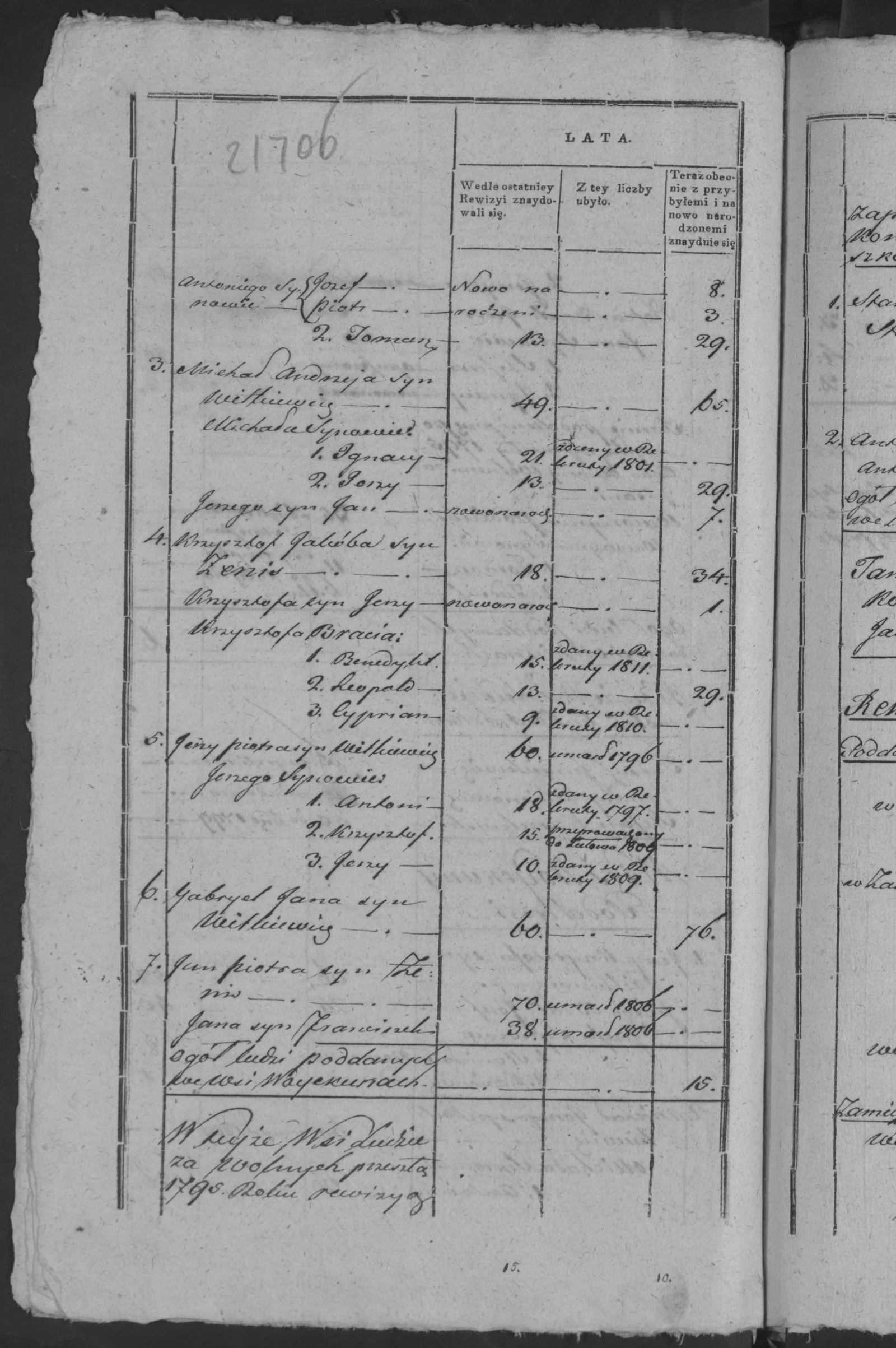
The number right after a name is the age at the previous census (1795). The middle column says who was gone and why. The last one gives the age of those still in the village in 1811. Households 3 to 7, the lower part of the village of Woyckuny, are transcribed below. The surname of the seventh household could not be read with certainty.
Original text (Polish): […] Michała Synowie: 1. Ignacy, 21, zdany w Rekruty 1801. 2. Jerzy, 13, teraz 29. Jerzego syn Jan, nowonarodzony, teraz 7. 4. Krzysztof Jakóba syn Żenis, 18, teraz 34. Krzysztofa syn Jerzy, nowonarodzony, teraz 1. Krzysztofa Bracia: 1. Benedykt, 15, zdany w Rekruty 1811. 2. Leopold, 13, teraz 29. 3. Cyprian, 9, zdany w Rekruty 1810. 5. Jerzy Piotra syn Witkiewicz, 60, umarł 1796. Jerzego Synowie: 1. Antoni, 18, zdany w Rekruty 1797. 2. Krzysztof, 15, przeprowadzony do Lutowa 1806. 3. Jerzy, 10, zdany w Rekruty 1809. 6. Gabryel Jana syn Witkiewicz, 60, teraz 76. 7. Jan Piotra syn […], 70, umarł 1806. Jana syn Franciszek, 38, umarł 1806. Ogół ludzi poddanych we Wsi Woyckunach: 15.
In English: […] Michał's sons: 1. Ignacy, 21 at the previous census, given up as a recruit in 1801. 2. Jerzy, 13, now 29. Jerzy's son Jan, born after the previous census, now 7. 4. Krzysztof, son of Jakub, Żenis, 18, now 34. Krzysztof's son Jerzy, born after the previous census, now 1. Krzysztof's brothers: 1. Benedykt, 15, given up as a recruit in 1811. 2. Leopold, 13, now 29. 3. Cyprian, 9, given up as a recruit in 1810. 5. Jerzy, son of Piotr, Witkiewicz, 60, died 1796. Jerzy's sons: 1. Antoni, 18, given up as a recruit in 1797. 2. Krzysztof, 15, moved to Lutów in 1806. 3. Jerzy, 10, given up as a recruit in 1809. 6. Gabriel, son of Jan, Witkiewicz, 60, now 76. 7. Jan, son of Piotr, […], 70, died 1806. Jan's son Franciszek, 38, died 1806. Total of serfs in the village of Woyckuny: 15.
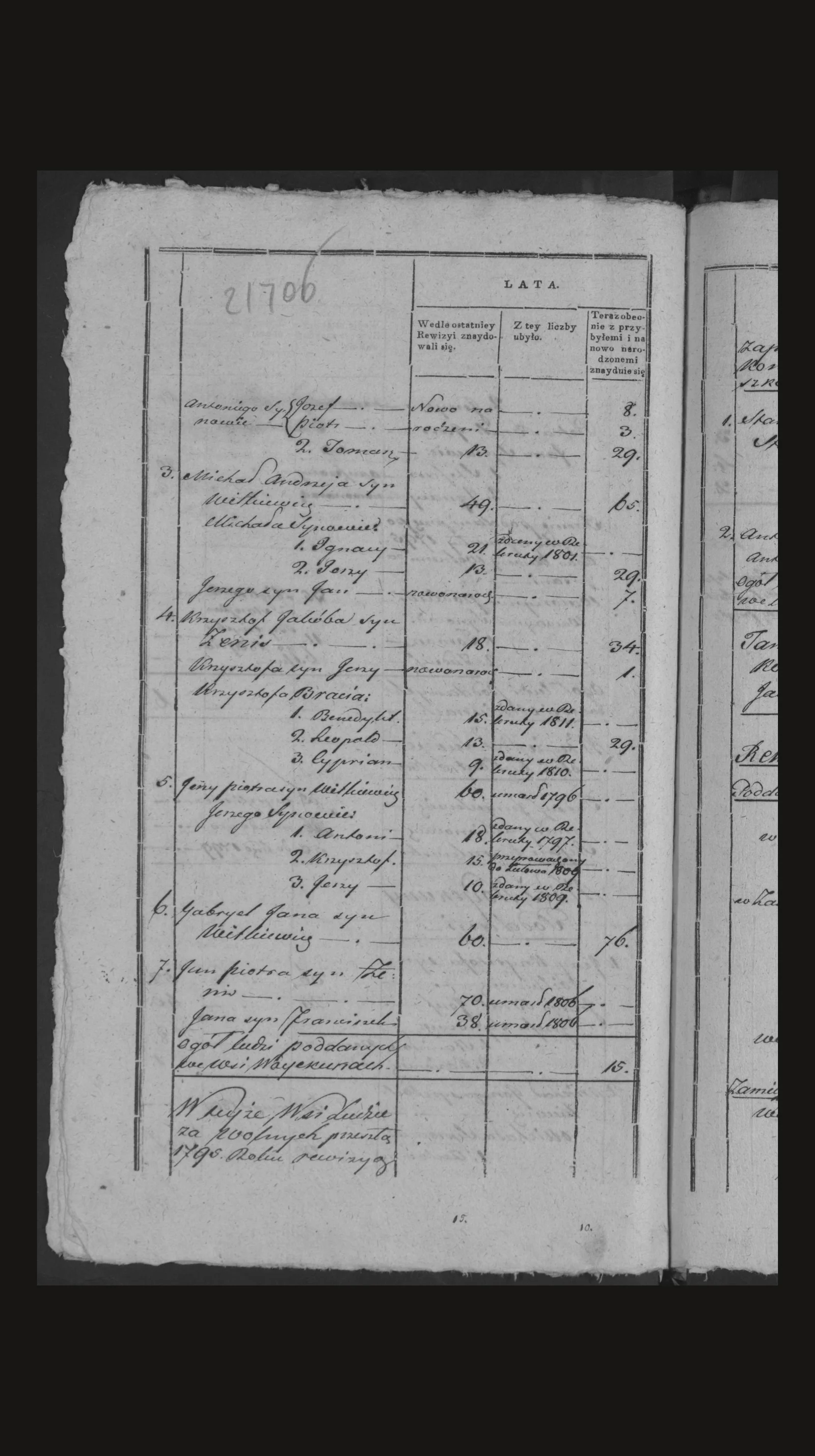
The same page in a wider frame. The number right after a name is the age at the previous census (1795). The middle column says who was gone and why. The last one gives the age of those still in the village in 1811. Households 3 to 7, the lower part of the village of Woyckuny, are transcribed below. The surname of the seventh household could not be read with certainty.
Original text (Polish): […] Michała Synowie: 1. Ignacy, 21, zdany w Rekruty 1801. 2. Jerzy, 13, teraz 29. Jerzego syn Jan, nowonarodzony, teraz 7. 4. Krzysztof Jakóba syn Żenis, 18, teraz 34. Krzysztofa syn Jerzy, nowonarodzony, teraz 1. Krzysztofa Bracia: 1. Benedykt, 15, zdany w Rekruty 1811. 2. Leopold, 13, teraz 29. 3. Cyprian, 9, zdany w Rekruty 1810. 5. Jerzy Piotra syn Witkiewicz, 60, umarł 1796. Jerzego Synowie: 1. Antoni, 18, zdany w Rekruty 1797. 2. Krzysztof, 15, przeprowadzony do Lutowa 1806. 3. Jerzy, 10, zdany w Rekruty 1809. 6. Gabryel Jana syn Witkiewicz, 60, teraz 76. 7. Jan Piotra syn […], 70, umarł 1806. Jana syn Franciszek, 38, umarł 1806. Ogół ludzi poddanych we Wsi Woyckunach: 15.
In English: […] Michał's sons: 1. Ignacy, 21 at the previous census, given up as a recruit in 1801. 2. Jerzy, 13, now 29. Jerzy's son Jan, born after the previous census, now 7. 4. Krzysztof, son of Jakub, Żenis, 18, now 34. Krzysztof's son Jerzy, born after the previous census, now 1. Krzysztof's brothers: 1. Benedykt, 15, given up as a recruit in 1811. 2. Leopold, 13, now 29. 3. Cyprian, 9, given up as a recruit in 1810. 5. Jerzy, son of Piotr, Witkiewicz, 60, died 1796. Jerzy's sons: 1. Antoni, 18, given up as a recruit in 1797. 2. Krzysztof, 15, moved to Lutów in 1806. 3. Jerzy, 10, given up as a recruit in 1809. 6. Gabriel, son of Jan, Witkiewicz, 60, now 76. 7. Jan, son of Piotr, […], 70, died 1806. Jan's son Franciszek, 38, died 1806. Total of serfs in the village of Woyckuny: 15.
Narration
In this old Polish record,
a father died.
A year later,
his eldest son was sent to the Tsar's army for twenty-five years.
We found this in old records while searching for our ancestors.
Next to his name,
the clerk wrote:
handed over
as a recruit.
This is a census of the men of a small village in the Vilnius region,
made in 1811.
The village had fifteen men and boys.
Almost all of them had the same surname.
The youngest of the three brothers
was taken twelve years after the eldest.
The middle one
was moved to another village.
None of the three brothers
was left at home.
Next door,
two brothers were taken,
one year apart.
In fourteen years,
this one village gave the Tsar
five soldiers.
Service lasted twenty-five years.
We do not know if any of them
came home.
Did someone in your family
go to war
and never come back?
Tell us in the comments.
Ex Archivis. We find out
where your family comes from.
Sources
- Male census, 1811, Lutów estate, Sorokpol parish, Woyckuny village, images 423, 435 and 436 (Lithuanian State Historical Archives in Vilnius, 515/15/217)
- Jerome Blum, “Lord and Peasant in Russia”, Princeton 1961
Scenes marked “Staged scene” are reconstructions. The documents are real.
This film on social media
Want us to look into your family?
Tell us where your ancestors came from. We will reply with how far back the records of that area go.