A father and three sons sold. Komaje, 1805
In November 1811 a clerk listed the men of the Dziakiszki estate in Komaje parish, in the Vilnius region. Next to sixteen men and boys from the village of Paukszte he wrote the same note: sold 1805. They included a father with his three sons and boys from other families aged about eleven and thirteen.
The historical background
Sold with the land or without it.
By 1805 this village was already part of the Russian Empire. A serf belonged to his lord. The lord could sell him, give him away, even lose him at cards.
In the first year of his reign Tsar Alexander I banned printed advertisements selling people apart from the land they lived on. Owners simply changed the wording: a cook or a serf girl was now “available for service”.
When a whole village was sold with its land, the peasants only got a new master. When people were sold on their own, they often lost their home and their family. In the Paukszte census one boy is “sold with the land”. Fifteen others are simply “sold”.
The census does not say where they went or whether the women went with them. Serfdom was abolished in 1861, fifty-six years after this sale.
Documents shown in the film
These are the real archive scans you see in the film. Each one has its archive reference, so anyone can check the source.
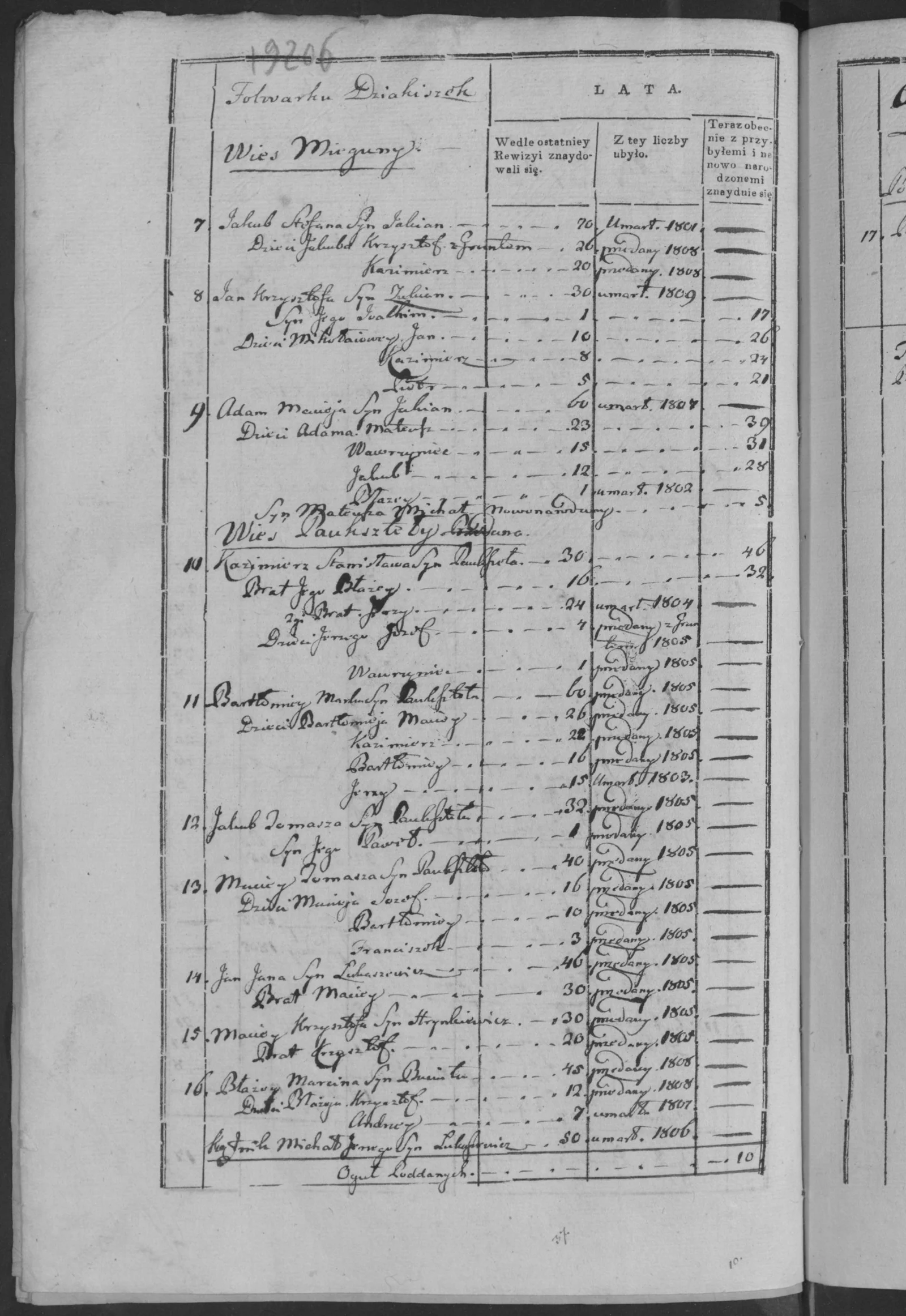
The number right after a name is the age at the previous census (1795). The middle column says who was gone and why. The last one gives the age of those still in the village in 1811. Entries 10 to 13 are transcribed below. Further down the same note, “przedany 1805” (sold 1805), stands beside more men.
Original text (Polish): Wieś Paukszte […]. 10. Kazimierz Stanisława Syn Paukszta, 30, teraz 46. Brat Jego Błażey, 16, teraz 32. 2gi Brat Jerzy, 24, Umarł 1804. Dzieci Jerzego: Józef, 4, przedany z gruntem 1805. Wawrzyniec, 1, przedany 1805. 11. Bartłomiey Marcina Syn Paukszta, 60, przedany 1805. Dzieci Bartłomieja: Maciey, 26, przedany 1805. Kazimierz, 22, przedany 1805. Bartłomiey, 16, przedany 1805. Jerzy, 15, Umarł 1803. 12. Jakub Tomasza Syn Paukszta, 32, przedany 1805. Syn Jego Paweł, 1, przedany 1805. 13. Maciey Tomasza Syn Paukszta, 40, przedany 1805. Dzieci Macieja: Józef, 16, przedany 1805. Bartłomiey, 10, przedany 1805. Franciszek, 3, przedany 1805.
In English: Paukszte village. 10. Kazimierz, son of Stanisław, Paukszta: 30 at the previous census, now 46. His brother Błażej: 16, now 32. Second brother Jerzy: 24, died 1804. Jerzy's children: Józef, 4, sold together with the land in 1805. Wawrzyniec, 1, sold 1805. 11. Bartłomiej, son of Marcin, Paukszta: 60, sold 1805. Bartłomiej's children: Maciej, 26, sold 1805. Kazimierz, 22, sold 1805. Bartłomiej, 16, sold 1805. Jerzy, 15, died 1803. 12. Jakub, son of Tomasz, Paukszta: 32, sold 1805. His son Paweł, 1, sold 1805. 13. Maciej, son of Tomasz, Paukszta: 40, sold 1805. Maciej's children: Józef, 16, sold 1805. Bartłomiej, 10, sold 1805. Franciszek, 3, sold 1805.
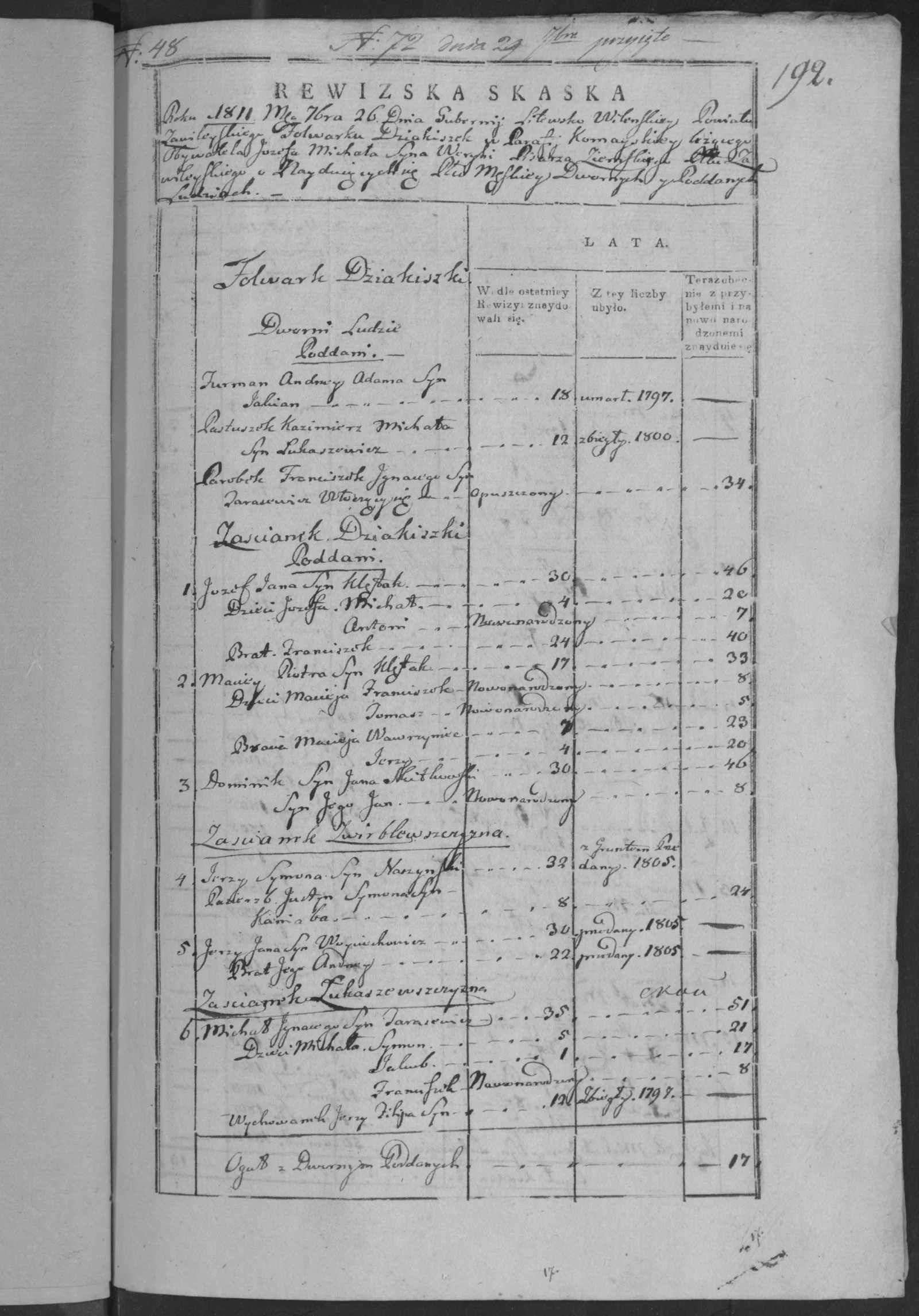
The top of the first page of the census. Below the handwritten text are the printed column headings of the table.
Original text (Polish): REWIZSKA SKASKA. Roku 1811 M[iesią]ca 9bra 26 Dnia Gubernij Litewsko Wilenskiey Powiatu Zawileyskiego Folwarku Dziakiszek w Parafij Komayskiey leżącego Obywatela Józefa Michała Syna Weryhi Pisarza Ziemskiego Powiatu Zawileyskiego o Naydujących się Płci Męskiey Dwornych y Poddanych Ludziach. Folwark Dziakiszki. Dworni Ludzie. Poddani. Lata: Wedle ostatniey Rewizyi znaydowali się. Z tey liczby ubyło. Teraz obecnie z przybyłemi i na nowo narodzonemi znayduie się.
In English: Revision list. In the year 1811, on the 26th day of November, in the Lithuanian-Vilnius province, Zawilejski district, of the male people, household servants and serfs, found on the Dziakiszki estate in Komaje parish, belonging to the citizen Józef, son of Michał, Weryha, land clerk of Zawilejski district. Dziakiszki estate. Household servants. Serfs. Ages: at the last revision there were. Of this number gone. Present now, with arrivals and the newly born.
Narration
In this old Polish record,
a father
and his three sons were sold.
We found this in old records while searching for our ancestors.
Next to each name,
the clerk wrote
the same word:
sold.
It is a list of serfs from a small village in the Vilnius region,
made in 1811.
The clerk noted who was gone
and why.
Sixteen men and boys from this village
have the same note.
The father
was about seventy.
His fourth son had died two years earlier.
Boys from other families were sold too.
One was about eleven,
another about thirteen.
Next to one boy
it says:
sold with the land.
Only two brothers were left in the village.
The list counted only men.
Their mothers,
wives and daughters are not in it.
We do not know who bought them,
where they went
or whether the family stayed together.
Did your family ever talk about serfdom?
Tell us in the comments.
Ex Archivis. We find out where your family comes from.
Sources
- Male census, 1811, Dziakiszki estate, Komaje parish, images 385 and 386 (Lithuanian State Historical Archives in Vilnius, 515/15/221)
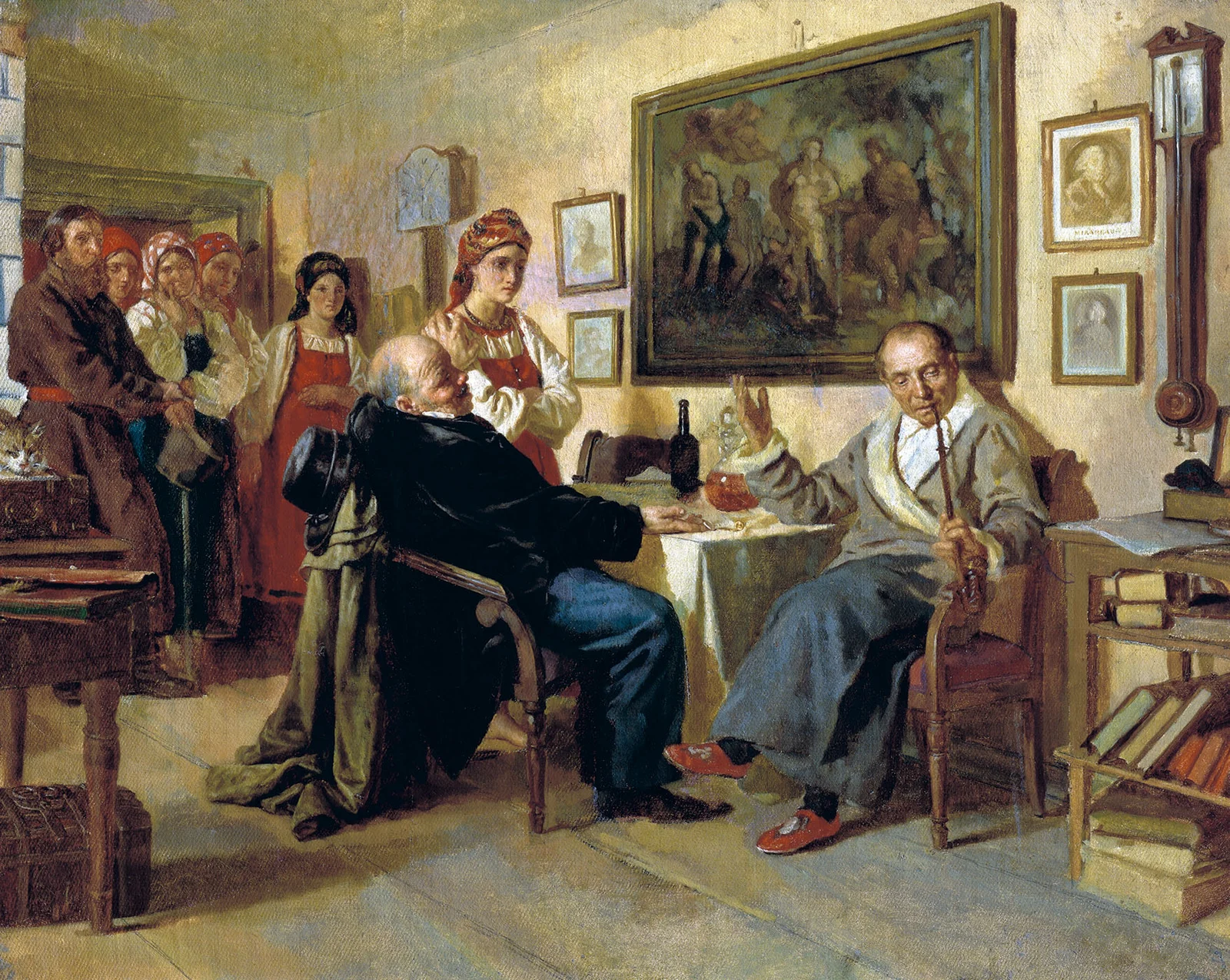
- Nikolai Nevrev, “Torg”, 1866 (Wikimedia Commons, public domain)
Scenes marked “Staged scene” are reconstructions. The documents are real.
Want us to look into your family?
Tell us where your ancestors came from. We will reply with how far back the records of that area go.