The Vilnius region: the land of Romuald's ancestors
Before we tell the story of the families, we need to tell the story of the land on which they lived. Romuald's ancestors lived around Vilnius from the 15th century until 1958. Over those five hundred years their home country changed rulers many times and foreign armies marched through it. Hunger and plague several times carried off a large part of the population. Knowing this makes it easier to understand why the descendants of a mayor of Vilnius were farming other people's land two hundred years later. It also explains why many ancestors left behind only a single entry in a register.
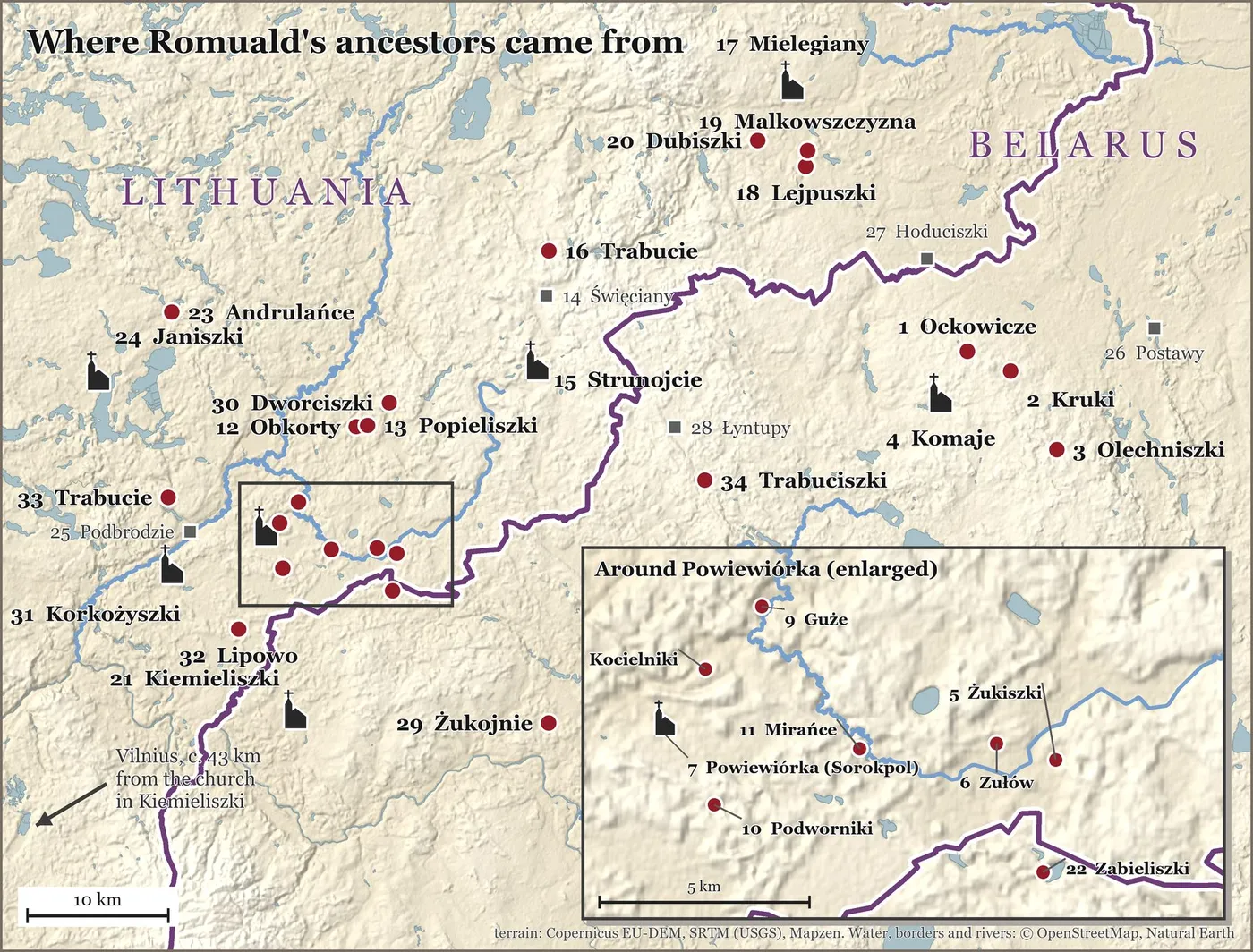
The Grand Duchy of Lithuania
Vilnius was the capital of the Grand Duchy of Lithuania. In the Middle Ages it was a huge state that stretched from the Baltic almost to the Black Sea. The Lithuanians were the last pagan nation in Europe. In 1385 Grand Duke Jogaila made an agreement with Poland. He was baptised, married Queen Jadwiga and became King of Poland, while Lithuania accepted the Catholic faith. From then on the two states had a common ruler, although each kept its own army, treasury and laws.
In 1569 in Lublin Poland and Lithuania joined into one state, which we call the Polish-Lithuanian Commonwealth. The Lithuanian nobility received the same rights as the Polish nobility and over time adopted the Polish language and customs. The townspeople of Vilnius also began to speak Polish. In the following centuries so did the inhabitants of the Catholic villages around the city. That is why our ancestors were Poles, even though they lived in Lithuania. The same was true of the Piłsudski family from neighbouring Zułów.
Many peoples lived side by side in the Grand Duchy. There were Lithuanians, Ruthenians (the ancestors of today's Belarusians), Poles, Jews, Tatars and Germans. Official documents were first written in Ruthenian. Ruthenian is not Russian. It was the speech of the old Ruthenians, from which today's Belarusian and Ukrainian languages grew. It was written in the Cyrillic alphabet and until the end of the 17th century it was the official language of the Grand Duchy. After that Polish and Latin replaced it. Russian appeared in offices only after the partitions and in church registers only in the 19th century. This can be seen in our family's documents. In 1567 Mayor Łukasz Markowicz wrote a letter in Ruthenian, the old official language. The will of his father Marek was confirmed in Latin. The church registers of the 18th century are already in Polish and Latin.
The 16th century: the time of Marek and Łukasz
The earliest ancestors we know by name are Marek Pietrowicz and his son Łukasz Markowicz. They lived in Vilnius in the 16th century. It was a century in which Lithuania was almost constantly at war with Moscow. Great wars were fought in 1500 to 1503, 1507 to 1508, 1512 to 1522 and 1534 to 1537. In 1514 Lithuania lost Smolensk and the Muscovite border moved towards Vilnius. Everyone who held land had to report on horseback for war when the ruler called. Whoever did not go paid a fine. Marek was given such a fine. King Sigismund the Old let him off it in 1509.
At that time Vilnius was growing fast. At the beginning of the 16th century it was surrounded by a wall meant to protect it against Tatar raids. Merchants from Ruthenia, Poland and Germany traded in the city. Marek was one of them and sat on the town council. The city, however, was almost entirely built of wood. Every dozen years or so it was destroyed by fire. In 1530 a large part of it burned down. Documents burned along with the houses. Without a document it was hard to prove one's rights to land.
In the middle of the 16th century King Sigismund Augustus ordered all the royal lands in Lithuania to be measured anew. The land was divided into equal plots called włóki. People's duties were set afresh. Anyone who sat on royal land and could not produce a document of grant lost it. That is what happened to Marek's land near Onikszty. He had received it from Queen Helena, but the officials joined it to the royal manor. Łukasz claimed it back in 1561 and 1564.
At the same time the Reformation reached Vilnius. Many wealthy townspeople and many noblemen left the Catholic Church. Łukasz belonged to the Arians, the most radical group. Towards the end of the century the Catholic Church regained the upper hand. Life in Vilnius became harder and harder for those of other faiths. Łukasz quarrelled with the city authorities and lost his office, his house and his property. In 1572 he fled from Vilnius. His fate shows that even the mayor of the capital could lose everything within a few years.
How easy it was to lose an estate
Today ownership of land is entered in the land register. No one can take it away without a court judgement. In the past it was different. An estate could be lost in many ways. Once lost, it rarely came back to the family.
- Division among sons. In Lithuania all the sons inherited land in equal shares. An estate that was enough for one family had to feed a dozen or more after three generations. This is how the petty nobility came into being: they had a coat of arms but walked behind the plough themselves.
- Pledge. Anyone who needed money handed land over to a creditor to use until the debt was repaid. If the debt was not repaid, the land stayed with the creditor. In this way Łukasz Markowicz gave up the family estate for forty kopa of groszy. His descendants never redeemed it.
- War and fire. Armies took horses, cattle and grain. They often burned the village too. A farmer who had lost his livestock and his seed grain had to go into debt or sell his land.
- Lack of documents. Anyone who could not produce a document lost the dispute in court. Documents were lost in fires and in wartime.
- Lawsuits. Disputes over boundaries, inheritances and debts dragged on for decades and could swallow more than the land itself was worth.
All of this can be seen in our family. The Trabuć family sold the family estate in 1672, just after the great war. In the 16th century the Markowicz family had land near Vilnius and a house in the city. Two hundred years later the revision list of 1795 recorded Bartłomiej Markowicz among the nobility living on peasant land in someone else's estate. In 1816 the owner of that estate announced in a newspaper that Bartłomiej and his sons were his runaway serfs. The family had to prove its nobility before the authorities. It did so in 1819.
The great war with Moscow and Sweden (1654-1667)
In 1654 the tsar's armies struck Lithuania. A year later the Swedes came in from the north. In Poland these years are called the Deluge. On 8 August 1655 Muscovite and Cossack troops took Vilnius. The city was looted and burned for many days. The inhabitants who had not managed to flee were killed. The Russians held Vilnius for six years. Hunger and plague followed the armies. Historians estimate that the Grand Duchy of Lithuania lost nearly half of its population in these years. Whole villages stood empty and forest grew over the fields.
The oldest information about the Trabuć family dates from this time. The proof of nobility states that Jerzy Trabuć was baptised in 1649, five years before the war. It also states that his father Maciej sold the estate in 1672, five years after it ended. Most of the church registers also burned in this war. That is why we know so little about the people who lived before it.
The Great Northern War, hunger and plague (1700-1721)
The country had barely recovered from one war when the next began. For twenty years Swedish, Saxon and Russian armies marched through Lithuania in turn. Each of them lived on what it took from the peasants and the nobility. In the winter of 1708 to 1709 frosts destroyed the crops and famine set in. Right after it came the plague, which lasted until 1711. In Vilnius alone tens of thousands of people died. Many villages died out to the last person.
People we know by name were already alive in these years. Samuel Bojaruniec was born between 1680 and 1690. Bartłomiej Markowicz was baptised in Mejszagoła in 1703. Łucja, the earliest known female ancestor in the Łukaszewicz family, was born about 1715, a few years after the plague. Each of them was the child of people who had survived the famine and the pestilence. Had even one of them died then, none of us would be here.
Peasant and lord
Most of Romuald's ancestors were not nobles but peasants. Until 1861 a peasant in Lithuania was a serf. This means that he belonged to the estate together with the land on which he lived. He could not move away or marry into another estate without the lord's consent. When an estate was sold, it was sold together with its people. The lord could also move a family from one village to another.
In return for the right to farm a piece of land, the peasant performed labour service. Usually this meant several days a week with his own horse or ox. He worked his own field on the remaining days. On top of this came dues in grain, hens and eggs, as well as extra days of work at harvest time. The Łukaszewicz family lived like this on the Stracza estate. The Gaul family lived like this in the village of Kruki near Komaje.
Life was short. Roughly one child in three died before the age of five, most often of illnesses that today are cured in a few days or prevented by a vaccine. As late as the end of the 19th century Stefan Łukaszewicz buried two small sons. Women often died in childbirth. A widower with small children remarried within a few months, because a farm could not be run alone. That is why second wives and half-siblings appear so often in this chronicle.
Years of bad harvest came back every few years or every dozen or so. A peasant had no stores to last beyond the next harvest. When the grain failed, hunger began in spring, a time people called the przednówek, the hungry gap before the new harvest. People then ate bread mixed with chaff, bark and goosefoot.
Under the rule of the tsar (1795-1915)
In 1795 Russia, Prussia and Austria divided what was left of the Commonwealth among themselves. The Vilnius region fell to Russia for a hundred and twenty years. For our ancestors several things changed at once.
First, the nobility had to prove their nobility before a Russian authority. Those who had old documents received a decree and kept their rights. The Markowicz family did this in 1819 and the Trabuć family in 1820. Those who had no documents or could not afford the costs were, after 1831, re-registered by the authorities as peasants or as free farmers. In this way tens of thousands of families of the petty nobility lost their status within a single generation.
Second, conscription came. Every village had to hand over a recruit from time to time. Service in the tsarist army lasted up to twenty-five years. The family said goodbye to such a boy as if he had died, because almost no one came back.
Third, a great war once again passed through these lands. In June 1812 Napoleon marched into Vilnius with an enormous army and set off for Moscow. His soldiers took horses, cattle and grain along the way. In December the same army came back shattered. Thousands of soldiers froze to death near Vilnius. The army left behind disease and stripped villages.
Twice the Poles took up arms against Russia, in 1831 and in 1863. Each uprising was followed by punishments. After 1863 Governor Muravyov had insurgents hanged, sent people into exile in Siberia and confiscated estates. The Polish language was banned in offices and schools. Church registers had already been ordered to be kept in Russian earlier, which is why the records of our ancestors from the second half of the 19th century are in Russian.
In 1861 the tsar abolished serfdom. The peasants became free people and received as their own the land they farmed. They had to pay the state for it in instalments over several decades, however. There was little land and many children. A farm was divided among the sons until it was no longer enough to live on. That is why at the turn of the 20th century hundreds of thousands of people from the Vilnius region left for America to earn a living. In 1914 Zofia, Jan Łukaszewicz's sister, went there. Around 1928 Jan himself sailed across the ocean.
The 20th century: two wars and five changes of rule
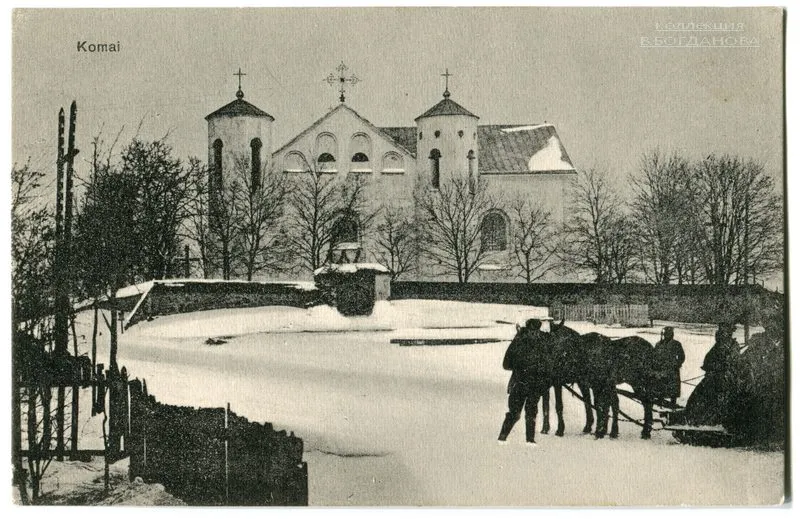
In September 1915 the Germans broke through the Russian front near Święciany. The line of trenches came to a halt for three years at Lake Narocz, some fifteen kilometres east of Komaje. Our ancestors' villages found themselves just behind the German front. The army took over houses, seized horses and grain and drove people out to forced labour. In the battle of Lake Narocz in March 1916 about a hundred thousand soldiers were killed or wounded.
German troops were stationed in Komaje too. Behind the church the Germans laid out a war cemetery. The cemetery no longer exists. A memorial marker now stands in its place.
After the war Poland, Lithuania and Bolshevik Russia fought over these lands. In 1919 and 1920 the front swept through here several times. From 1922 the Vilnius region belonged to Poland. For the first time in over a hundred years children were taught in Polish schools and priests wrote parish records in Polish. The countryside was poor and overcrowded, though, so people kept leaving for lands across the ocean.
In September 1939 the Red Army marched in. The Soviet authorities deported officials, settlers, foresters and the better-off farmers, together with their families, deep into Russia. In June 1941 the Germans came. That autumn, at the military training ground near Nowe Święciany, they shot several thousand Jews from the surrounding small towns, including Podbrodzie and Święciany. Young people were sent to Germany as forced labourers.
In July 1944 the Red Army returned and stayed for good. Men were taken into the army or sent to work deep inside the Soviet Union. Antoni Łukaszewicz, then about nineteen years old, was also taken away at that time. The new border between Soviet Lithuania and Soviet Belarus cut the area in two. Powiewiórka and Kocielniki stayed on the Lithuanian side, while Komaje and Ockowicze ended up on the Belarusian side. The peasants' land was taken from them and merged into kolkhozes.
Poles were allowed to leave for Poland in two waves, in 1945 to 1948 and in 1956 to 1959. Those who left gave up their home, their land and the graves of their loved ones. Our family left in November 1958. Antoni and Alina took their five children and Alina's parents, Dominik and Leokadia Markowicz. The Markowicz family's land in Obkorty was left behind across the border.
What this means for our family
When reading the chapters that follow, it is worth keeping three things in mind.
First: survival was not something to be taken for granted. Every one of our ancestors lived through a childhood in which one child in three died. Many also lived through war, famine or epidemic. That the family line has not been broken for five hundred years is largely a matter of good fortune.
Second: wealth and standing were not given for ever. The same family could sit on the council of the capital in one century and work someone else's field in another. The Markowicz and Trabuć families were nobility with a coat of arms, yet in the 18th century they lived like peasants. This happened through divisions of land, debts and wars, not through anyone's fault.
Third: almost nothing remains of most people. A peasant left no letters or wills. What remained was an entry for his baptism, marriage and burial, if the register had not burned. That is why we know more about Mayor Łukasz of the 16th century than about his descendants of two hundred years ago. It is also why every entry that has been found is shown and translated in this chronicle.