This chronicle tells the story of the ancestors of Mariola and Romuald. Romuald's family comes from the Vilnius region, from the area around Podbrodzie, Święciany and Komaje. Mariola's family comes from Kashubia, from the area around Kartuzy. Each chapter about a family begins with a person we still remember and ends with the earliest ancestor whom we have been able to name.
How this chronicle came about
None of our early ancestors left letters or memoirs. Each of them had to be found in old registers, written by hand in four languages.
On Mariola's side the family knew her parents and grandparents. In June 2026 , the son of Mariola and Romuald, began to search further.
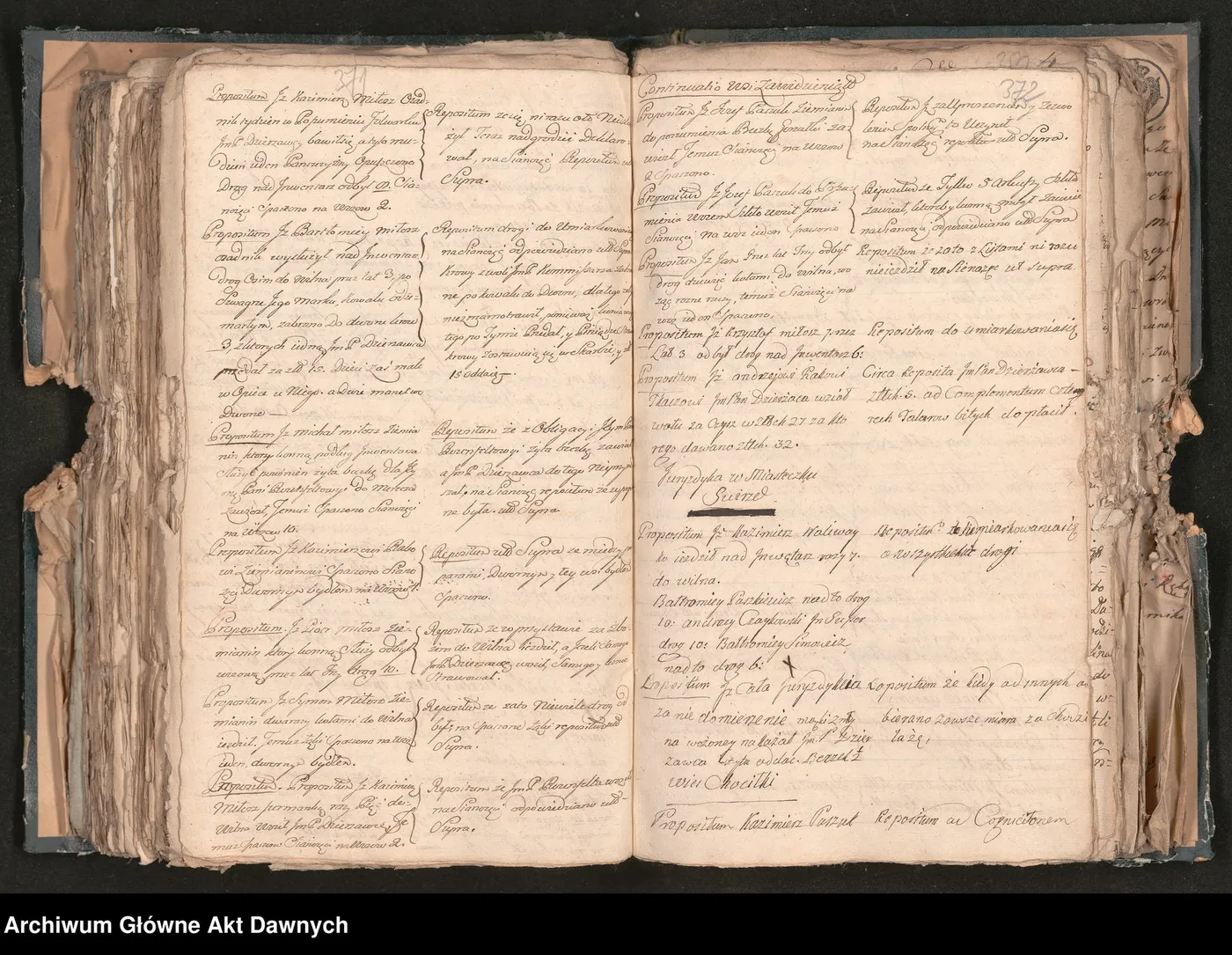
The old documents are kept today in archives and libraries in Vilnius, Warsaw, Gdańsk, Pelplin and Minsk. The archives have photographed most of them and put them on the internet, but nobody has transcribed what they say. They are photographs of pages written with a quill pen, often faded, stained or torn. Church registers in the Vilnius region were written in Latin, Polish and Russian. Those in Kashubia were written in Latin and German. A single register usually has several hundred pages, with anything from a few to a dozen or more entries on each.
To find a single ancestor, you first have to work out in which parish he might have been baptised, then find the register for the right years and read it page by page. Surnames were spelled differently every time. One village often had several people with the same first name and surname. That is why every important entry had to be confirmed by a second document, such as a marriage record, a death record or a revision list.
For Romuald's family more than 430 registers and files were downloaded, about 132 thousand photographs of pages. So far more than 50 thousand of them have been read, containing more than 370 thousand entries. For Mariola's family about 2 thousand photographs and 6 thousand records were read. then checked the most important entries himself, letter by letter.
Of the more than three hundred people on the family tree chart, the family knew twenty-three before 2026. The rest were found in these registers.
How to read this chronicle
The chronicle is read together with the family tree chart. The chart shows who comes after whom. The chronicle tells who these people were and how we know it.
The family tree chart
The chart is a large sheet that shows the whole family at once: Mariola and Romuald in the middle, their ancestors on the right and their children and grandchildren on the left. Below is only a reduced picture of it, on which the writing cannot be read. To see the chart at full size and zoom in freely, go to the chart's page on the internet. The link and the code below the picture lead there.
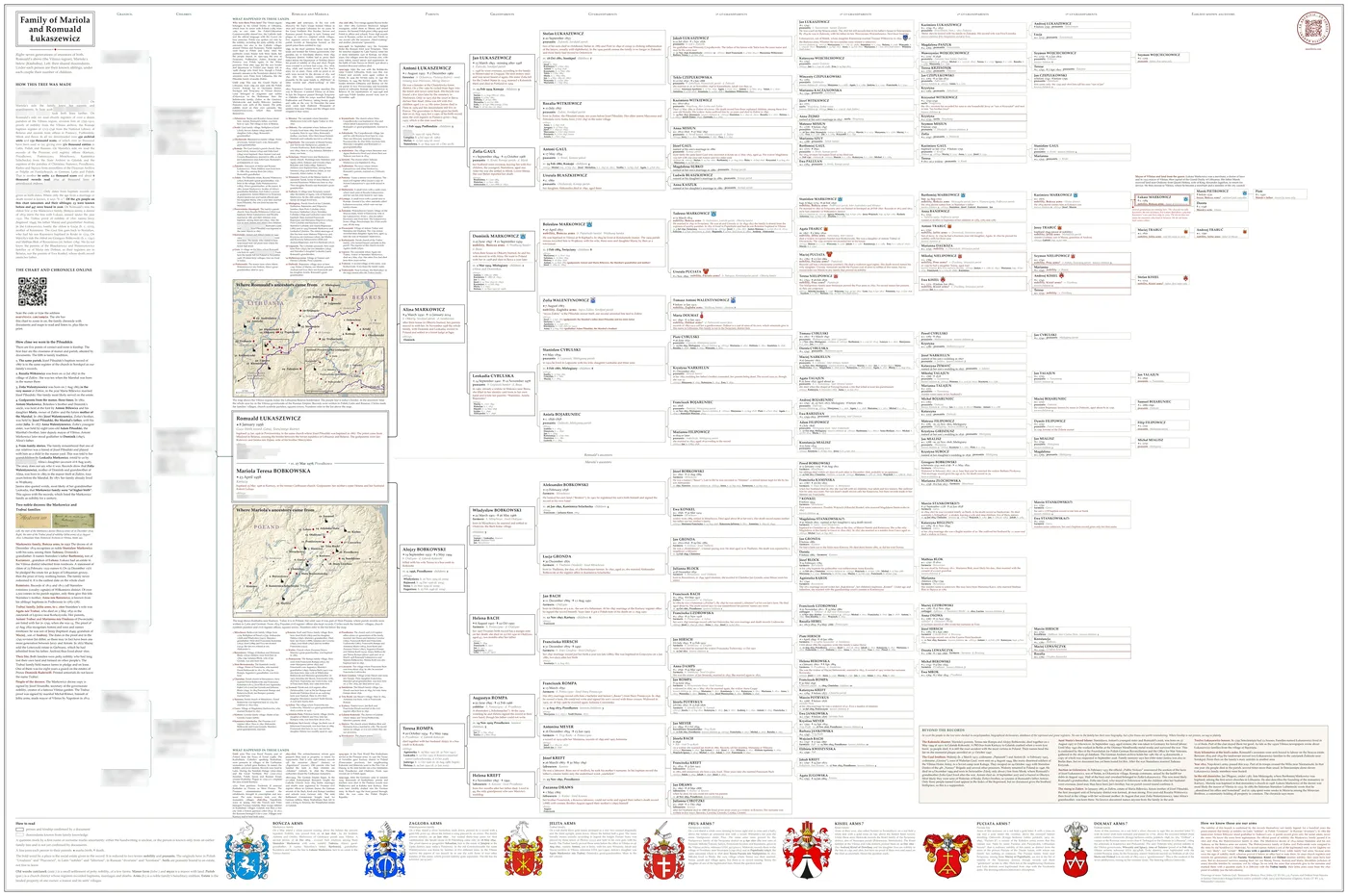
To open the chart on a computer or phone, click here or scan the code below with your phone.
The chronicle to listen to
You can also listen to this chronicle. On the family's website the chronicle can be read on screen. Under the title of each section there is a “Listen” button. A narrator then reads the story of that person, while the screen shows the documents and photographs being described. Together the recordings last more than four hours.
To read the chronicle or listen to it on a computer or phone, click here or scan the code below with your phone.
Chapters
The chronicle has two parts. The first tells the story of Romuald's family and the second that of Mariola's family. Each part begins with a chapter about the land on which that family lived: its wars, epidemics, changing borders and everyday life. It is worth reading it first, because it explains much of what later happens in the families.
Each following chapter describes one family. It opens with a diagram showing the successive generations from the oldest to the youngest. Then come the people, one after another, from the youngest to the oldest. Each has a box headed In brief with the most important dates, the story of his or her life and photographs of documents.
| Chapter | Whose family it is |
|---|---|
| The Vilnius region: the land of Romuald's ancestors | what happened on this land from the 15th century to 1958 and what life was like there |
| The Łukaszewicz family | the ancestors of Antoni, Romuald's father, in the male line |
| The Gaul family | Zofia née Gaul, Romuald's grandmother, Antoni's mother |
| The Witkiewicz and Misiun families | Rozalia née Witkiewicz, Romuald's great-grandmother, Stefan's wife |
| The Czepułkowski and Kaczanowski families | Tekla née Czepułkowska, Stefan's mother |
| The Markowicz and Trabuć families | the ancestors of Alina, Romuald's mother, in the male line |
| The Walentynowicz, Dołmat, Puciata, Nielipowicz and Kisiel families | the wives of the Markowicz men: Zofia and Urszula |
| The Cybulski, Bojaruniec, Narkielun and Filipowicz families | Leokadia née Cybulska, Romuald's grandmother, Alina's mother |
| Kashubia: the land of Mariola's ancestors | what happened in Kashubia from the Middle Ages to 1945 and what life was like there |
| The Bobkowski family and related families | Mariola's father, Alojzy |
| The Rompa and Kreft families and related families | Mariola's mother, Teresa |
Documents and their translations
With each document we show an extract from the original register. Below it is a box with the text transcribed letter by letter, together with the same text in translation. Church registers in the Vilnius region were written first in Latin, then in Polish and from the 1840s in Russian, because the tsarist authorities ordered it. In Kashubia, which belonged to Prussia, registers were written in Latin and German. That is why the same family appears in records in several languages.
In the original texts a question mark in square brackets marks a word that could not be read with certainty. An ellipsis in square brackets marks an omitted passage.
Dates
We give dates as they stand in the documents. In the registers of tsarist times the old calendar was in force. It ran twelve days behind today's calendar in the 19th century and thirteen days behind in the 20th century. In Kashubia today's calendar was used.
When we write “born about”, it means that we have no baptism record and have worked out the year from the age given in another document. Ages in old censuses and records were written down from memory, so they can be several years out.
Place names
We use the Polish names from the old documents. The places of Romuald's family lie today in Lithuania and Belarus, a few dozen kilometres north-east of Vilnius. The places of Mariola's family lie in Kashubia, west of Gdańsk. Maps and a description of the places are in a chapter near the end of the chronicle.