He drowned days after his son turned one. Józef Gaul, 1855
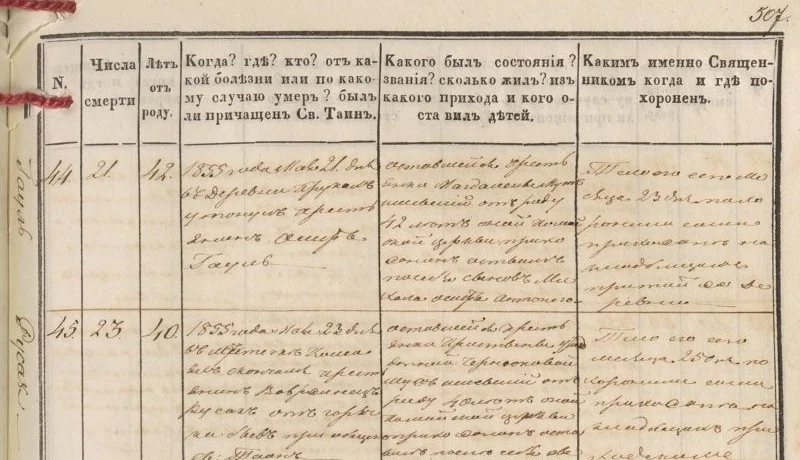
In May 1855 Józef Gaul from the village of Kruki drowns four days after his youngest son turned one. His neighbors bury him themselves. Little Antoni survived.
The historical background
What does it mean that his neighbors buried him themselves?
On the same page of the parish book, from May and June 1855, almost every entry ends the same way: the body was buried by the parishioners themselves, in the cemetery by the village. People buried their own dead. The priest wrote the death into the book.
Eight days after Józef, an eighty-year-old man died in a nearby village. Next to his name the priest noted that he had received the last sacraments. Next to Józef there is no such note. The water took him suddenly, with no goodbye and no priest.
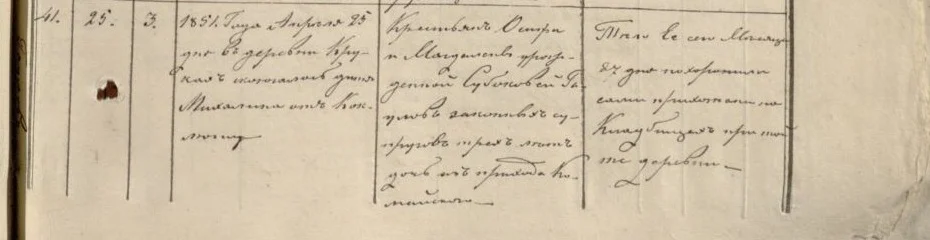
The whooping cough that took three-year-old Michalina four years earlier was a common childhood illness. There was no cure and no vaccine.
Within four years Magdalena buried a daughter and a husband. She was left with the farm and the children. Her youngest son was one year old.
Antoni never remembered his father. In 1880 he married in the same parish.
Documents shown in the film
These are the real archive scans you see in the film. Each one has its archive reference, so anyone can check the source.

Narration
His son had just turned one. Four days later, his father was dead.
Józef Gaul, a peasant from the village of Kruki, near Vilnius, married to Magdalena.
They had already buried one child.
Whooping cough took three-year-old Michalina.
In May 1854, little Antoni is born.
One year later, on May 21, Józef drowns.
He is 42.
The priest writes one word in the book: drowned.
And the names of his sons: Michał, Józef, Antoni.
His neighbors bury him themselves, in the village cemetery.
Magdalena is left alone with the children.
The youngest will never remember his father.
But little Antoni survived.
He grew up and started a family.
Every generation after him begins with that one-year-old boy.
Did someone in your family grow up without a father?
Tell us in the comments.
Ex Archivis. We find out where your family comes from.
Sources
- Komaje parish deaths, 1855, entry 44 (LVIA 604/37/76)
- Komaje parish baptisms, 1854, entry 88 (LVIA 604/37/75)
- Komaje parish deaths, 1851, entry 41 (LVIA 604/37/72)
Scenes marked “Staged scene” are reconstructions. The documents are real.
This film on social media
Want us to look into your family?
Tell us where your ancestors came from. We will reply with how far back the records of that area go.