Places
The two sides of the family come from opposite ends of old Poland. Romuald's ancestors lived in the Vilnius region and Mariola's ancestors in Kashubia. The history of each land is told in separate chapters at the start of each part of the chronicle. Here are the maps and a list of all the places.
The Vilnius region: the home of Romuald's family
Almost the whole history of Romuald's family took place in a small area north-east of Vilnius, between Podbrodzie, Święciany and Komaje. Today the border between Lithuania and Belarus divides this land in two. The numbers on the map match the numbers in the table.
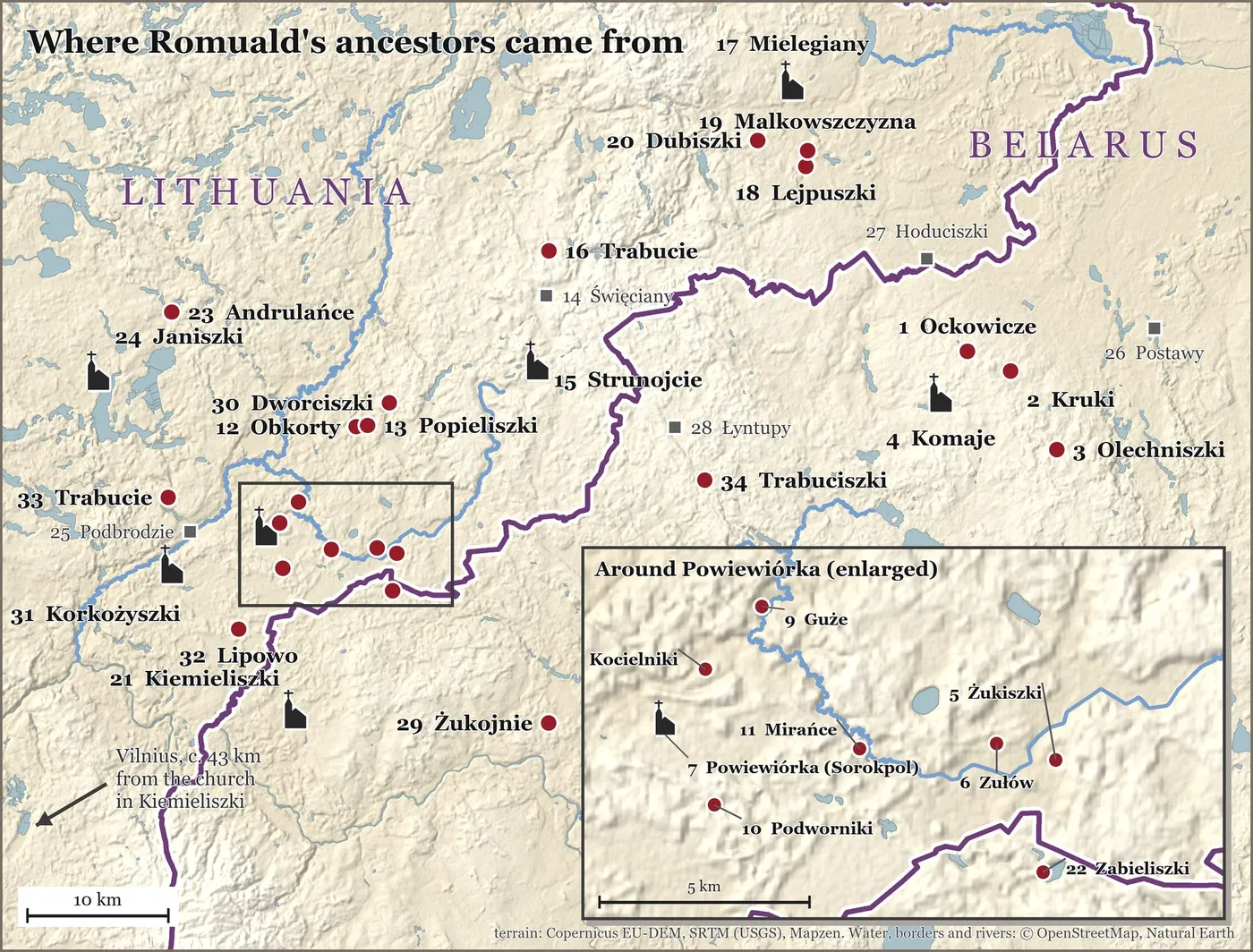
| No. | Place | What happened here |
|---|---|---|
| 1 | Ockowicze | The village where the Łukaszewicz family lived, the home of Stefan and Rozalia. Antoni, Romuald's father, was born here in 1925. Today the village lies in Belarus. |
| 2 | Kruki | The village of the Gaul family. Józef (1816), his son Antoni (1854) and Antoni's daughter Zofia (1894), Romuald's grandmother, were born here. |
| 3 | Olechniszki | The village of the Błaszkiewicz family. Urszula, the wife of Antoni Gaul and Romuald's great-grandmother, came from here. |
| 4 | Komaje | The parish church of the Gaul family. Józef (1816), Antoni (1854) and Zofia Gaul (1894) were baptised here. Antoni Gaul and Urszula Błaszkiewicz were married here in 1880. Jan Łukaszewicz and Zofia Gaul, Romuald's grandparents, were married here in 1919. |
| 5 | Żukiszki | The zaścianek where Stefan and Rozalia Łukaszewicz lived. Their children were born here between 1882 and 1893, among them Jan (1893), Romuald's grandfather. |
| 6 | Zułów | The Piłsudski estate. Rozalia Witkiewicz (1857), Romuald's great-grandmother, was born in the village. Zofia Walentynowicz (1863), Alina's grandmother, was born at the manor. In 1862 Antoni Markowicz, the brother of Alina's grandfather Bolesław, had the owners of Zułów as his godparents. They were Antoni Billewicz (a landowner of the Święciany district and a tsarist official) and his daughter Maria, who a year later married Józef Piłsudski. Her son Józef became the Marshal. |
| 7 | Powiewiórka (Sorokpol) | The family's parish church. Rozalia Witkiewicz (1857) was baptised here. Stefan Łukaszewicz and Rozalia were married here in 1881. Their children were baptised here, among them Jan (1893). After the war the five children of Antoni and Alina were baptised here too: Romuald (1956) and . Józef Piłsudski was baptised in the same church in 1867. |
| 8 | Kocielniki | The home of Antoni and Alina from 1949 to 1954. were born here. When the family visited in June 2026, all that was left of the house was a few old plum trees. |
| 9 | Guże | The village on the river Mera where Romuald was born in 1956 . From here the family left for Poland in November 1958. Of about forty cottages, four are lived in today. |
| 10 | Podworniki | The manor farm where Maria Walentynowicz née Dołmat, Alina's great-grandmother, died in 1915. |
| 11 | Mirańce | The zaścianek where Stanisław Markowicz lived with Agata Trabuć from 1816 to 1827. |
| 12 | Obkorty | The zaścianek where Tadeusz and Urszula lived from 1862 and later Dominik and Leokadia. Alina, Romuald's mother, was born here in 1930. After their house burned down, Dominik and Leokadia moved in with her. |
| 13 | Popieliszki | The zaścianek of Maciej Puciata and Teresa née Nielipowicz, the parents of Urszula Markowicz. Both died here (1856 and 1862). Salomea, Bolesław's sister, was born here in 1854. |
| 14 | Święciany | The district town and the church of the Markowicz family. Stanisław and Agata (1807), Tadeusz and Urszula (1840) and Bolesław and Zofia (1884) were married here. Tadeusz's children were baptised here, among them Salomea (1854) and Helena (1856). In 1897 Dominik, Alina's father, was baptised here. |
| 15 | Strunojcie | The parish church of the Misiun family from the zaścianek of Tartak, where Anna Misiun came from. Here in 1837 she married Kazimierz Witkiewicz. Their daughter was Rozalia, Romuald's great-grandmother. |
| 16 | Trabucie | A village that bears the Trabuć family name. By the 18th century the Trabuć family no longer lived there. |
| 17 | Mielegiany | The parish church of the Cybulski, Narkielun, Bojaruniec and Filipowicz families. Piotr Cybulski (1830), Krystyna Narkielun (1831), Stanisław Cybulski (1859) and Leokadia (1900) were baptised here. Franciszek Bojaruniec and Marianna Filipowicz (1853), Piotr Cybulski and Krystyna (1855) and Stanisław Cybulski and Aniela Bojaruniec (1887) were married here. So were Dominik Markowicz and Leokadia Cybulska in 1924. The oldest marriages of this line made here were those of Mateusz Filipowicz and Krystyna née Girdziusz (1802), Jan Mialisz and Krystyna Subocz (1808) and Andrzej Bojaruniec and Ewa Bardzian (1817). |
| 18 | Lejpuszki | The zaścianek of the Cybulski family. Piotr (1830), his son Stanisław (1859) and Stanisław's daughter Leokadia (1900), Romuald's grandmother, were born here. |
| 19 | Malkowszczyzna | The village of Tomasz and Dorota Cybulski, Piotr's parents. |
| 20 | Dubiszki | The village of the Bojaruniec family since at least 1795. Maciej lived here, then his son Michał, his grandson Andrzej with Ewa, their son Franciszek and his daughter Aniela, Romuald's great-grandmother. |
| 21 | Kiemieliszki | The church where Tekla Czepułkowska was baptised in 1830 and where in 1848 Jakub Łukaszewicz and Tekla, Romuald's great-great-grandparents, were married. |
| 22 | Zabieliszki | The village of the Czepułkowski family. Jan and his wife Krystyna were already living here in 1795. Their son Wincenty married Marianna Kaczanowska. Tekla, Wincenty's daughter and Romuald's great-great-grandmother, was born here in 1830. |
| 23 | Andrulańce | The village where Stanisław and Agata Markowicz lived and where their son Tadeusz was born in 1814. |
| 24 | Janiszki | The church where Tadeusz Markowicz was baptised in 1814. |
| 25 | Podbrodzie | The town where Antoni Łukaszewicz and Alina Markowicz, Romuald's parents, were married on 7 February 1949. |
| 26 | Postawy | Today a district town (Belarus). In 1958 the civil registry office here issued a copy of a birth record in which Antoni Łukaszewicz, born in 1925, is entered. |
| 27 | Hoduciszki | A small town with a castle court. Between 1927 and 1929 land cases were heard before it in which Rozalia Łukaszewicz and her son Jan appear. These are probably Stefan's wife and their son Jan, Romuald's grandfather. This is a hypothesis, because we know only the titles of these cases from the archive's inventory. No one in the family has yet read the files themselves. |
| 28 | Łyntupy | A small town with a parish neighbouring Komaje. Around it lay further zaścianki called Łukaszewszczyzna, which were not our family's home. |
| 29 | Żukojnie | The village of the Wojciechowicz family on the Stracza estate, where Katarzyna, the wife of Jan Łukaszewicz, came from. From about 1805 his father Kazimierz also lived here. Śnieciemięta, Kazimierz's home village, lies 18 km to the south-east, off the map. |
| 30 | Dworciszki | The village of Antoni Trabuć and Marianna née Dauksza. The 1795 census recorded their daughter Agata here, aged 14, later the wife of Stanisław Markowicz. |
| 31 | Korkożyszki | The parish church of the Trabuć family, who farmed leased zaścianki in this parish. Agata's death (1830) was recorded in this church's register. |
| 32 | Lipowo | The zaścianek where Agata née Trabuć, the widow of Stanisław Markowicz, died on 5 May 1830. Her sister Ewa had died here three years earlier. |
| 33 | Trabucie | A village that bears the Trabuć family name. By the 18th century the Trabuć family no longer lived there. |
| 34 | Trabuciszki | A village near Łyntupy, the third place on the map named after the Trabuć family. |
Kashubia: the home of Mariola's family
For at least two hundred and fifty years Mariola's ancestors lived in a dozen or so villages around Kartuzy, west of Gdańsk. The numbers on the map match the numbers in the table.
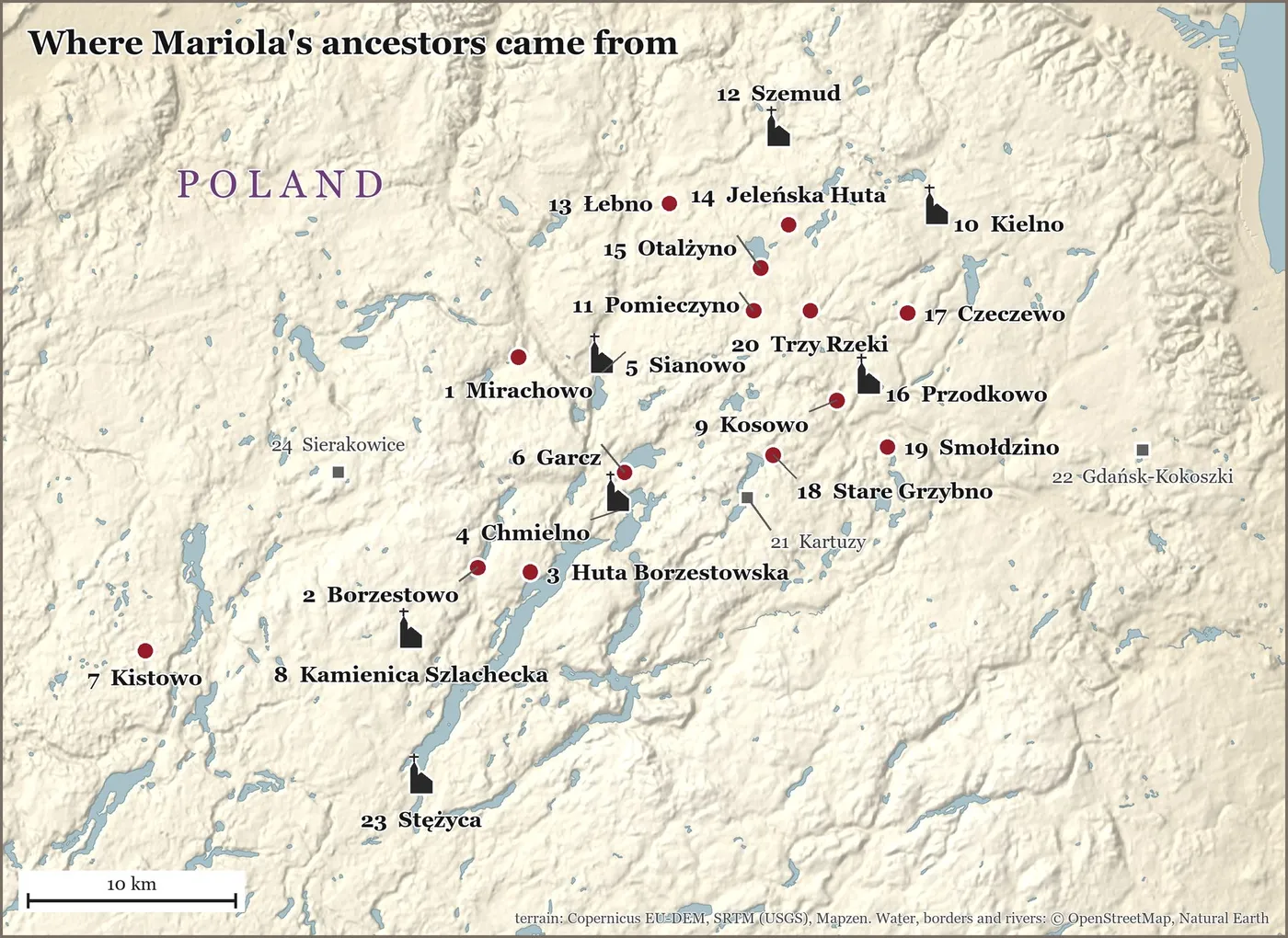
| No. | Place | What happened here |
|---|---|---|
| 1 | Mirachowo | The village of the Bobkowski family since 1779. Paweł (1779), Aleksander (1858) and Władysław (1901), Mariola's grandfather, were born here. Franciszka Kamińska died here (1853), as did Józef (1889) and Ewa née Konkel (1914), both living out their days in retirement with their son Aleksander. |
| 2 | Borzestowo | The village of Mathias and Marianna Block, whose children were born here between 1784 and 1799. Julianna Block, the wife of Jan Gronda, was also born here. |
| 3 | Huta Borzestowska | The village of the Kamiński family. Franciszka, who married Paweł Bobkowski in 1811, came from here. Jan Rompa, Augustyn's grandfather, was born here in 1824. |
| 4 | Chmielno | The parish church of Borzestowo. Paweł Bobkowski and Franciszka Kamińska (1811), Józef Block and Agnieszka Kąkol (1811) and Jan Gronda and Julianna Block (1849) were married here. In 1804 Franciszek Rompa and Katarzyna Kreft, the parents of Jan Rompa, also married here. |
| 5 | Sianowo | The parish church of Mirachowo. Paweł Bobkowski was baptised here in 1779. His children were baptised here between 1823 and 1835. |
| 6 | Garcz | The village of Magdalena Stankowska, who married Konkel in 1827. |
| 7 | Kistowo | The village of the Gronda family. Jan Gronda, Łucja's father, came from here. |
| 8 | Kamienica Szlachecka | A Prussian register office. Aleksander Bobkowski and Łucja Gronda, Mariola's great-grandparents, were married here in 1891. |
| 9 | Kosowo | The village of the Kreft and Draws families. Józef Kreft (1863) and his daughter Helena (1897), Mariola's grandmother, were born here. Jan Draws (1888), Julianna née Cyrocka (1895), Józef Kreft (1897) and his mother Franciszka (1915) died here. |
| 10 | Kielno | The church where Zuzanna Draws, Mariola's great-grandmother, was baptised in 1865. |
| 11 | Pomieczyno | The village of the Rompa family. Franciszek Rompa (1850), his sister Marcjanna (about 1855) and Franciszek's son Augustyn, Mariola's grandfather (1895), were born here. Helena Bach (1907), later the wife of Władysław Bobkowski and Mariola's grandmother, was also born here. In 1905 Antonina née Meyer, Franciszek's wife, died here. Franciszka née Uzdrowska, the wife of Franciszek Bach, also came from here. |
| 12 | Szemud | A parish and register office (Schönwalde). Towards the end of their lives Jan Rompa and Józefa née Potrykus lived on an outlying farmstead near Szemud. Here in 1875 their daughter Marcjanna married Teofil Derron. A year later Józefa died here. |
| 13 | Łebno | The village where Franciszka née Uzdrowska, Mariola's great-great-grandmother, died a widow in 1918. |
| 14 | Jeleńska Huta | The village of the Potrykus family. Józefa, the daughter of Marcin and Ewa and later the wife of Jan Rompa, was born here in about 1810. |
| 15 | Otalżyno | The village of the Bach family. Jan Bach, the son of the fisherman Franciszek, was born here in 1869. Franciszek died here in 1917. In 1950 Jan and his daughter Helena died here two months apart. |
| 16 | Przodkowo | The church and register office where six generations of the family were married: Jan Draws and Julianna Cyrocka (1855), Franciszek Bach and Franciszka Uzdrowska (1861), Franciszek Rompa and Antonina Meyer (1873), Józef Kreft and Zuzanna Draws (1891), Augustyn Rompa and Helena Kreft (1919), Alojzy Bobkowski and Teresa Rompa (about 1956) and also Romuald Łukaszewicz and Mariola Bobkowska on 27 March 1978. Helena Kreft was also baptised here in 1897. |
| 17 | Czeczewo | The village where Franciszek Bach was born in about 1834. In 1861 he married Franciszka Uzdrowska. |
| 18 | Stare Grzybno | The village of Jan Hirsch and Anna née Damps. Their daughter Franciszka, Mariola's great-grandmother, was born here on the last day of 1879. Jan died here in 1910. |
| 19 | Smołdzino | The village of the Hirsch family. Jan Hirsch was born here in 1845, his wife Anna Damps in about 1836. |
| 20 | Trzy Rzeki | The village of Jan Meyer. Antonina, the wife of Franciszek Rompa, was born here in 1854. |
| 21 | Kartuzy | The district town. Jan Bach and Franciszka Hirsch were married at the register office here in 1897. |
| 22 | Gdańsk-Kokoszki | The district of Gdańsk where Alojzy and Teresa Bobkowski, Mariola's parents, died. |
| 23 | Stężyca | The church where Mathias Blok and Marianna Karcz were married in 1782. The record does not give a village, so it is not certain that they are our ancestors. |
Glossary
| Word | What it means |
|---|---|
| zaścianek | a small settlement, usually a few houses of the petty nobility, standing apart from the village |
| manor farm | a farm belonging to a manor |
| estate, lands | the land of one owner: the manor and the villages of his serfs |
| parish | the district of one church. Baptisms, marriages and burials were written down in its registers |
| parish record | an entry in a church register about a baptism, marriage or burial |
| urodzony | in old Polish records: a nobleman (literally “well-born”). In Russian “дворянинъ” or “благородный”, in Latin “nobilis” or the abbreviation “G.D.” |
| pracowity | in old records: a peasant (literally “hard-working”). In Latin “laboriosus” |
| serf | a peasant bound to an estate, who could not leave it without the lord's consent. In Russia serfdom was abolished in 1861. |
| free people | people who were not serfs of any manor and could change where they lived |
| proof of nobility | a document in which a family proved its noble descent before an official body |
| revision list | an official list of all inhabitants, made in Russia every dozen or so years. The first one in the Vilnius region took place in 1795. |
| parish census | a list of all the inhabitants of a parish, house by house, written down by the priest |
| desyatina | an old Russian measure of land, a little more than a hectare |
| kmotrowie | godparents |
| croup | a choking inflammation of the larynx in children, usually with diphtheria |
| Standesamt | the Prussian register office, working in Kashubia from 1874 |
| gbur | in Kashubia: a well-off farmer with his own land |
| Rentenbauer | in Prussian records: a farmer who was paying for his farm to the state in yearly instalments, called a rent |
Picture credits
The documents from church and official registers come from the collections of the Lithuanian State Historical Archives in Vilnius, the National Library of Belarus, Polish state and diocesan archives and the FamilySearch website. The family photographs and home documents come from the family's own collections.
The photographs of places come from Wikimedia Commons and are used under free licences:
- Powiewiórka (church, interior, plaque) and the river Mera at Zułów: photo Vilensija, licence CC BY-SA 3.0.
- Zułów (foundations of the manor house, memorial stone): photo Zala, licence CC BY-SA 4.0.
- Podbrodzie, railway station: author unknown, public domain.
- Vilnius, St Raphael's Church: photo Józef Czechowicz, public domain. Mejszagoła, the church in 1916: author unknown, public domain.
- Janiszki: photo Julius. Korkożyszki: photo Juste. Giedrojcie: photo Iulius. Michaliszki: photo Paval Hadzinski. All under licence CC BY-SA 3.0.
- Portrait of Michał Römer: Jan Rustem, 1820, public domain.
- Komaje, church: photo Futureal, licence CC BY-SA 3.0. Strunojcie and Mielegiany, churches: photo Juste, licence CC BY-SA 3.0.
- Vilnius, St John's Church: photo Jan Mehlich, licence CC BY-SA 3.0. Vilnius, town hall: photo Augustas Didžgalvis, licence CC BY-SA 4.0.
- Onikszty: photo Hugo.arg. Raków: photo Wikipek. Przodkowo, church: photo Ulrich Jahr. All in the public domain.
- Kartuzy, the former Carthusian church: photo Panek, licence CC BY-SA 4.0. Kielno, church: photo Maciej Nux, licence CC BY-SA 4.0.
- Mirachowo, manor house: photo Gdaniec, licence CC BY-SA 3.0. Sianowo, church: photo Gdaniec, licence CC BY 3.0.
- Mirsk: photo Pankrzysztoff, licence CC BY-SA 3.0 PL. Wołów, town hall: photo Mzopw, licence CC BY-SA 3.0.
- Old photographs and postcards (Komaje 1916, Świr and Kiemieliszki about 1900, Święciany 1916, Podbrzezie about 1930, Kartuzy about 1900, Montevideo 1928, Zułów 1919): authors unknown or named in the captions, public domain.
The portraits and old engravings come from Wikimedia Commons and are in the public domain. The captions under the illustrations give their authors and dates. The photograph of Napoleon Cybulski comes from the archive of the Ilustrowany Kurier Codzienny (National Digital Archives) and is used under licence CC BY-SA 4.0.
Other photographs:
- The town hall in Iława in the early 1980s: author unknown, Iława Digital Chronicle, collections of the Municipal Public Library in Iława.
- The wrecked bus at the scene of the crash in Gdańsk-Kokoszki (1994): photo Bogusław Nieznalski, archive of “Dziennik Bałtycki”, from an article on dziennikbaltycki.pl for the 24th anniversary of the crash (2018).
- The plaque at the scene of the crash in Gdańsk-Kokoszki: photo Przemysław Kozłowski / www.gdansk.pl, from the article “Ostatni kurs. Już 30 lat od katastrofy autobusu w Kokoszkach” (The last run. 30 years since the bus crash in Kokoszki, 2024).
- The gravestone of the Kalesnick family in South Portland: photo LB, Find a Grave website, memorial no. 160824764.
- The photograph of Zofia Kalesnick and her son's 1923 birth certificate: shared by the user jbburke2 on Ancestry.
Drawings of coats of arms: Tadeusz Gajl and Bastianow, Wikimedia Commons, licences CC BY-SA 3.0 and CC BY 3.0. The Puciata and Dołmat coats of arms were drawn from the descriptions in Juliusz Ostrowski's Księga herbowa rodów polskich (Book of Arms of Polish Families, 1898 and 1903).
The maps were drawn on our own base map. The relief comes from Copernicus EU-DEM and SRTM data. Water, borders and rivers come from the © OpenStreetMap database.
About this chronicle
Every piece of information in this chronicle has its source. Next to each one stands an extract of the document, the text in the original language, a translation into English and the archival reference, that is, the document's address in the archive. This way anyone can check for themselves where a given piece of information comes from.
The round mark at the foot of every page is the seal of Ex Archivis, under whose name such chronicles and charts are made. The seal bears three Latin phrases.
- Ex archivis means “from the archives”. Everything in this chronicle comes from documents kept in archives.
- Ad fontes means “to the sources”. We check every piece of information in a document from those times, not in someone else's description.
- Scripta manent means “what is written remains”. It is the second half of an old saying: words fly away, writing remains. That is why registers from two hundred years ago still speak to us today.