Kashubia: the land of Mariola's ancestors
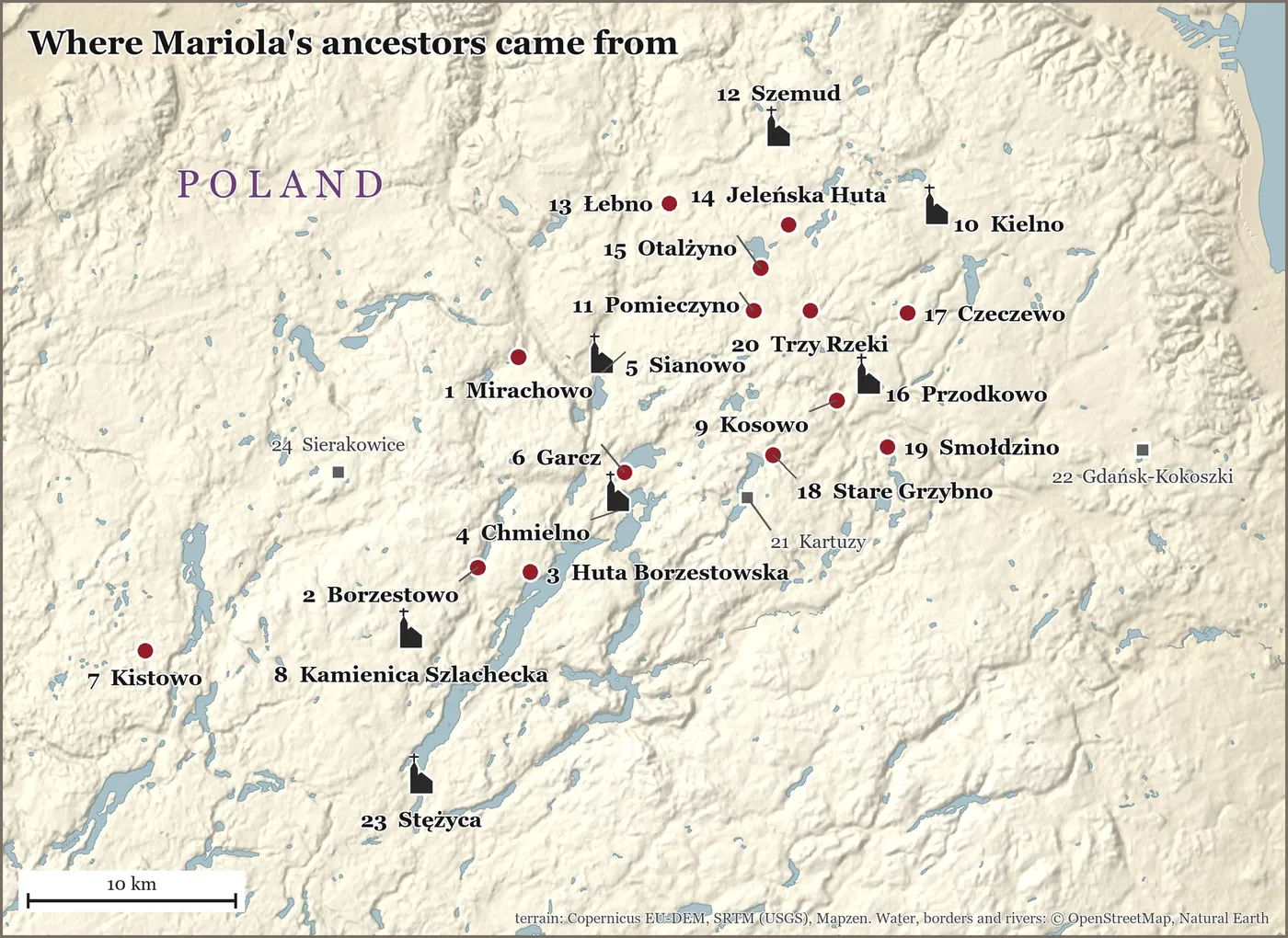
Mariola's family comes from the other end of old Poland, from Kashubia. Her ancestors lived for at least two hundred and fifty years in a dozen or so villages around Kartuzy. They were farmers on poor, sandy land. Over that time their part of the country belonged in turn to Poland, to Prussia, to Germany and to Poland again. This chapter tells what happened in Kashubia and what life was like there.
Who the Kashubians are
The Kashubians are Slavs who have lived by the Baltic, west of Gdańsk, for more than a thousand years. They have their own language, Kashubian, closely related to Polish. At home they spoke Kashubian and in church they prayed in Polish. Almost all the Kashubians around Kartuzy were Catholics. For centuries this faith set them apart from their German neighbours, who were mostly Protestants.
The Kartuzy country is beautiful but hard to farm. It is a land of hills, lakes and forests left behind by the glacier. The soil here is sandy and full of stones. Winter lasts longer than further inland. Rye, oats and buckwheat grew well here, as did potatoes from the 18th century. A farmer earned extra from fish in the lake, from felling timber and from grazing sheep. Nobody made a fortune on land like this. The skill lay in keeping the farm going and handing it on to the next generation.
Where the name of the Kashubians comes from, according to Jan Długosz
The chronicler Jan Długosz was already writing about the Kashubians in the 15th century. At the beginning of his „Annals” he explains the names of various tribes. He derives the name of the Kashubians from their dress. They were supposedly named after the folds into which they arranged their clothes: the word „huba” meant a fold and „kasz” was the command „fold it”. Długosz took this explanation from the older Greater Poland Chronicle. Today's linguists explain the name differently.

Original text (Latin): Item Kassubyanye, a plicatione rugarum in vestimentis, quibus primum vestiri consueverant (Huba enim in Polonico seu Slavonico dicitur ruga, Kasz autem dicitur plica in modo imperativo).
In English: Further, the Kashubians, named from the laying of folds in the garments in which they used to dress in former times. For „huba” means a fold in Polish, that is, in Slavonic. And „kasz” means „fold” in the imperative mood.
The Pomeranian dukes and the Teutonic Knights (until 1466)
In the Middle Ages Gdańsk Pomerania was ruled by local dukes. The last of them, Mściwój, bequeathed his duchy to Duke Przemysł, later King of Poland. After Mściwój's death in 1294 Pomerania was united with Poland. It did not last long. In 1308 the Teutonic Knights seized Gdańsk. A year later they took the whole of Gdańsk Pomerania. They ruled it for almost a hundred and fifty years.
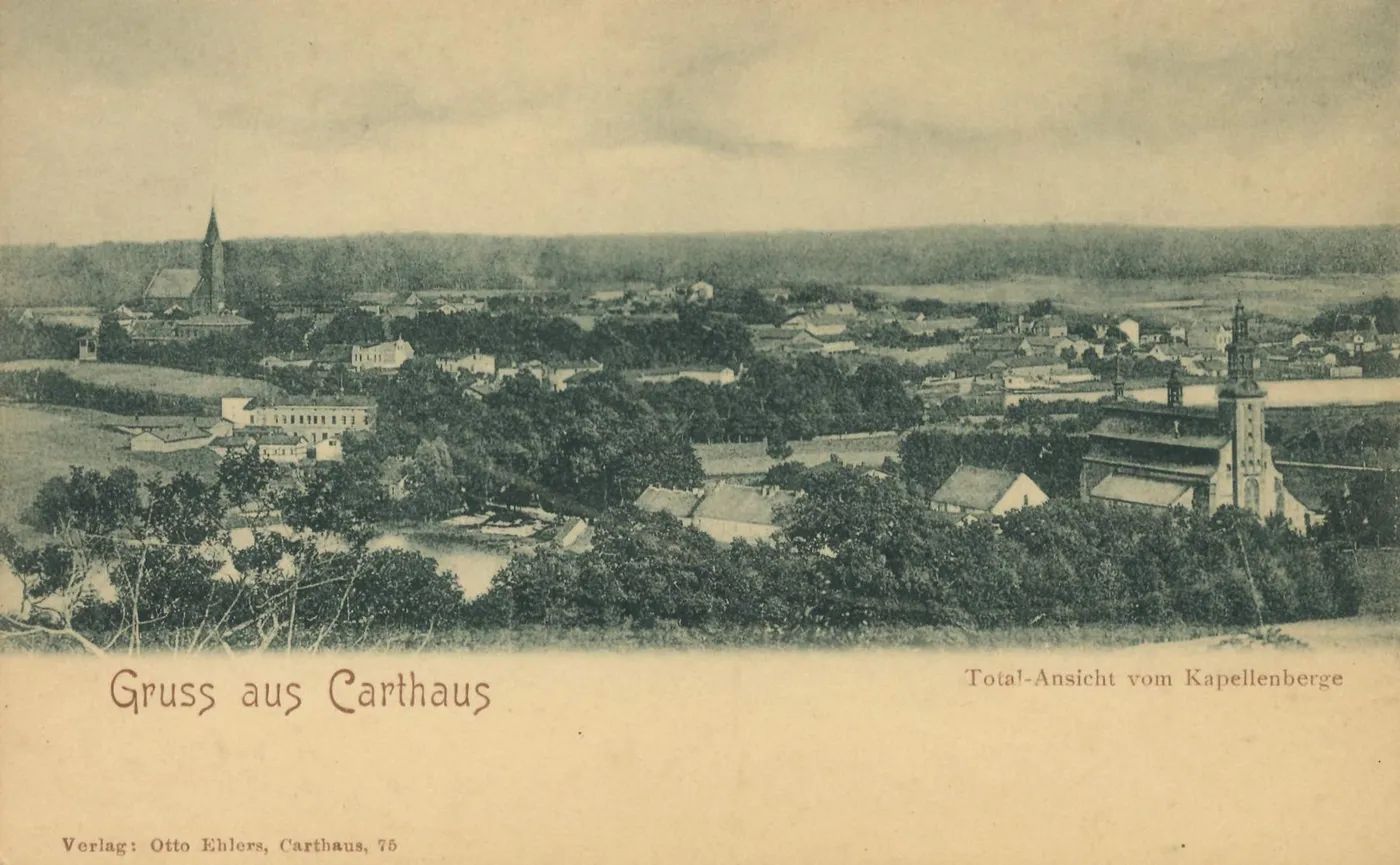
Under the Teutonic Knights a monastery was founded that gave Kartuzy its name. At the end of the 14th century Carthusians settled here, monks who lived in silence, each in his own small house. The monastery was given the surrounding villages. The peasants of those villages worked for the monks from then on. Mirachowo, later the village of the Bobkowski family, was under the Teutonic Knights the seat of an official who administered the whole area.
In 1454 the people of Prussia rebelled against the Teutonic Knights and submitted to the King of Poland. The war lasted thirteen years. Both sides hired soldiers who lived by plunder, so the villages of Pomerania were burned and looted many times over. In 1466 peace was made at Toruń and Gdańsk Pomerania returned to Poland.
Royal Prussia: three hundred years in Poland (1466-1772)
The lands recovered from the Teutonic Knights were called Royal Prussia. Kashubia belonged to the Pomeranian Voivodeship. The villages were of three kinds. Some belonged to the king and were run by a starost, who lived in Mirachowo. Others belonged to the Carthusian monastery. The rest were owned by the nobility. A peasant either did labour service or paid rent, depending on who owned his village. In Kashubia the better-off farmers were called gburs.
Mirachowo, the village of the Bobkowski family, was in those days the chief town of a district. Szymon Starowolski, in his description of Poland from the 17th century, lists seven districts of the Pomeranian Voivodeship: Człuchów, Tuchola, Świecie, Tczew, Żukowo, Puck and Mirachowo. In the same passage he mentions the Carthusian monastery near Gdańsk and adds that it is the only monastery of this order in the whole of Prussia.
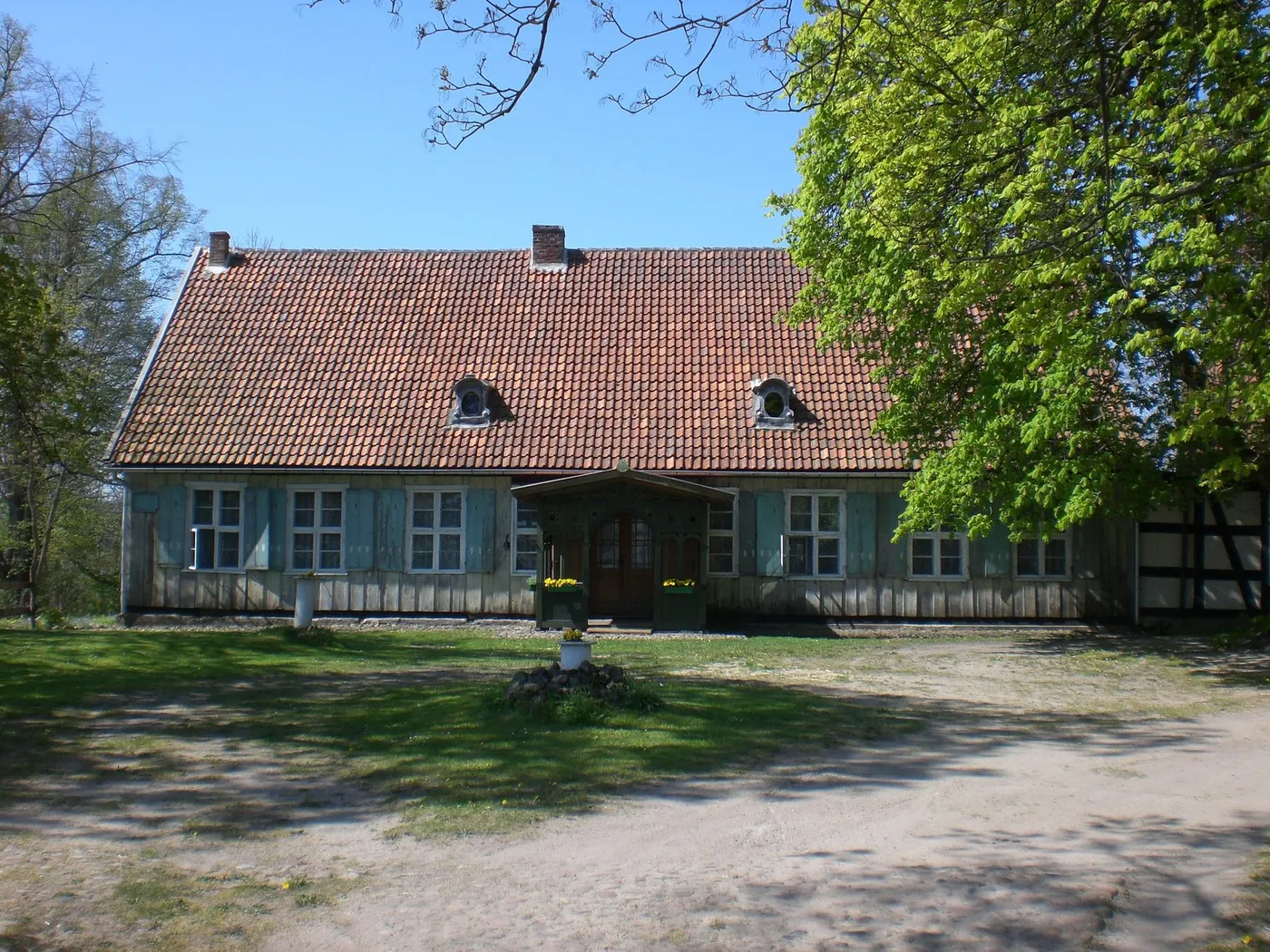
Kashubia was also home to an unusually large number of petty nobility. These were people with a coat of arms and a surname taken from their family village, who ploughed their own fields themselves and lived just like peasants. The only thing that set them apart from a peasant was their personal freedom.
Those three hundred years were not peaceful. Kashubia lay next to Gdańsk, the richest city of the Polish-Lithuanian Commonwealth, so every war over Gdańsk was fought on Kashubian fields.
- The wars with Sweden in 1626 to 1629 and 1655 to 1660. The Swedes landed on the coast and besieged Gdańsk. Their troops took food, horses and money from the villages. Anyone who refused had his farmstead burned.
- The Great Northern War of 1700 to 1721. Swedish, Saxon, Polish and Russian armies passed through Kashubia in turn. In 1709 to 1711 came the plague. Nearly half the inhabitants of Gdańsk died then. Around Kartuzy whole villages were emptied of people.
- The siege of Gdańsk in 1734. Russian and Saxon troops besieged the city for several months and all that time lived off the surrounding villages.
After every war the villages had to be settled anew. The district governor or the monastery would bring in new farmers and give them a few years free of dues. That is why in many Kashubian villages surnames appear in the registers quite suddenly. Grzegorz Bobkowski, Mariola's earliest known ancestor on her father's side, was born about 1741, a few years after the last of these wars.
Under the King of Prussia (1772-1871)
In 1772 Russia, Prussia and Austria took part of Poland's lands for the first time. Kashubia went to the King of Prussia, Frederick II. So Grzegorz Bobkowski was born a subject of the King of Poland and died in 1820 a subject of the King of Prussia. His son Paweł came into the world in 1779, already under the new rule.
Prussia was a state of officials and soldiers. The new authorities recorded every farm and imposed higher taxes. The royal and monastic villages were taken over by the Prussian treasury. Every area had to supply recruits for the Prussian army. In offices and courts German was required, a language the peasants did not know.
In 1806 and 1807 Napoleon's war with Prussia passed through Kashubia. In the spring of 1807 French and Polish troops besieged Gdańsk and their units were quartered in Kashubian villages. Paweł Bobkowski was twenty-eight at the time. Gdańsk then became a free city with a French garrison for a few years. In 1813 the Russians and Prussians besieged it for almost a year. The countryside had to feed first one army, then the other. These years left poverty and debts behind them.
The most important change came afterwards. In 1807 the King of Prussia abolished serfdom and in the years that followed the peasants were given ownership of the land they farmed. They did not get it for free. They had to hand over part of their land to the lord or the state, or pay for it in instalments over decades. From then on a Kashubian farmer owned his own land. That is why in 19th-century records Mariola's ancestors appear as farm owners. In 1826 the Prussian authorities closed the Carthusian monastery.
Owning land did not mean prosperity. The farm usually went to one son or son-in-law. The elderly parents retired on a life annuity, which meant they handed over the land in return for a room, fuel and food until they died. The other children had to be paid off, or they went into service with other farmers and worked as labourers without land. In the 1840s blight destroyed the potatoes all over Europe and famine came to Kashubia. Cholera, spread by dirty water, also returned several times.
In the German Empire (1871-1920)
In 1871 Prussia unified Germany and the German Empire was created. Chancellor Bismarck regarded Catholics and Poles as a threat to the new state. A struggle against the Catholic Church began, which was called the Kulturkampf, the struggle for culture. Priests were punished and removed from their parishes. From 1874 births, marriages and deaths were recorded by a German official rather than by the priest. In school only German was allowed, in the end even for religion lessons. The state bought land from Poles and settled Germans on it.
The Kashubians answered with stubbornness. They held on to their faith, their language and their land. They set up their own cooperatives and banks, so that a farmer in need would not have to sell his land to a German. Even so, poverty pushed people out into the world. In the second half of the 19th century thousands of Kashubians left for America, for the mines of Westphalia and for work in Gdańsk.
In 1914 the First World War broke out. The Kashubians were German citizens, so they served in the German army and died on the fronts in France and Russia. Women, old men and children were left in the villages and towards the end of the war there was not enough bread.
In Poland again, but on the border (1920-1939)
After the war the Kartuzy district returned to Poland. The Polish army entered it in February 1920, after a hundred and forty-eight years of Prussian rule. Władysław Bobkowski, Mariola's grandfather, was born in 1901 a subject of the German Emperor and in 1920 became a citizen of Poland.
Gdańsk did not return to Poland. It became a separate Free City under the protection of the League of Nations. The border ran a few kilometres from Przodkowo and Otalżyno and the neighbouring villages of Kokoszki and Matarnia already lay on the other side. Farmers who for generations had taken grain and butter to the market in Gdańsk now had to cross a customs border. In these years Poland built its own port at Gdynia and many young Kashubians found work there.
The Second World War (1939-1945)
The Germans occupied Kashubia in the first days of September 1939 and at once annexed it to their state. That autumn the executions began. In the forests of Piaśnica near Wejherowo and at Kaliska near Kartuzy thousands of people were shot: priests, teachers, officials, activists and ordinary farmers whom someone had denounced. Many families were thrown off their farms and deported and their land was given to German settlers. Not far away, near Gdańsk, the Germans set up the Stutthof concentration camp.
From 1942 the Germans forced the Kashubians to sign the German national list. Anyone who refused faced a camp or the deportation of the whole family. Anyone who signed was taken into the German army. In this way thousands of Kashubians were sent to the front against their will. Many of them crossed over to the other side at the first opportunity and joined the Polish army in the West.
In March 1945 the front passed through Kashubia. The Red Army drove the Germans back towards Gdańsk and Gdynia. Soviet soldiers treated this land as a conquered part of Germany. They looted farms and harmed women and they deported many men to work deep inside the Soviet Union. Alojzy Bobkowski, Mariola's father, was six when the war began and twelve when it ended. Teresa née Rompa, her mother, was a year younger.
What this means for Mariola's family
The history of Kashubia differs from the history of the Vilnius region, but it leads to similar conclusions.
First, staying put was an achievement. The Bobkowski family is recorded in Mirachowo without a break from 1779. They survived the Napoleonic wars, famine and Germanisation. Every generation, down to Mariola, was born in Kashubia.
Second, a farm could support only one family. So in every generation some of the children left for another village, for a town or for abroad. That is why Mariola's family has so many villages and so many surnames.
Third, the language of the documents says nothing about nationality. The records of Mariola's ancestors are in Latin and German, because that was the language the authorities required. The people they concern were Kashubians and Catholics.
Jan Długosz's words about the name of the Kashubians come from the first book of his „Annals” (Kraków edition of 1873, page 58). The districts of the Pomeranian voivodeship are listed by Szymon Starowolski in his work „Polonia” (Wrocław edition of 1734, page 38).