The Markowicz and Trabuć families
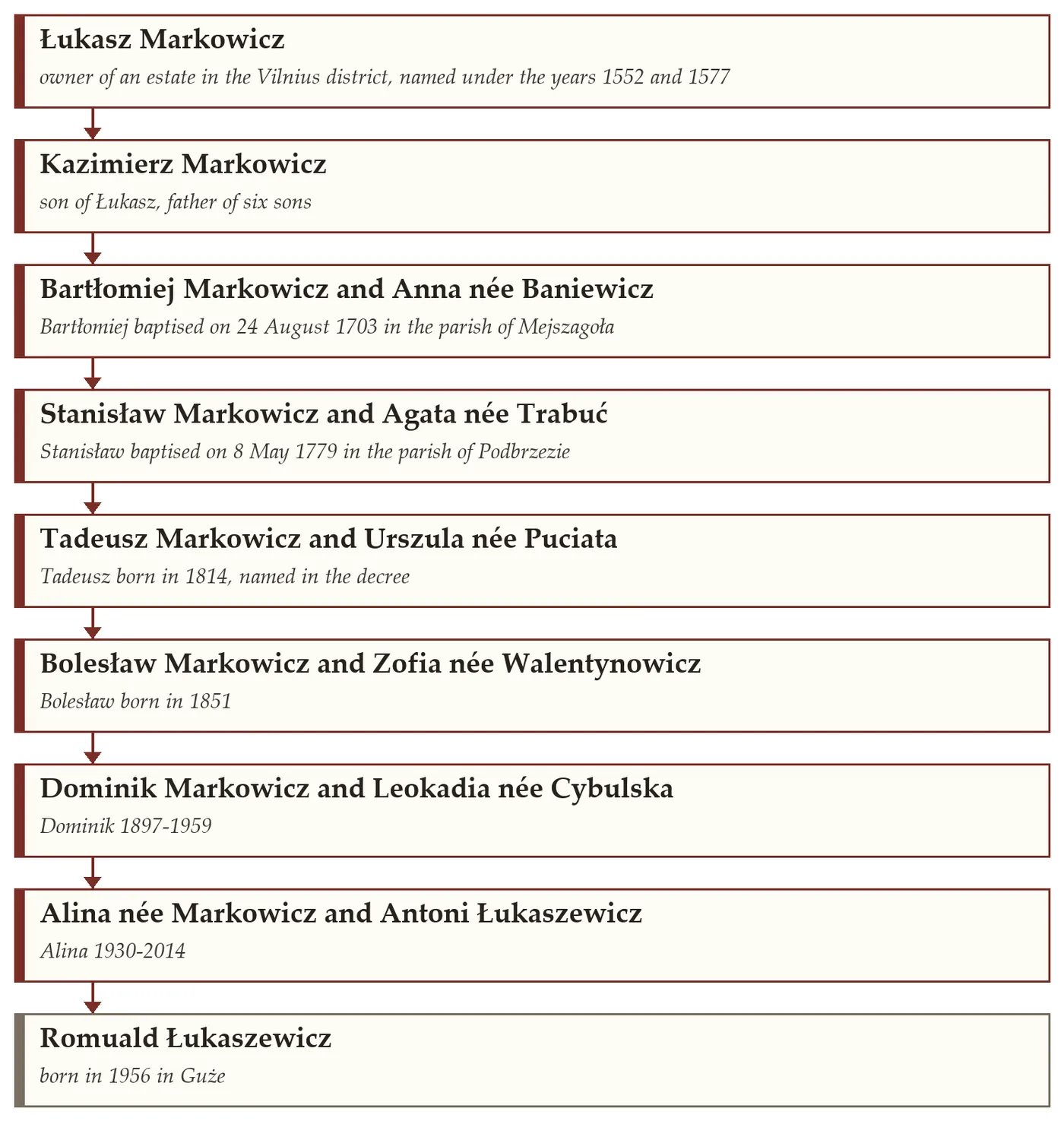
The Markowicz family was the family of Alina, Romuald's mother. They were minor nobility from around Święciany and Podbrodzie. Their story is known from the baptism of Stanisław in 1779. A nobility decree of 1819 lists Stanisław Markowicz's ancestors back to his great-grandfather Łukasz, recorded under the year 1552. He is the earliest ancestor we know by name. Through Agata née Trabuć, Stanisław Markowicz's wife, this branch also reaches back to Andrzej Trabuć, who lived about 1600.
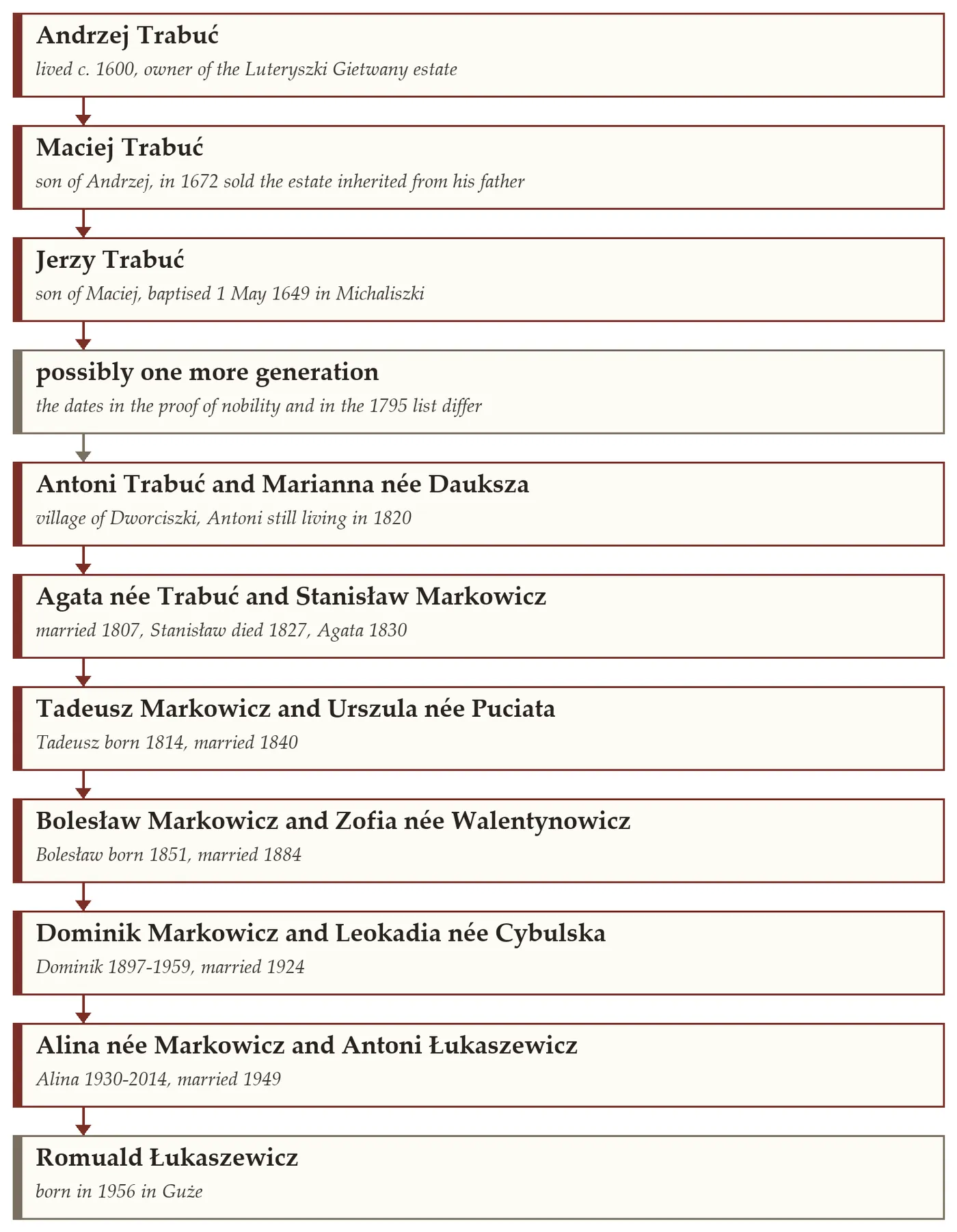
The chapter begins with Alina and goes back in time, generation by generation. First come the Markowicz family, from Alina to Stanisław and Agata. After them come Stanisław's ancestors known from the decree of 1819: Bartłomiej, Kazimierz and Łukasz. Then come the Trabuć family, Agata's relatives. At the end are the coats of arms, family stories and a list of sources.
Alina née Markowicz (1930-2014)
| Who she was | Alina was Romuald's mother |
| Birth | 4 March 1930, the zaścianek of Obkorty near Podbrodzie |
| Parents | Dominik Markowicz and Leokadia née Cybulska |
| Siblings | sister Dominika, married name Ziemczonek |
| Marriage | 7 February 1949 in Podbrodzie, husband Antoni Łukaszewicz of Ockowicze |
| Children | , Romuald (1956), |
| Move to Poland | autumn 1958 |
| Death | 12 January 2014 in Samborowo, buried in Iława |
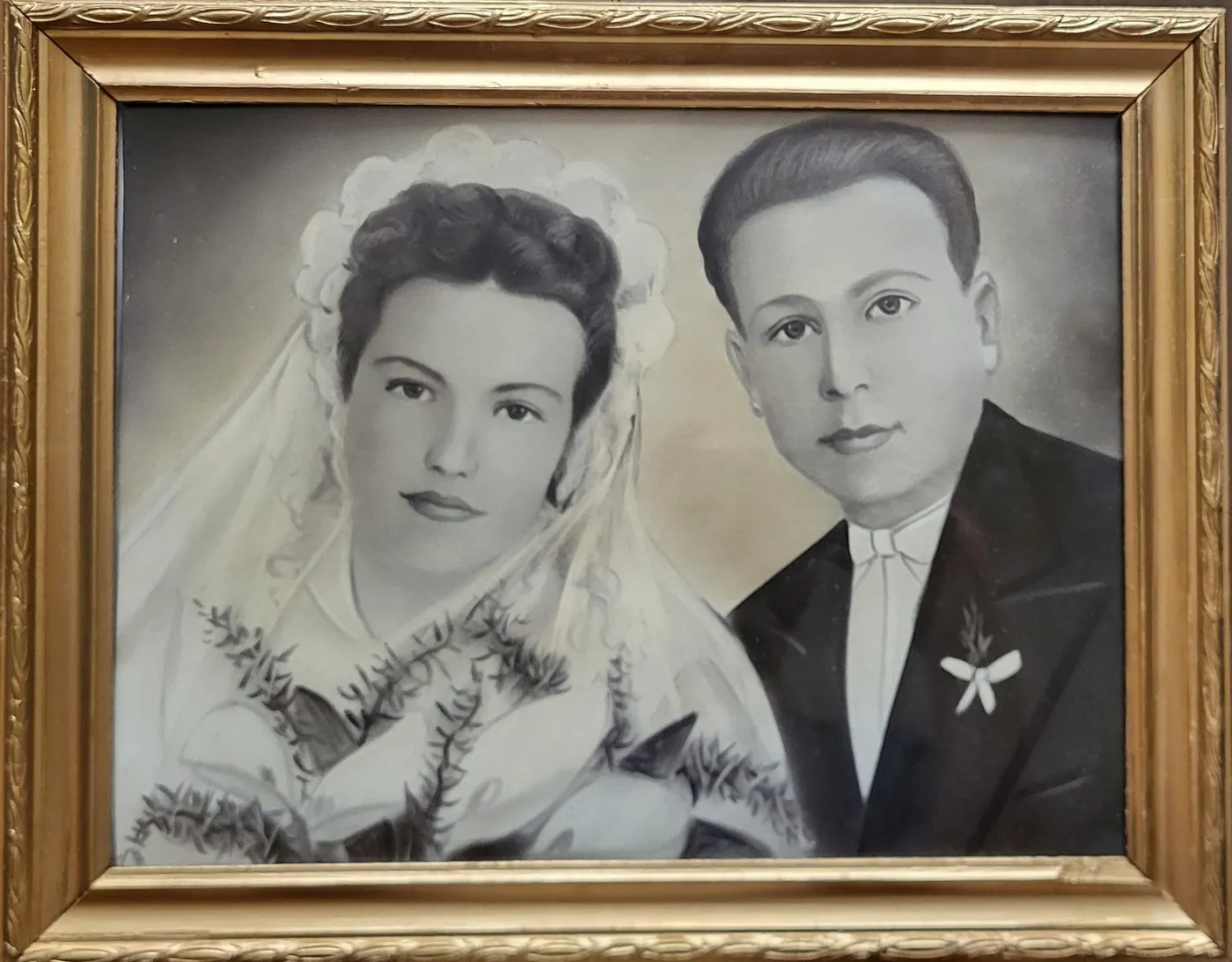
Alina was born in Obkorty. It is a small zaścianek among the forests, a dozen or so kilometres north-east of Podbrodzie, today in Lithuania. A zaścianek is a few houses of minor nobility standing on their own, away from the village. Alina's father, Dominik, had land and a house there. Alina had a sister, Dominika, married name Ziemczonek.
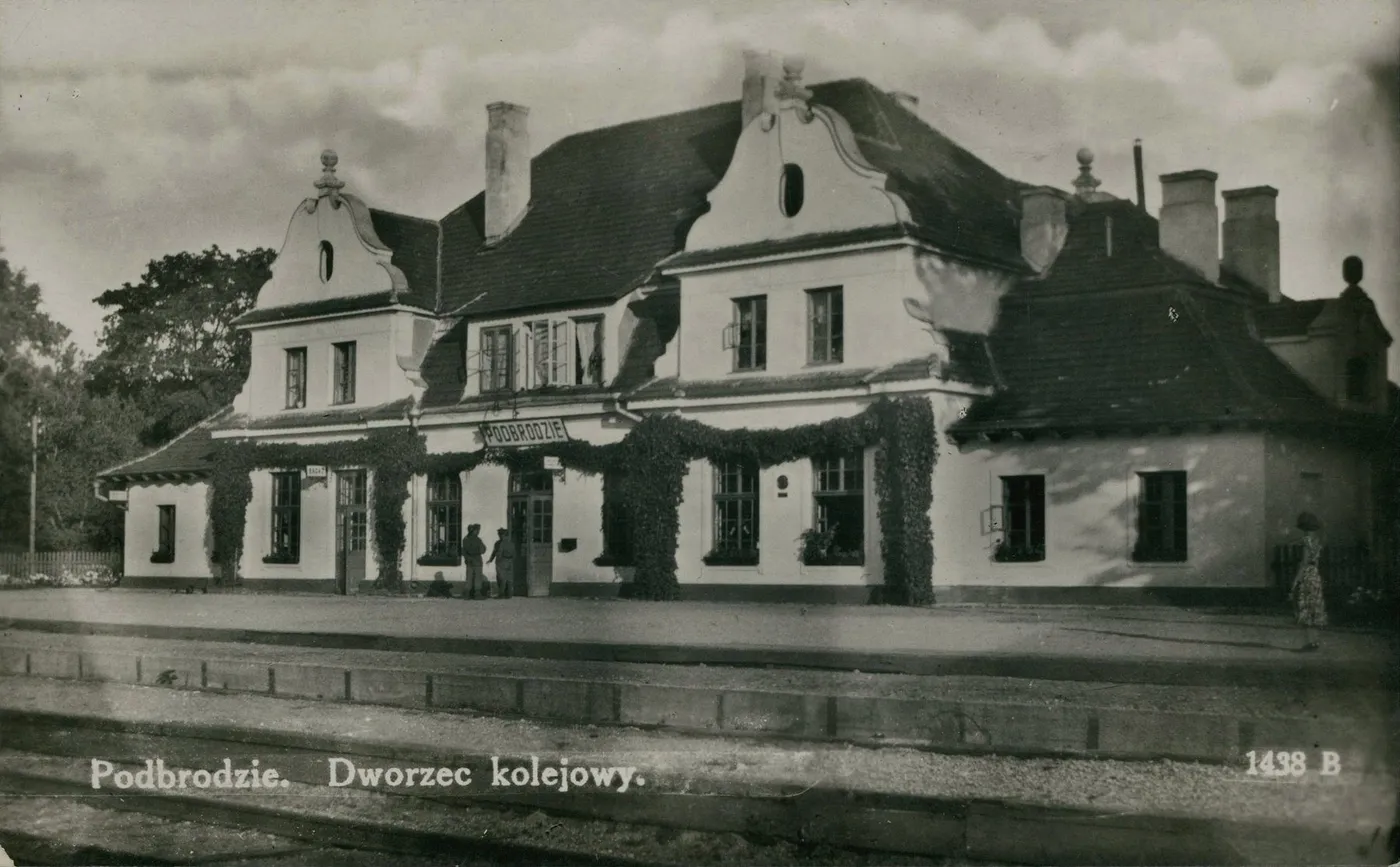
On 7 February 1949 Alina married. Her husband was Antoni Łukaszewicz, born in 1925 in Ockowicze near Komaje. The marriage was registered at the civil registry office in Podbrodzie under number 10. The young couple settled in Kocielniki, a village two kilometres from the church at Powiewiórka. There were born. Between June 1954 and the end of 1955 the family moved to Guże on the river Mera, two and a half kilometres away. There Romuald were born.
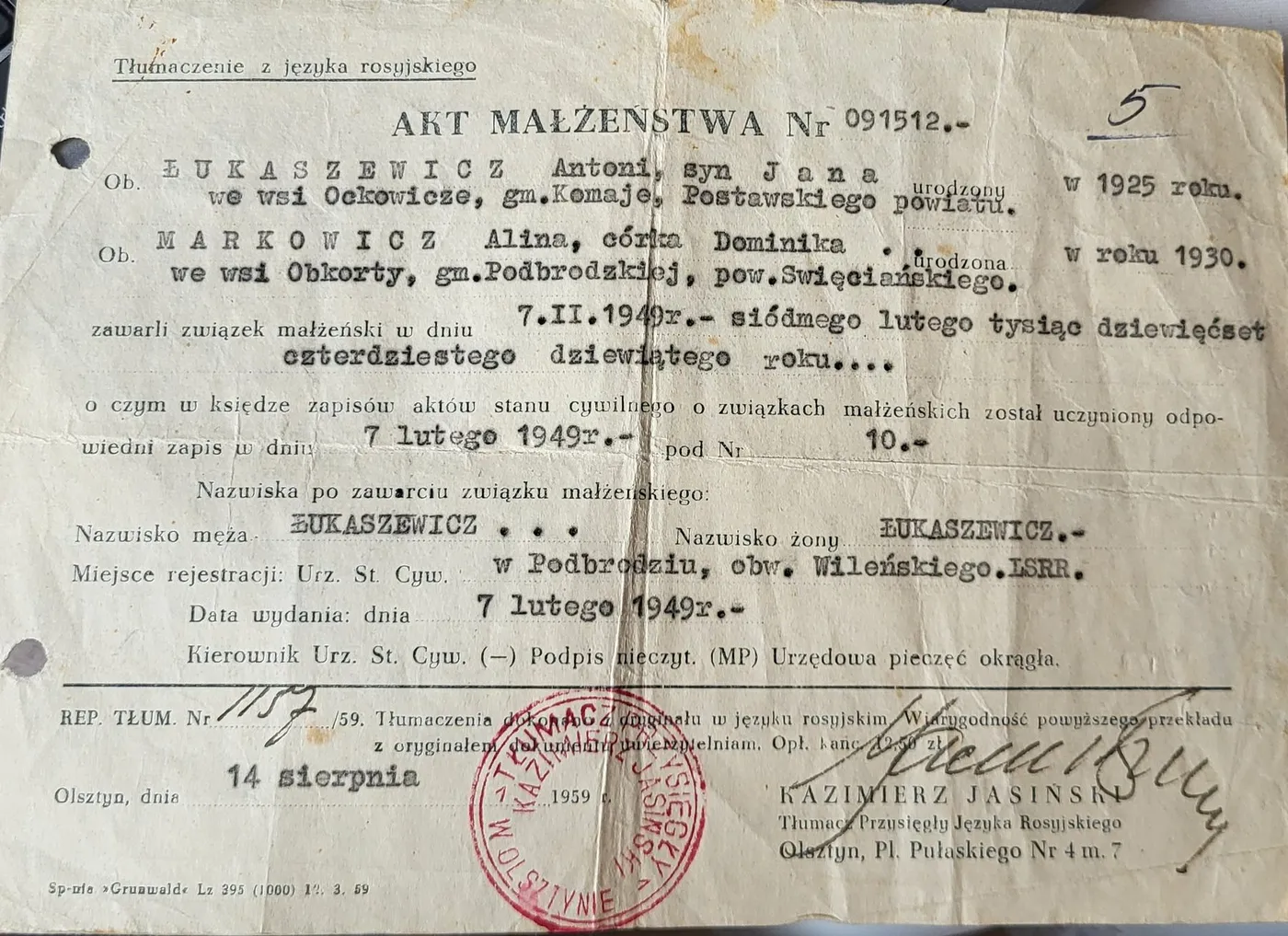
Original text (Polish): Tłumaczenie z języka rosyjskiego. AKT MAŁŻEŃSTWA Nr 091512. Ob. ŁUKASZEWICZ Antoni, syn Jana, urodzony w 1925 roku we wsi Ockowicze, gm. Komaje, Postawskiego powiatu. Ob. MARKOWICZ Alina, córka Dominika, urodzona w roku 1930 we wsi Obkorty, gm. Podbrodzkiej, pow. Święciańskiego, zawarli związek małżeński w dniu 7.II.1949 r., siódmego lutego tysiąc dziewięćset czterdziestego dziewiątego roku, o czym w księdze zapisów aktów stanu cywilnego o związkach małżeńskich został uczyniony odpowiedni zapis w dniu 7 lutego 1949 r. pod Nr 10. Nazwiska po zawarciu związku małżeńskiego: Nazwisko męża ŁUKASZEWICZ. Nazwisko żony ŁUKASZEWICZ. Miejsce rejestracji: Urz. St. Cyw. w Podbrodziu, obw. Wileńskiego, LSRR. Data wydania: dnia 7 lutego 1949 r. Kierownik Urz. St. Cyw. (-) Podpis nieczyt. (MP) Urzędowa pieczęć okrągła. […] Tłumaczenia dokonano z oryginału w języku rosyjskim. […] Olsztyn, dnia 14 sierpnia 1959 r.
In English: Translation from the Russian language. MARRIAGE RECORD No. 091512. Citizen ŁUKASZEWICZ Antoni, son of Jan, born in 1925 in the village of Ockowicze, Komaje commune, Postawy district. Citizen MARKOWICZ Alina, daughter of Dominik, born in the year 1930 in the village of Obkorty, Podbrodzie commune, Święciany district, contracted marriage on 7.II.1949, the seventh of February nineteen hundred and forty-nine, of which a corresponding entry was made in the register of civil status records of marriages on 7 February 1949 under No. 10. Surnames after the marriage: husband's surname ŁUKASZEWICZ. Wife's surname ŁUKASZEWICZ. Place of registration: Civil Registry Office in Podbrodzie, Vilnius region, Lithuanian SSR. Date of issue: 7 February 1949. Head of the Civil Registry Office (-) Illegible signature. (Seal) Round official seal. […] The translation was made from the original in the Russian language. […] Olsztyn, 14 August 1959.
All the children were baptised in the church in Powiewiórka. This church used to be called the Sorokpol church. That is the name it bears in the old registers. In this same church Józef Piłsudski was baptised in 1867.
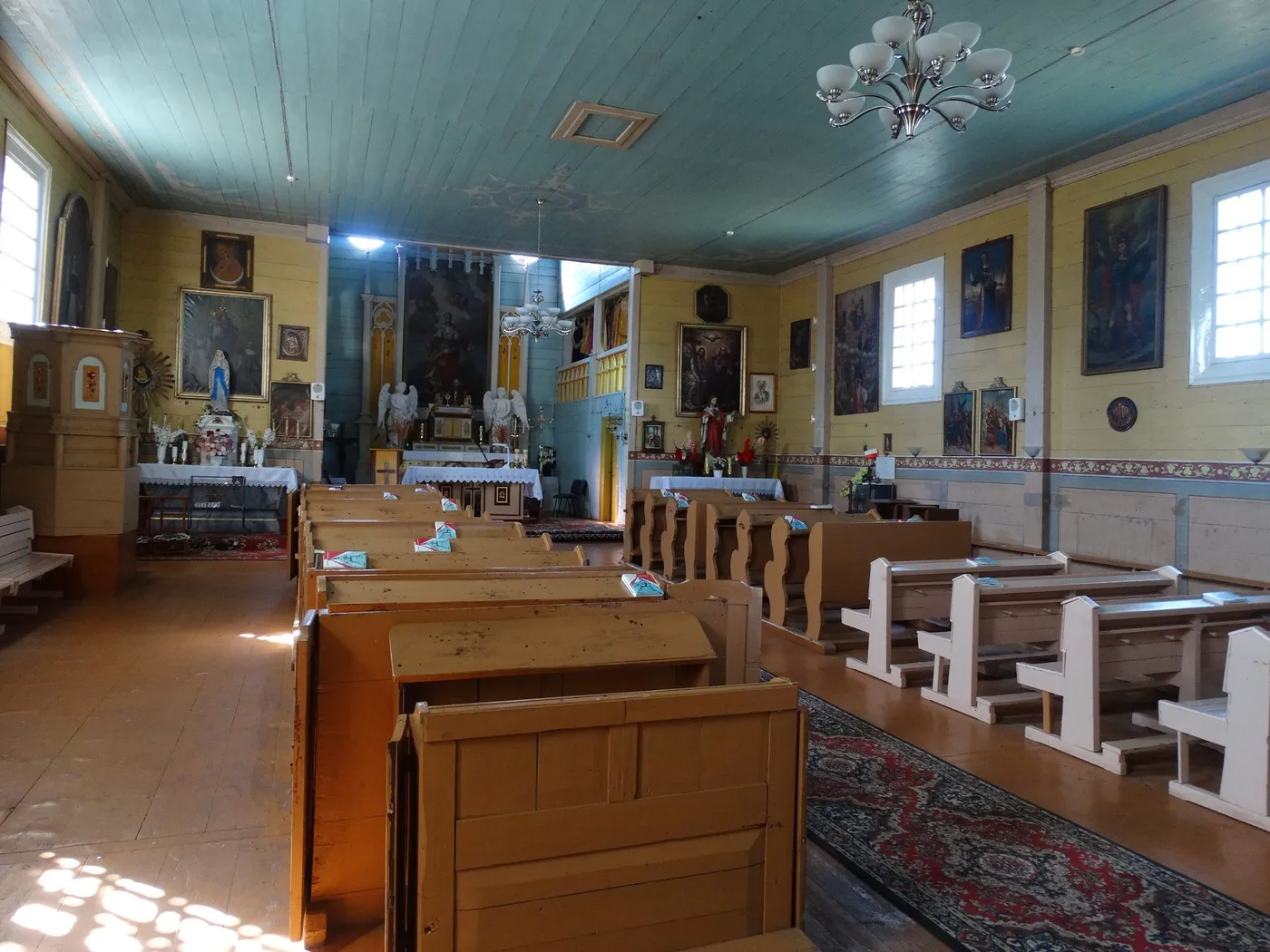
| Child | Birth | Baptism | Godparents |
|---|---|---|---|
| Romuald | 8 Jan 1956, Guże | 22 Jan 1956, entry 3 | Jan Kulewicz and Janina Kulewicz (brother-in-law and sister-in-law, not a married couple) |
Guże lay right next to a military training ground. Alina and her mother Leokadia remembered that life there was good and that one could get along with the soldiers. Today, of about forty cottages, four in Guże are still lived in.

Baptism records of Romuald and his siblings
The register of the church in Powiewiórka has preserved the baptism records of all five children of Alina and Antoni. Photographs of the entries were sent in 2026 by Father Vladimiras Solovej, parish priest of Podbrodzie, the parish to which the church in Powiewiórka belongs today. He searched for them at the request of Romuald . The records were written in Latin. Four of them were written by Father Franciszek Bylica and Romuald's record by Father Jakub Filek. Each record gives the day of birth, the day of baptism, the village, the parents and the godparents. In the three oldest records the church is called the Sorokpol church. In the two youngest it already bears the name Powiewiórka. It is the same church. The records appear here in the order in which the children were born.



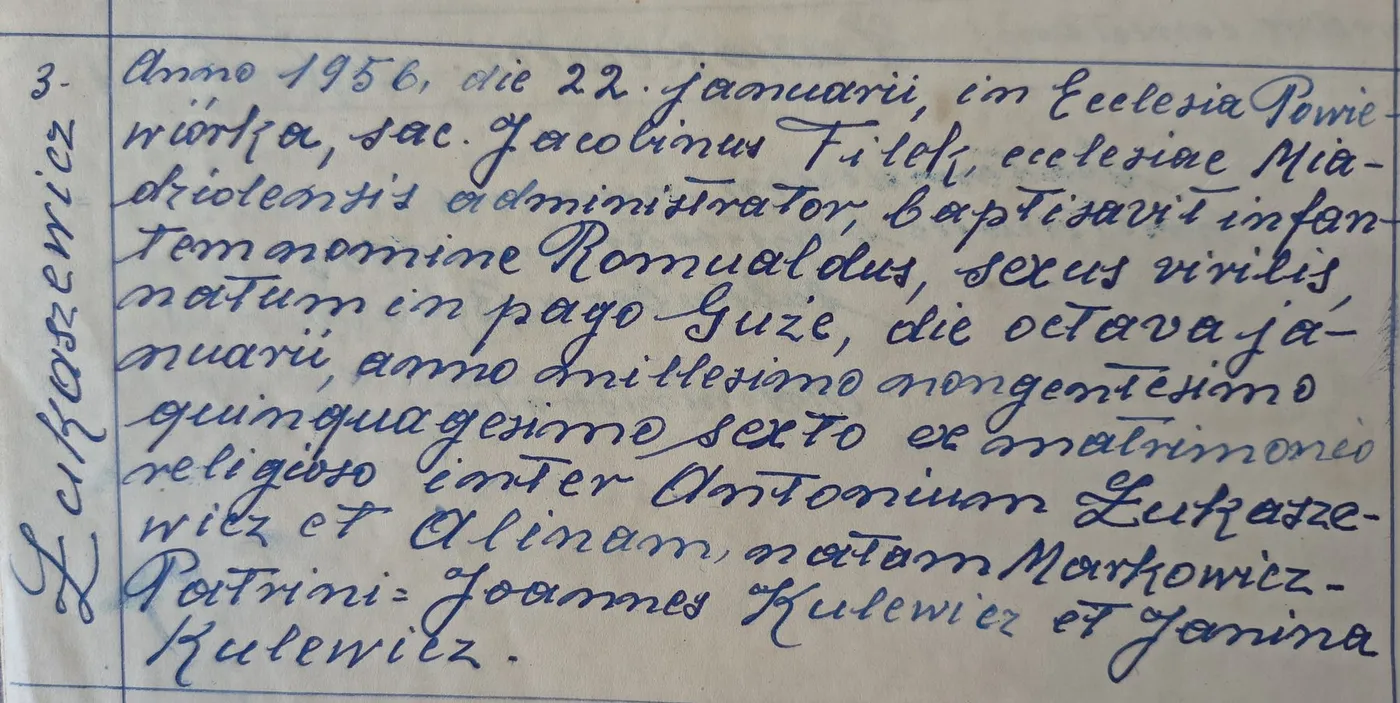
Original text (Latin): Anno 1956, die 22. januarii, in Ecclesia Powiewiórka, sac. Jacobinus Filek, ecclesiae Miadziolensis administrator, baptisavit infantem nomine Romualdus, sexus virilis, natum in pago Guze, die octava januarii, anno millesimo nongentesimo quinquagesimo sexto ex matrimonio religioso inter Antonium Łukaszewicz et Alinam, natam Markowicz. Patrini: Joannes Kulewicz et Janina Kulewicz.
In English: In the year 1956, on the 22nd day of January, in the church in Powiewiórka, Father Jakub Filek, administrator of the church in Miadzioł, baptised a child named Romuald, of the male sex, born in the village of Guże on the eighth day of January in the year one thousand nine hundred and fifty-six of the church marriage between Antoni Łukaszewicz and Alina née Markowicz. Godparents: Jan Kulewicz and Janina Kulewicz.
The priest wrote the name of the village as “Guze”. In Romuald's Polish birth record an official later wrote “Góra”. Both mean the same village of Guże.

The road to Poland
In the years 1955-1959 Poles from the Vilnius region could leave for Poland for the last time as repatriates, that is, people returning to their homeland. Alina's parents, Dominik and Leokadia, left first. Dominik's repatriation card was issued on 6 October 1958 at the repatriation point in Biała Podlaska. They settled in the village of Blanki near Lidzbark Warmiński, where Leokadia's brothers were already living.
The family of Alina and Antoni followed soon after them, in the autumn of 1958. All the documents needed for the journey were arranged by Alina. It was she who travelled to the offices, handed in the applications and collected the permits. Antoni preferred not to show himself in offices. He had a reason. At the end of the war, in 1944-1945, when he was about nineteen, he hid in the forests to avoid being called up into the Soviet army. Someone informed on him when he came home for one night. He was beaten and taken away. The family speaks of deportation to Siberia. He was gone for about a year. He came back on foot, so emaciated that his own mother did not recognise him. , Alina's daughter, supposes that after these experiences her father feared offices and another arrest. He told his wife: “once you sort out the papers, we go”. Alina arranged them on her own. Thanks to her the family reached Poland.
On arrival the family went first to a centre for repatriates in western Poland. remembers Zielona Góra. From there Antoni travelled with his brother Stefan to look for work and a home. He found a post as a forester's assistant under the forester from Chmielówka and a renovated house at the Sąpy forester's lodge near Iława. The family got off the train in Samborowo. Their belongings were brought by lorry. remembered that two motorcycles came to Poland with the family. Grandfather Dominik brought a Pannonia. Her father, Antoni, brought a Junak with a sidecar.
On Sunday 2 December 1962 Antoni set off by bicycle towards Wielowieś and did not come back. The bicycle was found a few days later by the cemetery in Wielowieś. The public prosecutor's office in Morąg conducted an investigation and discontinued it. The body was never found. Only on 23 August 1973, at Alina's request, did the court in Iława declare Antoni dead as of 2 December 1962.
Alina was left alone with five children. She was not entitled to a widow's pension, because the body had not been found and for eleven years her husband was not officially declared dead. The family lived on Alina's work for farmers, on gathering mushrooms and berries and on three hectares of land allotted to the forester's assistant. The head teacher of the school helped her. Later Alina lived first in Mały Gil and from the end of the 1970s in Samborowo. She died there on 12 January 2014.
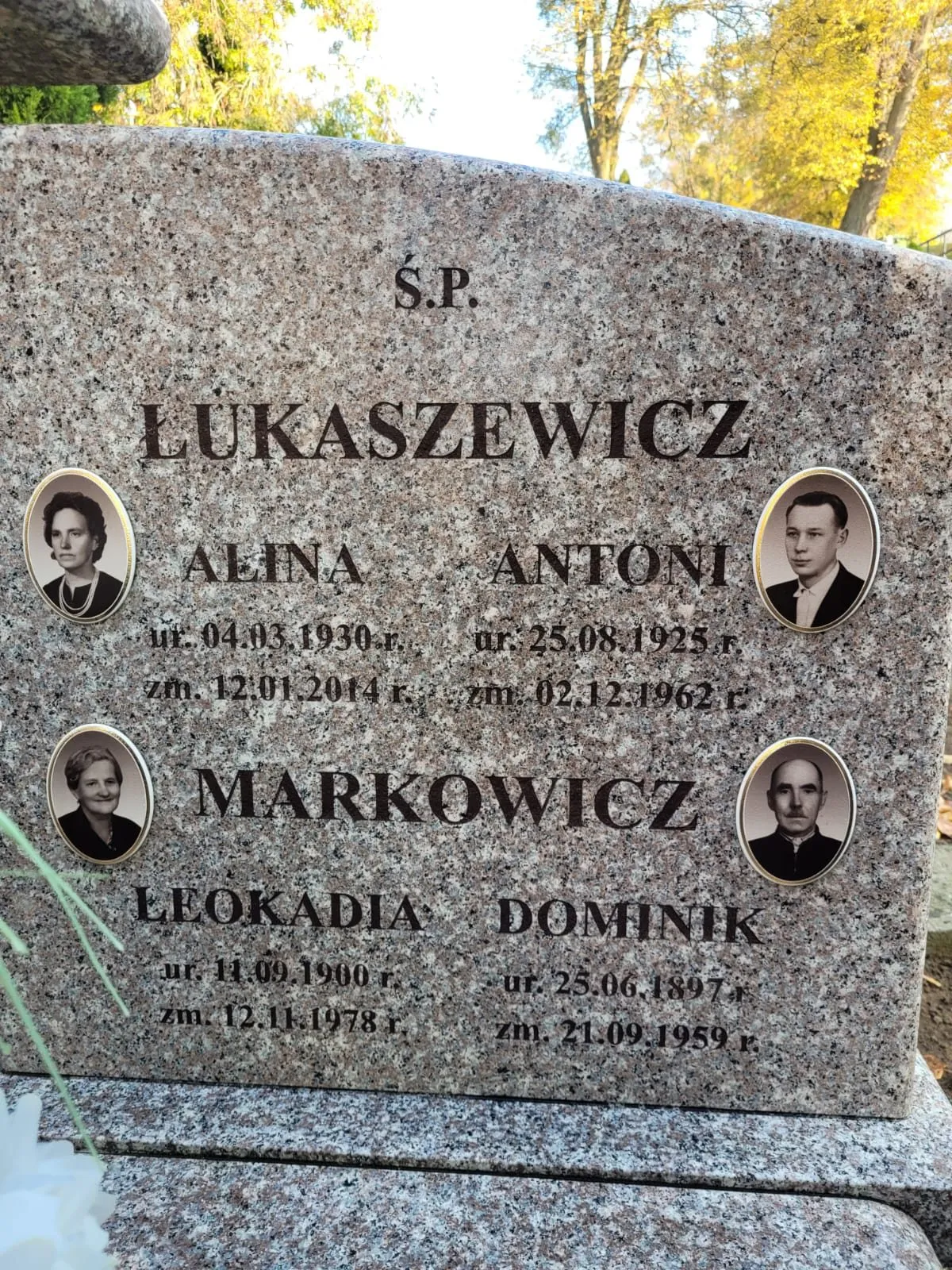
Original text (Polish): Ś.P. ŁUKASZEWICZ ALINA ur. 04.03.1930 r. zm. 12.01.2014 r. ANTONI ur. 25.08.1925 r. zm. 02.12.1962 r. MARKOWICZ ŁEOKADIA ur. 11.09.1900 r. zm. 12.11.1978 r. DOMINIK ur. 25.06.1897 r. zm. 21.09.1959 r.
In English: OF BLESSED MEMORY ŁUKASZEWICZ ALINA b. 04.03.1930 d. 12.01.2014 ANTONI b. 25.08.1925 d. 02.12.1962 MARKOWICZ ŁEOKADIA b. 11.09.1900 d. 12.11.1978 DOMINIK b. 25.06.1897 d. 21.09.1959
Dominik Markowicz (1897-1959)
| Who he was | Dominik was Romuald's grandfather and Alina's father |
| Birth | 25 June 1897, zaścianek of Wojtkuny |
| Baptism | 20 July 1897, the church in Święciany |
| Parents | Bolesław Markowicz and Zofia née Walentynowicz |
| Marriage | 2 March 1924 in Mielegiany, wife Leokadia née Cybulski |
| Children | Alina (1930) and Dominika |
| Occupation | farmer on his own land in Obkorty |
| Move to Poland | October 1958 |
| Death | 21 September 1959, buried in Iława |
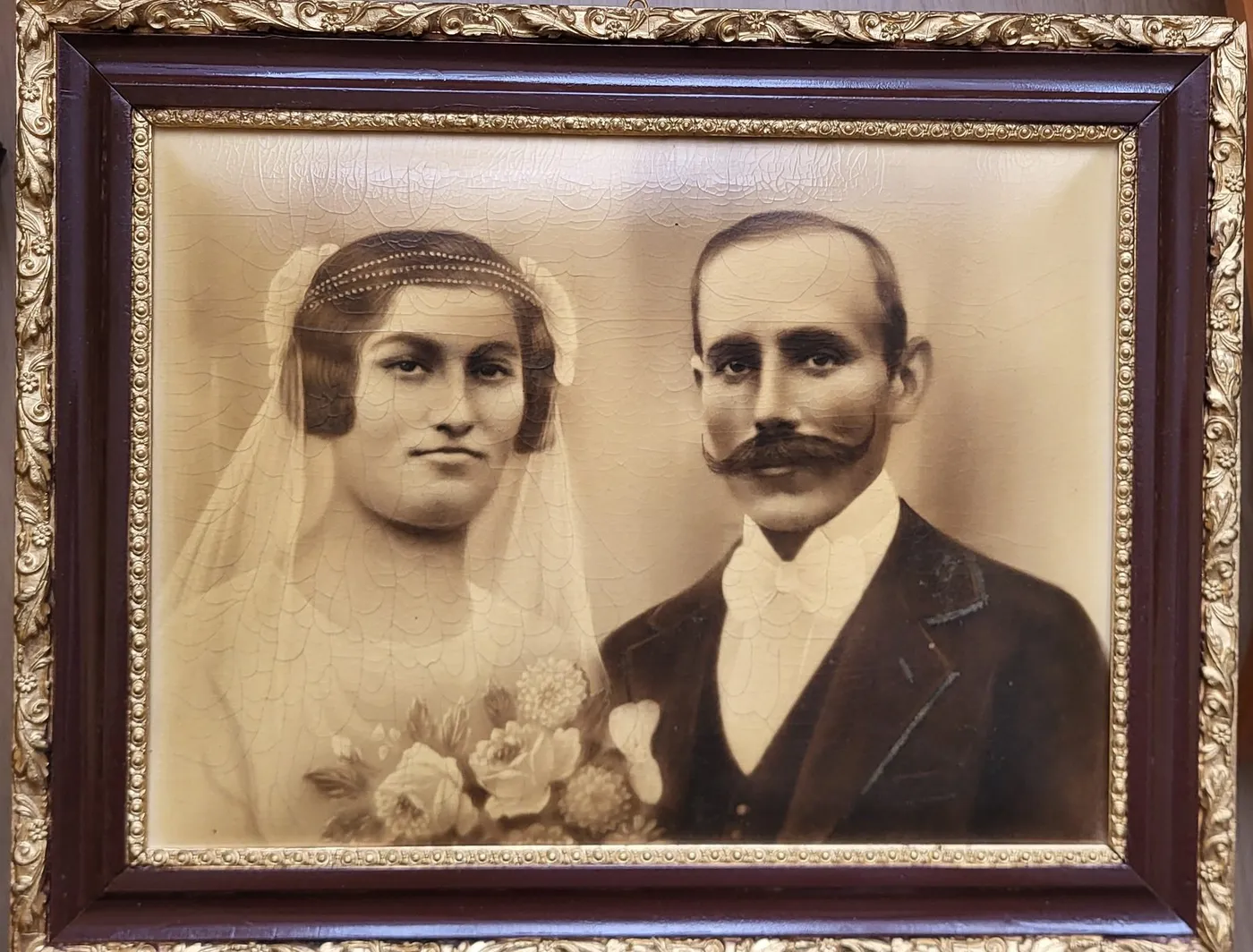
Dominik was born in the zaścianek of Wojtkuny as the sixth child of Bolesław and Zofia. The priest recorded the parents as nobility. The godfather was Antoni Markowicz, most probably his paternal uncle, that is, his father's brother. The godmother was Józefa, wife of Józef Bejnar.
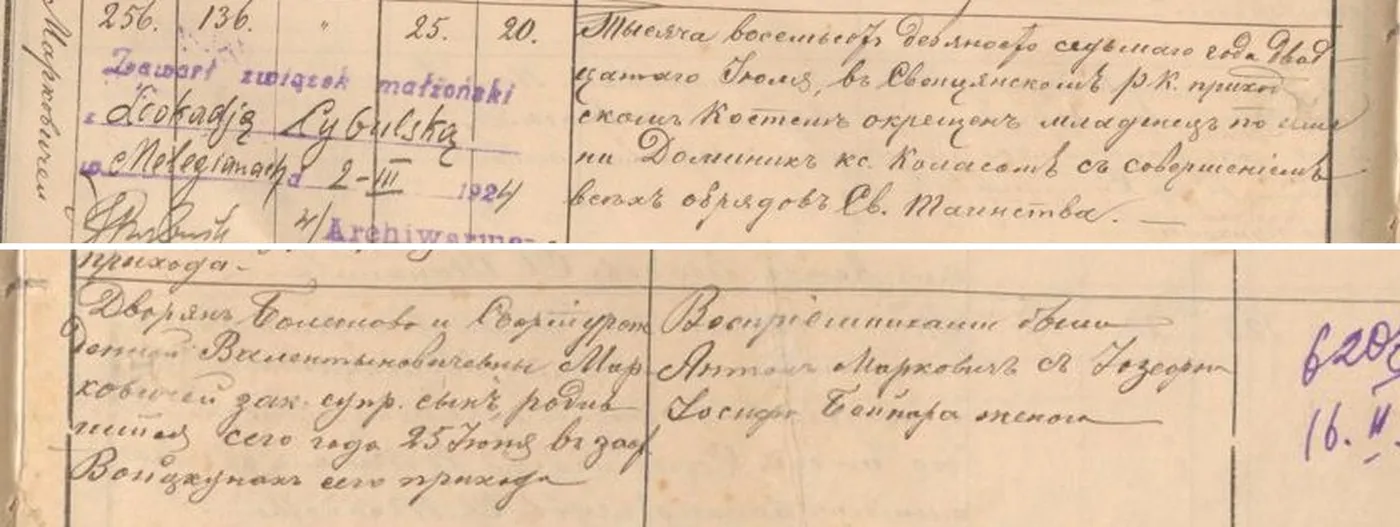
Original text (Russian): Тысяча восемьсотъ девяносто седьмаго года Іюля двадцатаго дня, въ Свенцянскомъ Р. К. приходскомъ Костелѣ окрещенъ младенецъ по имени Доминикъ кс. Коласомъ съ совершеніемъ всѣхъ обрядовъ Св. Таинства. Дворянъ Болеслава и Софіи урожденной Валентыновичевны Марковичей зак. супр. сынъ родившійся сего года 25 Іюня въ зас. Войцкунахъ сего прихода. Воспріемниками были Антонъ Марковичъ съ Іозефою Іосифа Б[о]йнара женою. Dopisek: Zawarł związek małżeński z Leokadją Cybulską w Melagianach 2-III 1924
In English: In the year one thousand eight hundred and ninety-seven, on the twentieth day of July, in the Święciany Roman Catholic parish church, Father Kolas baptised an infant named Dominik with the fulfilment of all the rites of the holy sacrament. Son of the nobility Bolesław and Zofia née Walentynowicz, lawful spouses Markowicz, born this year on 25 June in the zaścianek of Wojtkuny of this parish. The godparents were Antoni Markowicz and Józefa, wife of Józef Bejnar (the surname is written unclearly, Bejnar or Bojnar). Note in Polish: he married Leokadia Cybulska in Mielegiany on 2 March 1924.
The note in the margin dates from 1924. It was made in Polish by an archive official when Dominik married. An identical note stands beside Leokadia's baptism record. These two notes link both records to our Dominik and Leokadia.
In the parish census of 1909 twelve-year-old Dominik lives in Wojtkuny with his parents, his brothers Jan and Kazimierz and his sister Maria. In 1923 he already has his own land in Obkorty. In 1924 he marries Leokadia Cybulska from Lejpuszki. In 1930 Alina is born.
The family remembers Dominik above all with his harmoshka. He played a button accordion, that is, an accordion with buttons instead of keys. He brought a Pannonia motorcycle to Poland. After arriving he lived with Leokadia in the village of Blanki. Towards the end of his life with his daughter. In September 1959 he still played for the children at the school in Sąpy for the start of the school year. He died on 21 September 1959.
Wife: Leokadia née Cybulski (1900-1978)
Leokadia was born on 14 September 1900 in the zaścianek of Lejpuszki in the parish of Mielegiany. Her parents, Stanisław Cybulski and Aniela née Bojaruniec, were farmers. She died on 12 November 1978 and rests in Iława beside her husband. Her life, her baptism record and her family are described in the chapter on the Cybulski family.
The land in Obkorty and the compensation
Dominik's farm in Obkorty is described in two certificates from Lithuanian archives, issued in 2013 for the compensation case.
| Year | What Dominik Markowicz owned in Obkorty | How we know |
|---|---|---|
| 1923 | 14 desyatinas of land, that is about 15 hectares: 1 1/4 desyatinas of arable land, 1 desyatina of meadow, 5 desyatinas of pasture, 1 desyatina of forest and 5 3/4 desyatinas of wasteland (as at 1 July 1923) | certificate of the Lithuanian Central State Archives of 5 February 2013 |
| 1957 | 0.66 hectare of land, a dwelling house built in 1920 and a pigsty from 1930 | certificate of the Vilnius Regional Archives of 15 May 2013 |
The difference between 1923 and 1957 is the result of collectivisation. After the war the Soviet authorities took the land from the farmers and put it into a kolkhoz. Dominik was left with little more than half a hectare by the house. According to a family story the newly built Markowicz house in Obkorty burned down. Dominik and Leokadia then moved in with their daughter. The fire hastened the decision to leave for Poland. still has a scorched document about her grandfather's land.

When he left in 1958, Dominik left behind in Obkorty a house, a pigsty and land. Polish law provides state compensation for such property left beyond the eastern border. First it had to be established who inherited from Dominik and Leokadia.
- The estate of Dominik (died in 1959) passed to three persons in equal shares: his wife Leokadia, his daughter Dominika Ziemczonek and his daughter Alina Łukaszewicz, each 1/3.
- The estate of Leokadia (died in 1978) passed to both daughters in halves.
- As a result each of the daughters was entitled to half of the parents' property. This was the ruling of the District Court in Iława on 19 June 1990.
Alina filed the application for compensation on 17 December 1990 at the District Office in Iława. She did so eighteen years before the end of the deadline, which expired on 31 December 2008. The case lasted more than thirty years. In 2004 it was passed on. In the end it was handled by the Governor of the Warmian-Masurian Province. A valuer assessed the property in Obkorty as it stood in 1958, that is the house, the pigsty and 0.66 hectare. The land taken earlier into the kolkhoz was not included in the valuation, because the law covers only what the family left on the day of departure.
| Item | Amount |
|---|---|
| Value of the property in Obkorty according to the valuation (prices of 20 August 2020) | PLN 472,637.96 |
| The same value recalculated to the date of the 2024 decision | PLN 639,656.19 |
| Compensation for the whole family, that is one fifth of the value (as the act provides) | PLN 127,931.23 |
| Half for the heirs of Dominika Ziemczonek (15/30), decision of 10 December 2020 | PLN 63,965.61 |
The half due to Alina's side was divided equally among her five children. Each of the siblings received one fifth of that half, that is three thirtieths of the whole compensation: PLN 12,793.12. The share of a child who was no longer living went to that child's heirs. In one case this was a widow. In the other it was three children, each of whom received one third of their father's share, that is PLN 4,264.37.
Bolesław Markowicz (b. 1851)
| Who he was | Bolesław was Romuald's great-grandfather and Dominik's father |
| Birth | 27 April 1851, zaścianek of Popieliszki |
| Baptism | 27 May 1851, St Raphael's Church in Vilnius |
| Parents | Tadeusz Markowicz and Urszula née Puciata |
| Marriage | 7 February 1884 in Święciany, wife Zofia Walentynowicz |
| Children | eight, including Dominik (1897) |
| Lived in | Popieliszki, Obkorty, Wojtkuny, in 1894 the manor of Kondariszki |
| Last record | parish census of March 1909, Wojtkuny |
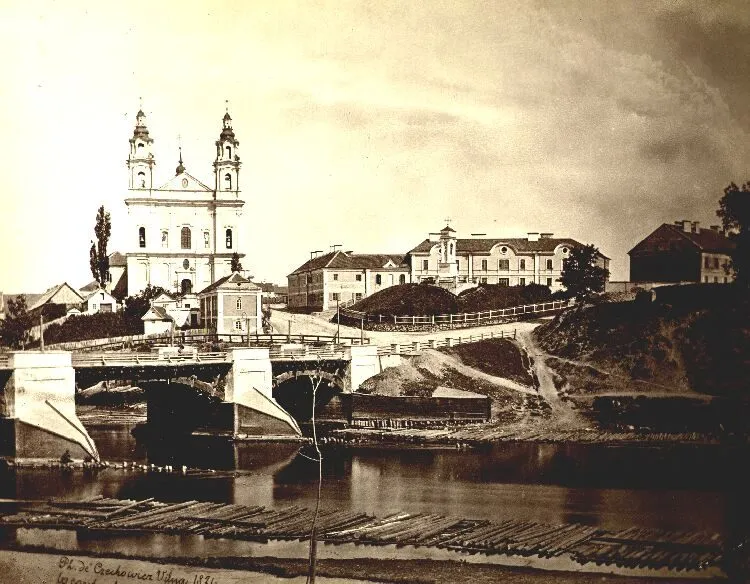
Bolesław came into the world in Popieliszki, in the zaścianek where his mother's parents lived. Popieliszki lies right next to Obkorty. A month after the birth his parents took their son to Vilnius to be baptised, to St Raphael's Church. That is a journey of more than fifty kilometres.
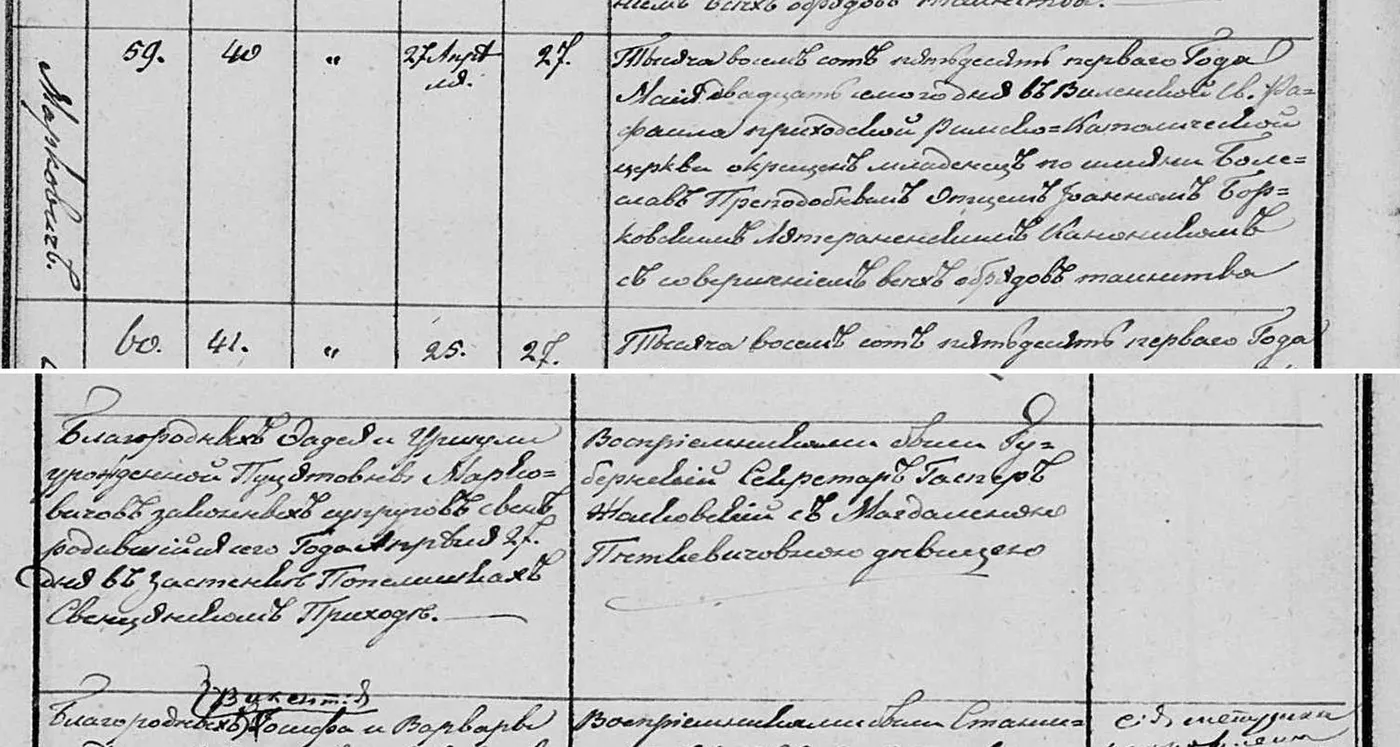
Original text (Russian): Тысяча восемь сотъ пятьдесятъ перваго Года Маія двадцать седьмого дня въ Виленской Св. Рафаила приходской Римско-Католической церкви окрещенъ младенецъ по имени Болеславъ Преподобнымъ Отцемъ Іоанномъ Борковскимъ Латеранскимъ Каноникомъ съ совершеніемъ всѣхъ обрядовъ таинства. Благородныхъ Фадея и Уршули урожденной Пуцятовны Марковичовъ законныхъ супруговъ сынъ родившійся сего Года Апрѣля 27. дня въ застенкѣ Попелишкахъ Свенцянскомъ Приходѣ. […] Губернскій Секретарь Гаспаръ Жил[ин]скій[?] съ Магдалиною Пѣткевичовною дѣвицею.
In English: In the year one thousand eight hundred and fifty-one, on the twenty-seventh day of May, in the Vilnius Roman Catholic parish church of Saint Raphael, the Reverend Father Jan Borkowski, Lateran canon, baptised an infant named Bolesław with the fulfilment of all the rites of the sacrament. Son of the nobly born Tadeusz and Urszula née Puciata, lawful spouses Markowicz, born this year on 27 April in the zaścianek of Popieliszki in the parish of Święciany. The godparents were the governorate secretary Kasper Żyliński (surname uncertain) and Miss Magdalena Pietkiewicz.
In 1884 Bolesław married Zofia Walentynowicz. According to the record he was 33 and she was 20. Both were living in Wojtkuny at the time. The marriage record names the parents of both, so a single document links three generations at once.
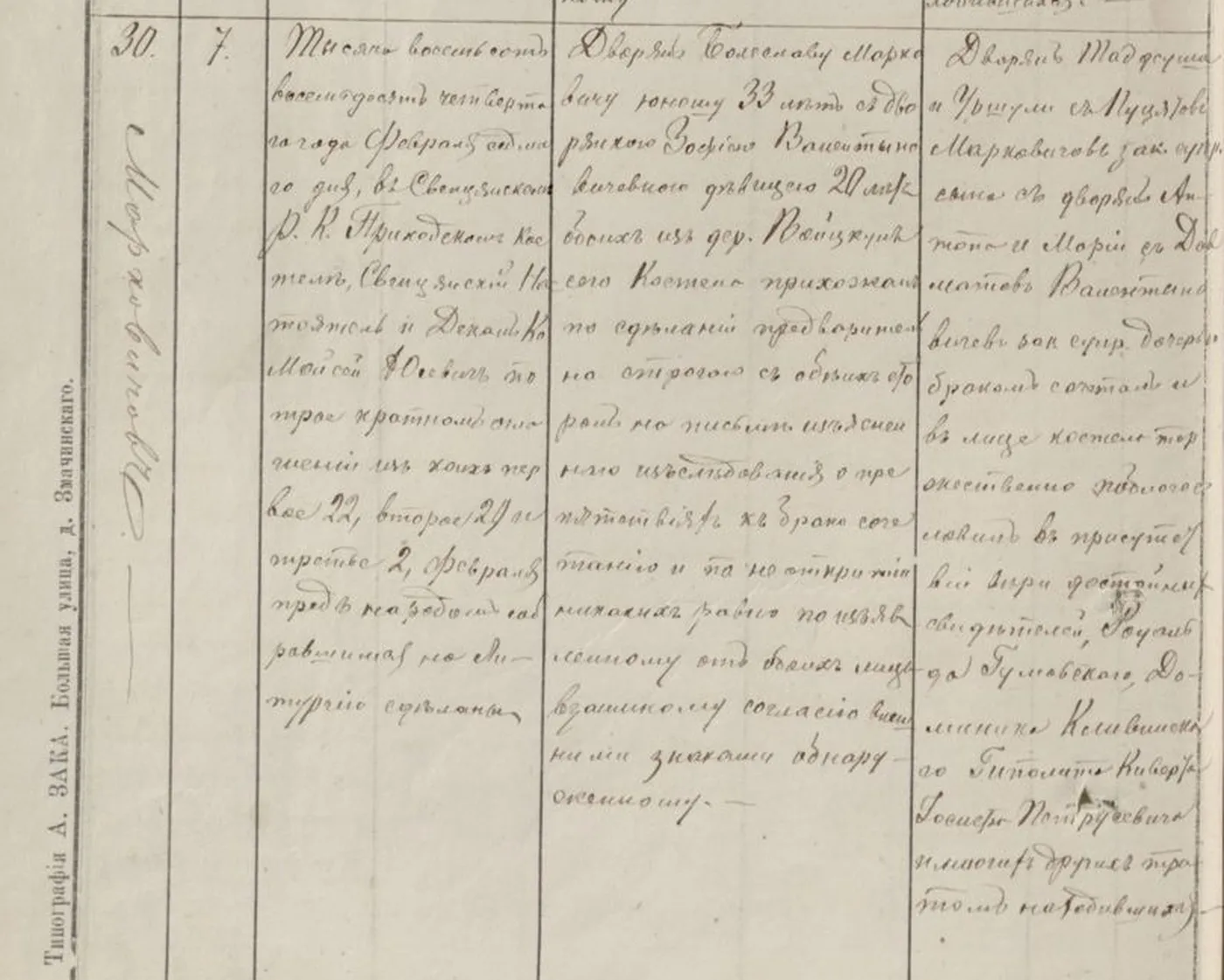
Original text (Russian): Тысяча восемьсотъ восемьдесятъ четвертаго года Февраля седьмаго дня, въ Свенцянскомъ Р. К. Приходскомъ Костелѣ, Свенцянскій Настоятель и Деканъ Ксёндзъ Моисей Юсевичъ, по трёхкратномъ оглашеніи, изъ коихъ первое 22, второе 29 и третье 2 Февраля предъ народомъ собравшимся на Литургію сдѣланы […] Дворянъ Болеславу Марковичу юношу 33 лѣтъ съ дворянкою Зофіею Валентыновичевною дѣвицею 20 лѣтъ, обоихъ изъ дер. Войцкунъ сего Костела прихожанъ […] Дворянъ Тадеуша и Уршули съ Пуцятовъ Марковичевъ зак. супр. сына, съ дворянъ Антона и Маріи съ Долматовъ Валентыновичевъ зак. супр. дочерью бракомъ сочеталъ и въ лицѣ костела торжественно благословилъ […]
In English: In the year one thousand eight hundred and eighty-four, on the seventh day of February, in the Święciany Roman Catholic parish church, the parish priest and dean of Święciany, Father Mojżesz Jusiewicz, after three banns announced before the people gathered at Mass (the first on 22 January, the second on 29 January, the third on 2 February), joined in marriage the nobleman Bolesław Markowicz, a bachelor aged 33, with the noblewoman Zofia Walentynowicz, a maiden aged 20. Both were from the village of Wojtkuny and belonged to this parish. He is the son of the nobility Tadeusz and Urszula née Puciata, lawful spouses Markowicz. She is the daughter of the nobility Antoni and Maria née Dołmat, lawful spouses Walentynowicz. The priest solemnly blessed them before the face of the Church.
Children of Bolesław and Zofia
Of the eight children four died in childhood. In April 1893, within four days, the parents lost two sons, one-year-old Józef and almost six-year-old Kazimierz. Both died of croup, a choking inflammation of the larynx. To the next son, born a year later, the parents again gave the name Kazimierz.
| Child | Birth | Later life |
|---|---|---|
| Antoni | 1885, Wojtkuny | died 21 November 1886 in Wojtkuny |
| Kazimierz | 1887 | died 30 April 1893 of croup |
| Jan | 1889 | in 1909 he lived in his parents' house, married in 1927 |
| Józef | 22 March 1892, Wojtkuny | died 26 April 1893 of croup |
| Kazimierz | 1894 | baptised in February 1894, when his parents were living at the Kondariszki manor. In 1909 he lived in his parents' house |
| Dominik | 25 June 1897, Wojtkuny | Alina's father |
| Maria | c. 1902 | in 1909 she lived in her parents' house |
| Helena | 15 May 1907, Wojtkuny | died 25 October 1908 |
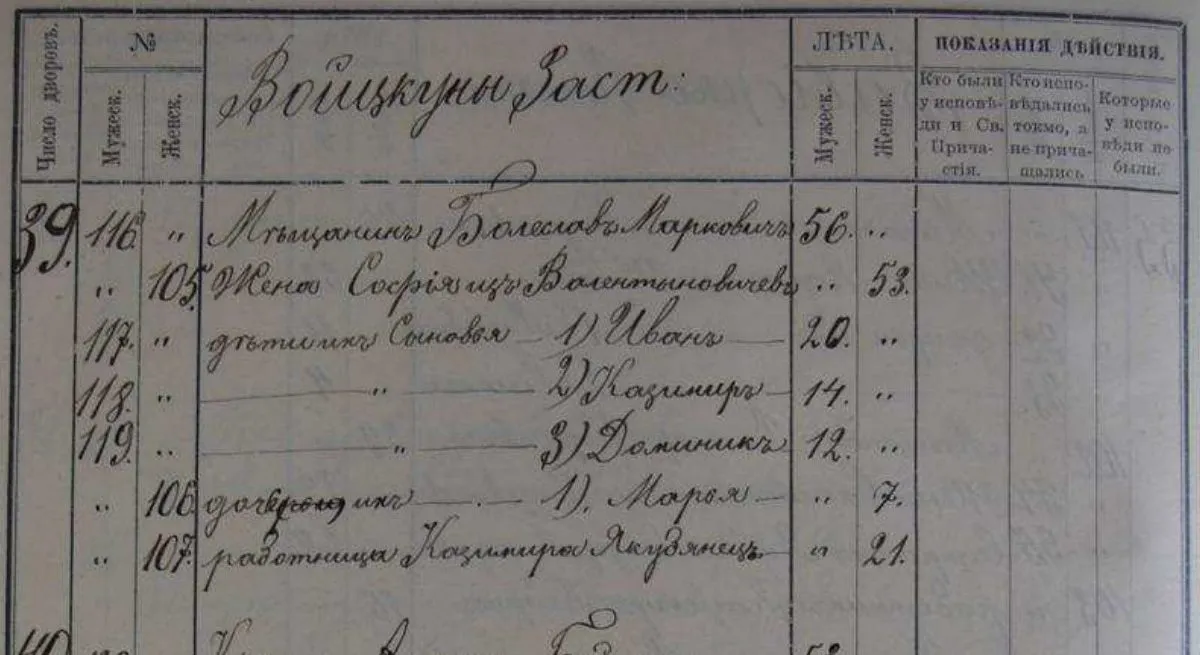
Original text (Russian): Мѣщанинъ Болеславъ Марковичъ 56 / Жена Софія изъ Валентиновичевъ 53 / дѣти ихъ Сыновья 1) Иванъ 20, 2) Казиміръ 14, 3) Доминикъ 12 / дочь ихъ Марья 7 / работница Казиміра Якубянецъ 21
In English: Townsman Bolesław Markowicz, aged 56. His wife Zofia née Walentynowicz, aged 53. Their children, sons: Jan 20, Kazimierz 14, Dominik 12. Their daughter Maria 7. Maidservant Kazimiera Jakubianiec 21.
The census gives ages only roughly. Zofia was then 45, not 53. In this census Bolesław is recorded as a townsman, although in the parish records of 1851-1897 he and his family are nobility.
Wife: Zofia née Walentynowicz (b. 1863)
Zofia was born on 7 August 1863 at the manor in Zułów, the same manor where Józef Piłsudski came into the world four years later. Her parents, Tomasz Antoni Walentynowicz and Maria née Dołmat, were nobility without land of their own. By April 1871 the family was already living in Wojtkuny. Zofia grew up there. Her baptism record, her parents and her siblings are presented in the chapter on the Walentynowicz family.
Tadeusz Markowicz (b. 1814)
| Who he was | Tadeusz was Romuald's great-great-grandfather and Bolesław's father |
| Birth | 15 March 1814, the village of Andrulańce, parish of Janiszki |
| Baptism | 16 March 1814, the church in Janiszki |
| Parents | Stanisław Markowicz and Agata née Trabuć |
| Marriage | 2 July 1840 in Święciany, wife Urszula Puciata |
| Children | Marianna (1843), Bolesław (1851), Salomea (1854), Helena (1856), Antoni (1862), Józef (1864) |
| Lived in | Andrulańce, Mirańce, Lipowo, Popieliszki, Obkorty |
| Last record | 1862-1864, zaścianek Obkorty |
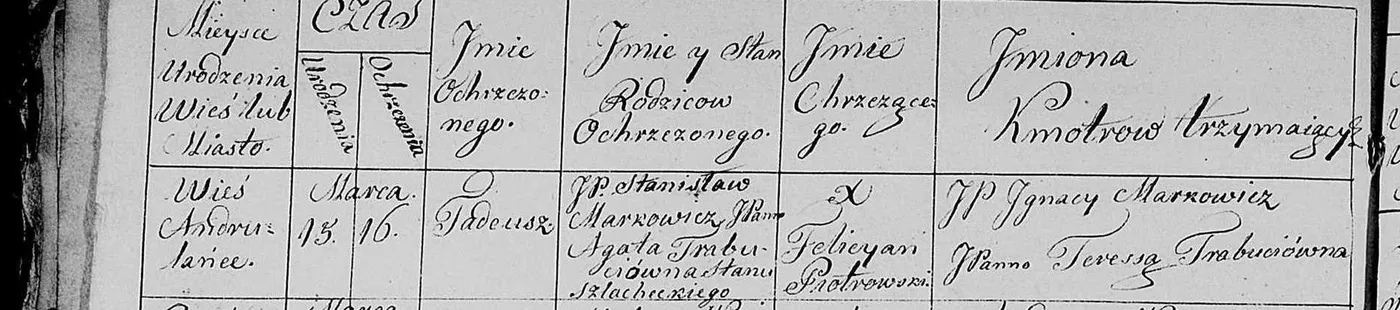
Original text (Polish): Mieysce Urodzenia Wieś lub Miasto: Wieś Andrulańce. Czas Urodzenia, Ochrzczenia: Marca 15. 16. Imie Ochrzczonego: Tadeusz. Imie y Stan Rodzicow Ochrzczonego: JP. Stanisław Markowicz, JPann[a] Agata Trabuciówna Stanu Szlacheckiego. Imie Chrzczącego: X Felicyan Piotrowski. Imiona Kmotrow trzymaiących: JP Ignacy Markowicz, JPanno Teressa Trabuciówna
In English: Place of birth: the village of Andrulańce. Born 15 March, baptised 16 March. Name of the child: Tadeusz. Parents: Mr Stanisław Markowicz and Mrs Agata née Trabuć, of the noble estate. Baptised by the priest Felicjan Piotrowski. Godparents: Mr Ignacy Markowicz and Miss Teresa Trabuć.
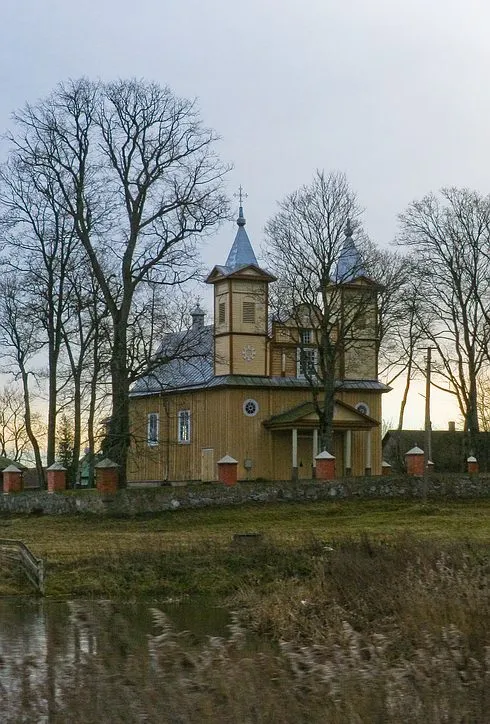
Tadeusz was at most two years old when his parents moved from Andrulańce to Mirańce, a village four and a half kilometres east of the church in Sorokpol. He was twelve when his father died. His mother then moved with the children to Lipowo and died there in 1830, when Tadeusz was sixteen. In 1840 he married Urszula Puciata from Popieliszki. The marriage record names the parents of both.
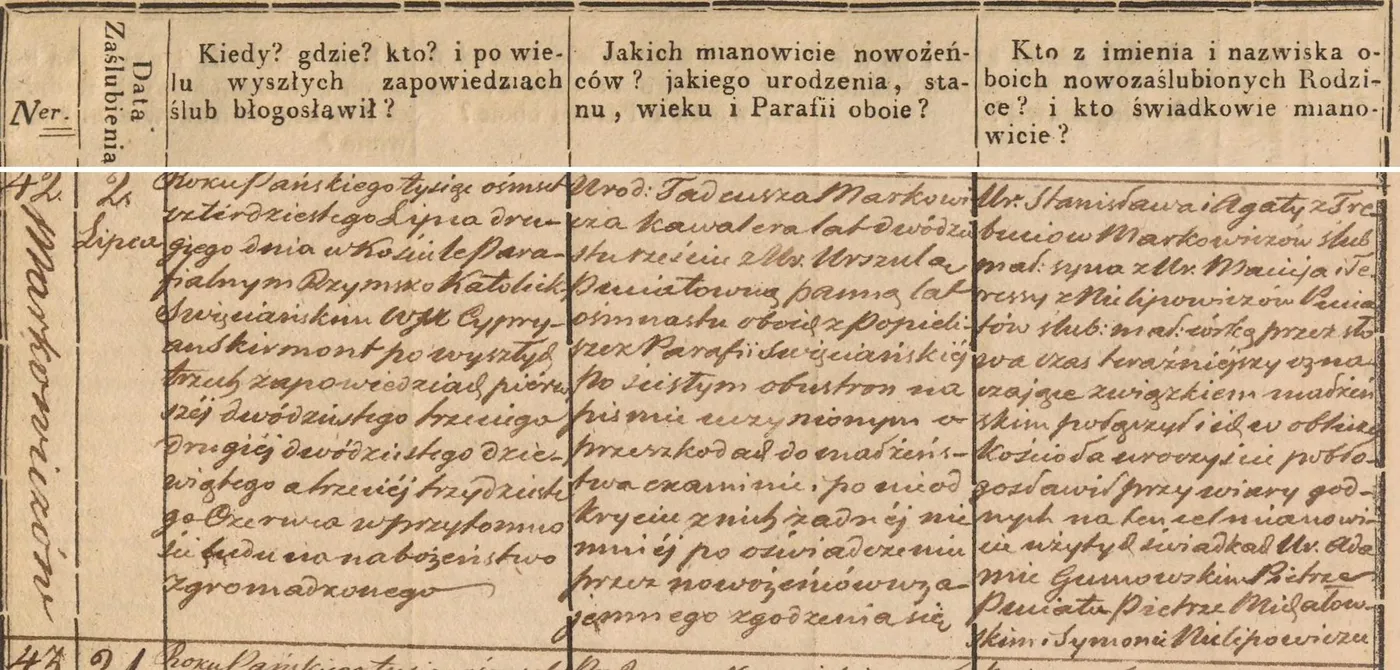
Original text (Polish): Roku Pańskiego tysiąc ośmset czterdziestego Lipca drugiego dnia w Kościele Parafialnym Rzymsko Katolickim Swiecianskim W. X. Cypryan Skirmont po wyszłych trzech zapowiedziach, pierwszej dwódziestego trzeciego, drugiej dwódziestego dziewiątego a trzeciej trzydziestego Czerwca […] Urod: Tadeusza Markowicza kawalera lat dwódziestu sześciu z Ur. Urszulą Puciatowną panną lat ośmnastu, obojż z Popieliszek Parafii Swiecianskiej […] Ur. Stanisława i Agaty z Trebuciow Markowiczow ślub: mał: syna z Ur. Macieja i Teressy z Neilipowiczow Puciatów ślub: mał: córką […] przy świadkach Ur. Adamie Gumowskim, Piotrze Puciacie, Piotrze Michałowskim i Symonie Nielipowiczu.
In English: In the Year of Our Lord 1840, on the 2nd day of July, in the Roman Catholic parish church of Święciany, the Reverend Father Cyprian Skirmont, after three banns (the first on 23 June, the second on 29 June, the third on 30 June), blessed the marriage of the well-born Tadeusz Markowicz, a bachelor aged twenty-six, with the well-born Urszula Puciata, a maiden aged eighteen, both of Popieliszki in the parish of Święciany. He is the son of the well-born Stanisław and Agata née Trabuć, the lawfully wedded Markowicz couple. She is the daughter of the well-born Maciej and Teresa née Nielipowicz, the lawfully wedded Puciata couple. The witnesses were the well-born Adam Gumowski, Piotr Puciata, Piotr Michałowski and Szymon Nielipowicz.
The word “well-born” (urodzony) in these records meant a nobleman. This was how the minor nobility were styled in church registers.
The young couple settled in Popieliszki with Urszula's parents. Marianna and Bolesław were born there. In Obkorty, a zaścianek right next door, the Markowicz family appear in 1862. Dominik later had land there too. Alina was born there in 1930.
| Child | Birth | Later life |
|---|---|---|
| Marianna | 11 November 1843, Popieliszki | baptised in Święciany |
| Bolesław | 27 April 1851, Popieliszki | Dominik's father |
| Salomea | 16 May 1854, Popieliszki | baptised in Święciany, her godmother was her aunt Bogumiła |
| Helena | 28 May 1856 | baptised in Święciany, her godmother was her aunt Bogumiła |
| Antoni | 14 March 1862, Obkorty | his godparents were the Billewicz family |
| Józef | c. May 1864 | died 23 November 1864 in Obkorty, aged six months |
The eldest daughter, Marianna, was baptised in Święciany by the priest Józef Rouba ten days after her birth. The record was still written in Polish.
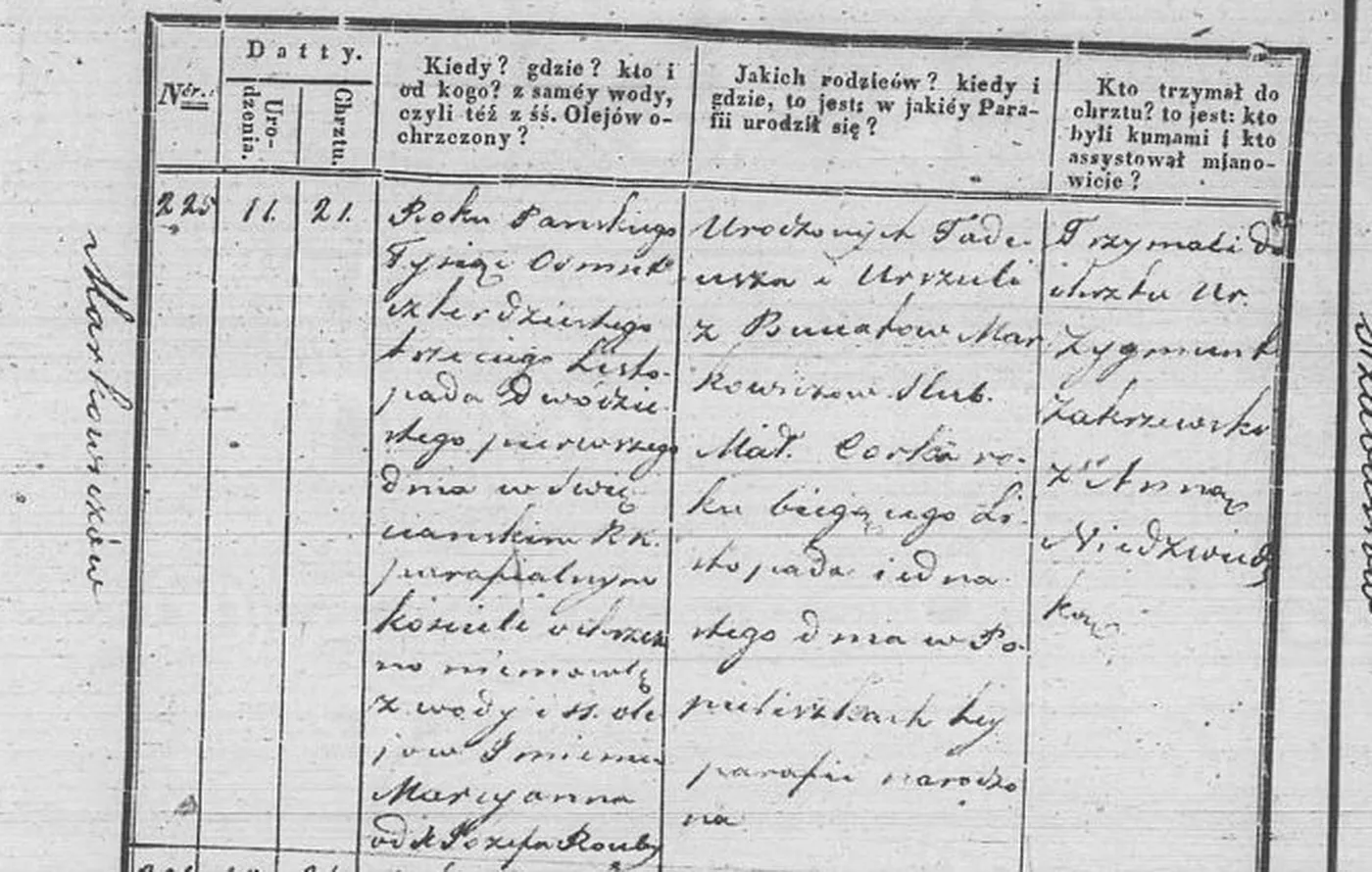
Original text (Polish): 225. Urodzenia 11. Chrztu 21. Roku Pańskiego Tysiąc Osmset czterdziestego trzeciego Listopada Dwudziestego pierwszego dnia w Swięciańskim R.K. parafialnym kościele ochrzczono niemowlę z wody i ss. Olejow Imieniem Maryanna od X. Józefa Rouby. Urodzonych Tadeusza i Urszuli z Puciatow Markowiczow Ślub. Mał. Córka roku bieżącego Listopada iednastego dnia w Popieliszkach tey parafii narodzona. Trzymali do chrztu Ur. Zygmunt Zakrzewski z Anną Niedzwiedzką
In English: Entry 225. Born on the 11th, baptised on the 21st. In the Year of Our Lord 1843, on the twenty-first day of November, in the Roman Catholic parish church of Święciany, the priest Józef Rouba baptised with water and the holy oils an infant named Marianna. Daughter of the well-born Tadeusz and Urszula née Puciata, the lawfully wedded Markowicz couple, born on the eleventh of November of this year in Popieliszki in this parish. Her godparents were the well-born Zygmunt Zakrzewski and Anna Niedźwiedzka.
Eleven years later the registers were already kept in Russian. At Salomea's baptism the godmother was Bogumiła, Tadeusz's sister. The priest wrote the name of the zaścianek in a shortened form.
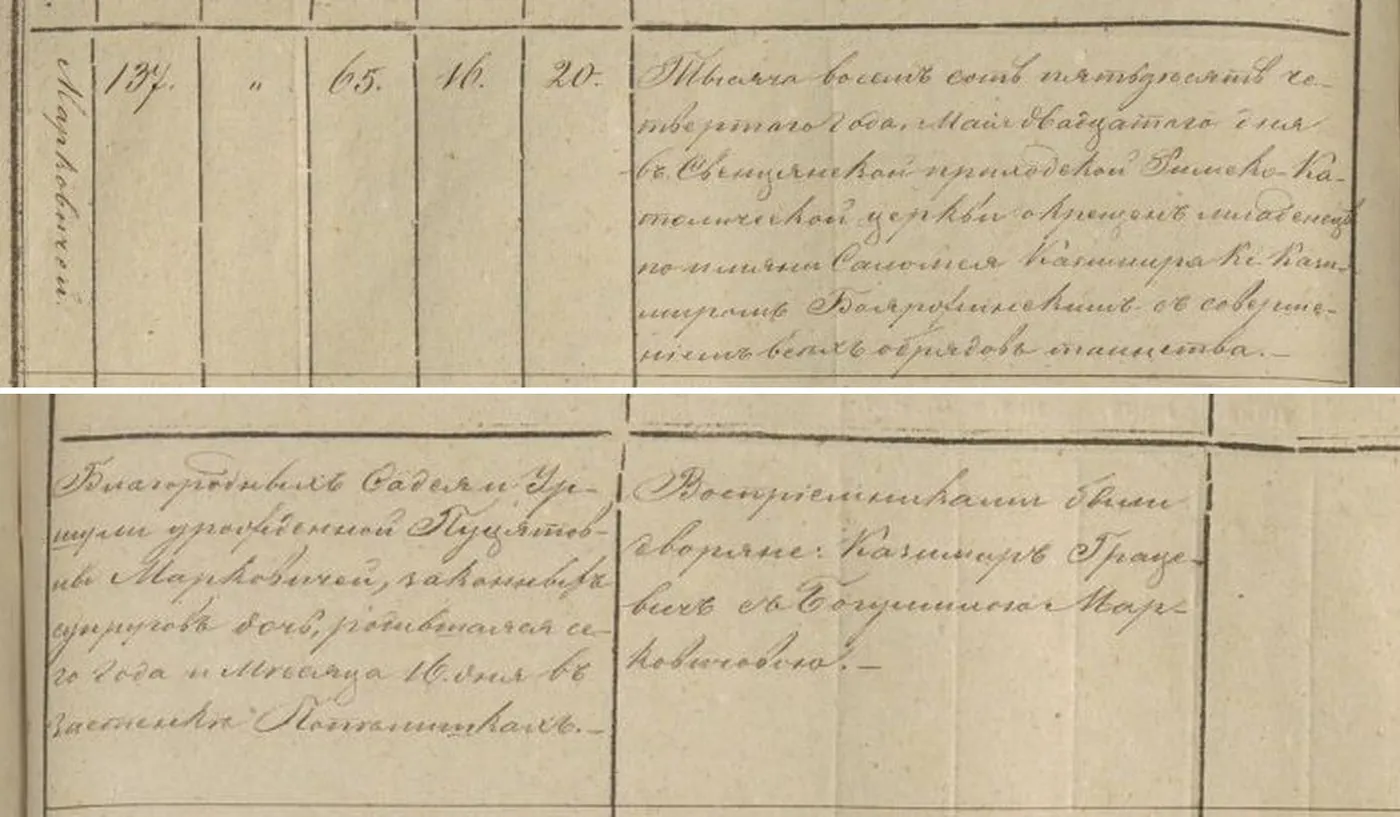
Original text (Russian): 137. 65. 16. 20. Тысяча восемь сотъ пятьдесятъ четвертаго года, Мая двадцатаго дня, въ Свенцянской приходской Римско-Католической церкви окрещенъ младенецъ по имяни Саломея Ксендзомъ Казимиромъ Богробинскимъ[?], съ совершениемъ всехъ обрядовъ таинства. Благородныхъ Ѳадея и Уршули урожденной Пуцятовъ Марковичей, законныхъ супруговъ дочь, родившаяся сего года и Мѣсяца 16 дня въ застѣнкѣ Попишкахъ. Воспріемниками были дворяне: Казимиръ Грацевичъ[?] съ Богумилою Марковичевою.
In English: Entry 137. Born on the 16th, baptised on the 20th. In the year one thousand eight hundred and fifty-four, on the twentieth day of May, in the Roman Catholic parish church of Święciany, the priest Kazimierz Bogrobiński (surname uncertain) baptised an infant named Salomea with the performance of all the rites of the sacrament. Daughter of the nobly born Tadeusz and Urszula née Puciata, the lawful Markowicz couple, born on the 16th day of the same month and year in the zaścianek of Popiszki, that is Popieliszki. The godparents were the nobleman Kazimierz Gracewicz (surname uncertain) and the noblewoman Bogumiła Markowicz.
The last son, Józef, died in Obkorty as a baby of six months. The priest gave an abscess as the cause of death.
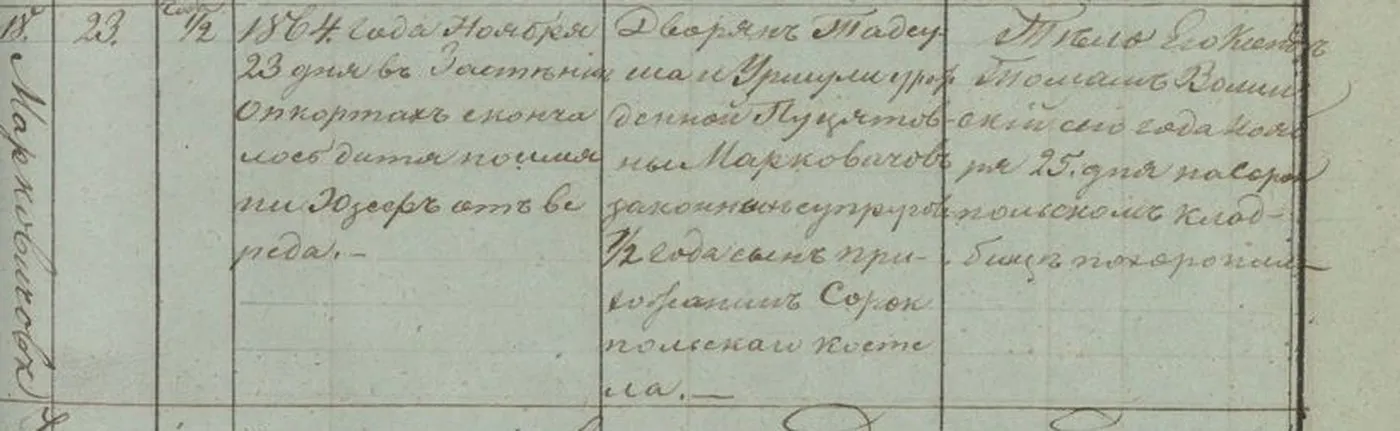
Original text (Russian): 18. 23. ½ года. 1864 года Ноября 23 дня въ Застѣнкѣ Опкортахъ скончалось дитя по имяни Юзефъ отъ вереда. Дворянъ Тадеуша и Уршули урожденной Пуцятовны Марковичовъ законныхъ супруговъ ½ года сынъ прихожанинъ Сорокпольскаго Костела. Тѣло Его Кс: Томашъ Волинскій сего года Ноября 25 дня на Сорокпольскомъ кладбищѣ похоронилъ.
In English: Entry 18. Died on the 23rd, aged six months. On the 23rd day of November 1864, in the zaścianek of Obkorty, a child named Józef died of an abscess. The six-month-old son of the nobles Tadeusz and Urszula née Puciata, the lawful Markowicz couple, a parishioner of the Sorokpol church. His body was buried on 25 November of this year in the Sorokpol cemetery by the priest Tomasz Woliński.
The Billewicz family at Antoni's baptism
On 14 March 1862 Antoni, Bolesław's younger brother, was born in Obkorty. Two days later he was baptised in Sorokpol by the priest Tomasz Woliński. The child was held at the font by Antoni Billewicz, a landowner of the Święciany district called president in the record, together with Miss Maria Billewicz. The godparents were most probably the owner of Zułów and her father. In April 1863 Maria Billewicz of Zułów married Józef Wincenty Piłsudski. In 1867 their son Józef was born, later the Marshal. The choice of such godparents shows that the Markowicz family lived close to the manor in Zułów. Zułów and the Piłsudski family are described in the chapter on the Witkiewicz and Misiun families.
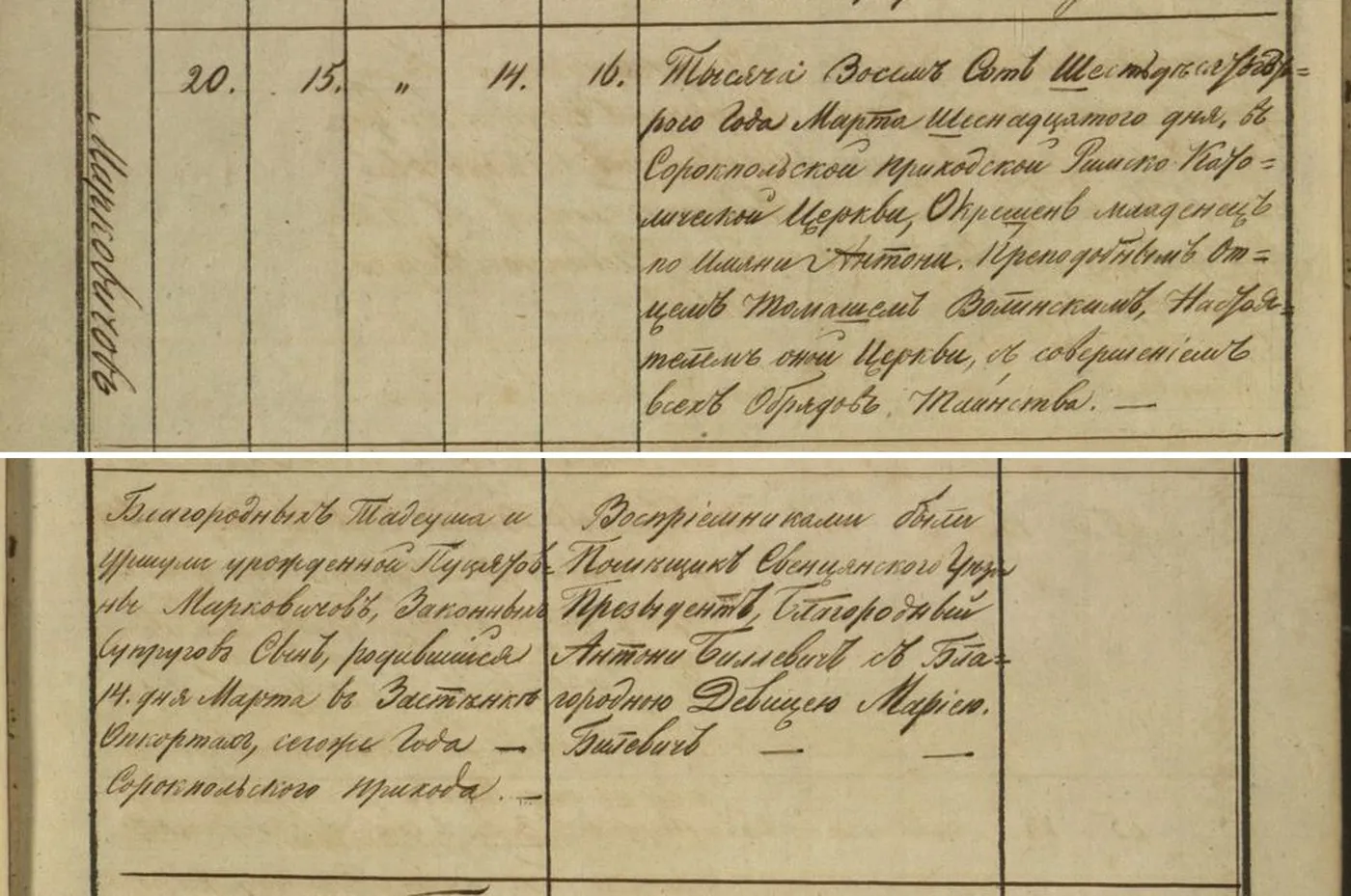
Original text (Russian): Тысяча Восемь Сотъ Шестьдесятъ Второго Года Марта Шеснадцатого дня, въ Сорокпольской Приходской Римско Католической Церкви, Окрещенъ младенецъ по имяни Антони. Преподобнымъ Отцемъ Томашемъ Волинскимъ, Настоятелемъ оной Церкви, съ совершеніемъ всѣхъ Обрядовъ Таинства. Благородныхъ Тадеуша и Урш[у]ли урожденной Пуцятовны Марковичовъ, Законныхъ Супруговъ Сынъ, родившійся 14. дня Марта въ Застѣнкѣ Опкортахъ, сегоже Года Сорокпольского прихода. Воспріемниками были Помѣщикъ Свенцянского Уѣзда Презыдентъ, Благородный Антонъ Биллевичъ съ Благородною Дѣвицею Маріею Билевичъ
In English: In the year one thousand eight hundred and sixty-two, on the sixteenth day of March, in the Roman Catholic parish church of Sorokpol, an infant named Antoni was baptised. He was baptised by the Reverend Father Tomasz Woliński, parish priest of this church, with the performance of all the rites of the sacrament. Son of the nobly born Tadeusz and Urszula née Puciata Markowicz, a lawful married couple, born on 14 March of this year in the zaścianek of Obkorty in the parish of Sorokpol. The godparents were a landowner of the Święciany district, the president, the nobly born Antoni Billewicz, with the nobly born Miss Maria Billewicz.
Playing with the young Piłsudski
The family is certain that one of our people played with little Józef Piłsudski as a child. The story was passed on to us by , Alina's daughter. The Markowicz and Walentynowicz families lived close to the manor at Zułów. Zofia Walentynowicz, Alina's grandmother, was born in that manor in 1863. In 1862 the Billewiczes were godparents of Antoni Markowicz. In 1865 the Marshal's father Józef Wincenty Piłsudski and his sister Julia held Józef, Zofia's brother, at the font. In 1877 Adam Piłsudski, the Marshal's younger brother, held Anna, Zofia's sister, at the font. Zofia was four years older than Józef Piłsudski and Antoni five years older. The story fits these two best. These were ties between neighbours, though. Our families were not related to the family of the manor. The whole story, the history of the manor and the Marshal's baptism record are given in the chapter on the Witkiewicz and Misiun families.
Wife: Urszula née Puciata (b. 1822)
Urszula was born on 1 November 1822 in the village of Nareysze in the parish of Konstantynów. Her parents were Maciej Puciata and Teresa née Nielipowicz. Both died in Popieliszki: Teresa in 1856 and Maciej in 1862. A separate chapter of the chronicle tells of the Puciata, Nielipowicz and Kisiel families. There we also show the entry of Urszula's baptism.
Stanisław Markowicz (d. 1827) and Agata née Trabuć (d. 1830)
| Who they were | Tadeusz's parents |
| Stanisław's parents | Bartłomiej Markowicz and Anna née Baniewicz, the village of Niemenczynka in the parish of Podbrzezie |
| Stanisław | baptised 8 May 1779 in the parish of Podbrzezie, died 26 February 1827 in Mirańce, buried 28 February in Sorokpol |
| Stanisław's siblings | Ignacy Wincenty (1783), Jerzy Wojciech (1785), Rachela Antonina (1787) |
| Agata | born c. 1781, died 5 May 1830 in Lipowo, buried 7 May in Korkożyszki |
| Marriage | 1807, parish of Święciany |
| Title | in records of 1812 and 1813 Stanisław is recorded as rotmistrz (cavalry captain) of the Wiłkomierz district |
| Children | Józef (1807), Justyn Mateusz (1810), Tadeusz (1814), twins Felicjan and Bogumiła (1816) |
| Agata's parents | Antoni Trabuć and Marianna née Dauksza |

Original text (Latin): Auksztajny. 7. Idem B[e]n[e]d[ix]i matrimonium rite contractum inter Nobiles G:D: Stanislaum Markowicz et G:D: Agatham Trebuciowna Virginem. Testes fuere G:D: Dominicus Lazowski, G:D: Georgius Balewicz, G:D: Augustinus Abramowicz.
In English: Auksztajny. Entry 7. I, the same priest, blessed the marriage duly contracted between nobles: the well-born Stanisław Markowicz and the well-born Miss Agata Trabuć. The witnesses were the well-born Dominik Łazowski, Jerzy Balewicz and Augustyn Abramowicz.
The abbreviation “G:D:” is the Latin “Generosus Dominus”. In Polish at that time the word was “urodzony” (well-born). It was the title of a nobleman. The record does not give the day of the wedding. The neighbouring entries show that it was May or June 1807.
After the wedding Stanisław and Agata lived in the village of Andrulańce in the parish of Janiszki, in the Vilnius district. Their sons Justyn Mateusz and Tadeusz were born there. Most probably the eldest, Józef, was born there too. At Józef's baptism the priest recorded the father as Stanisław Barkowski. By 1816 the family was already living in Mirańce, which the priest also called Podmirańce. In November of that year twins were born there.

Original text (Polish): wieś Andrulańce / 23. 24. / Justyn Mateusz / Stanisław Markowicz, Agata Trabuciowna Stanu Szlachec[kiego] / X Felicyan Piotrowski Admini[strator] / Wincenty Trabuć, Anna Markowiczówna
In English: Place of birth: the village of Andrulańce. Born 23 October, baptised 24 October. Names of the child: Justyn Mateusz. Parents: Stanisław Markowicz and Agata née Trabuć, of the noble estate. Baptised by the priest Felicjan Piotrowski, administrator of the parish. Godparents: Wincenty Trabuć and Anna Markowicz.
There is no month name in this line of the register, because the clerk wrote it only once, in an earlier entry. The godfather Wincenty Trabuć was Agata's brother.
Rotmistrz of the Wiłkomierz district
Justyn Mateusz lived for less than two years. He died on 29 September 1812 in Andrulańce and was buried the next day in the cemetery in Janiszki. Next to his name the priest added his father's title: rotmistrz of the Wiłkomierz district.
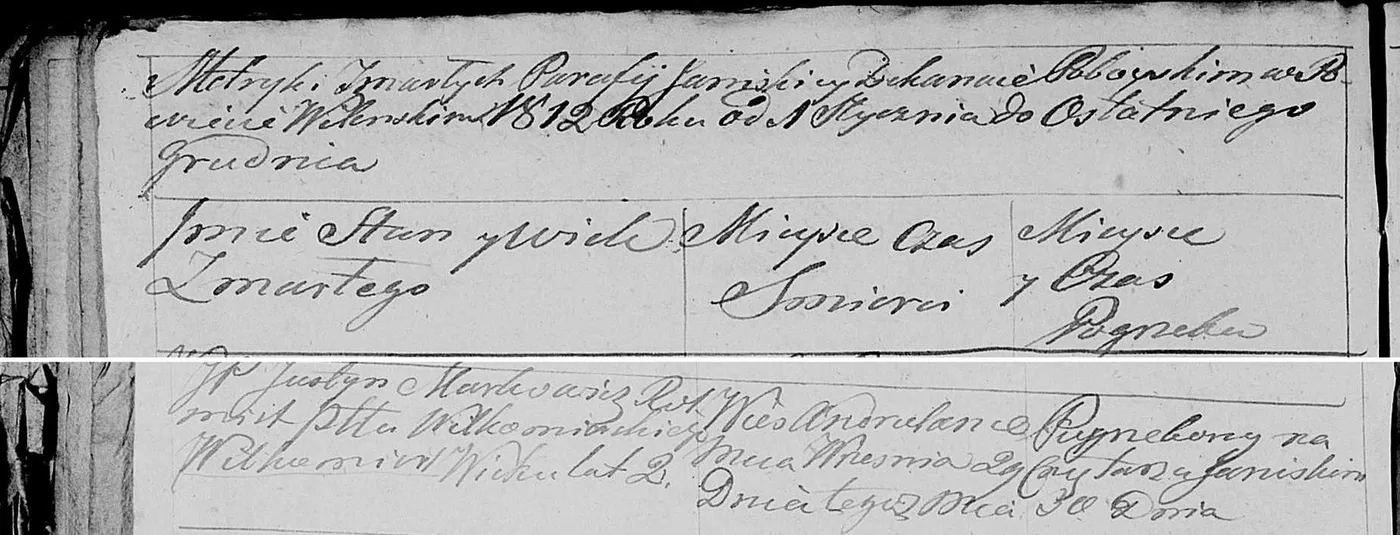
Original text (Polish): Metryki Zmarłych Parafij Janiskiey Dekanacie Pobojskim w Powiecie Wilenskim 1812 Roku od 1 Stycznia do Ostatniego Grudnia. Imie Stan y Wiek Zmarłego. Mieysce Czas Smierci. Mieysce y Czas Pogrzebu. […] JP Justyn Markowicz Rotmist[rza] P[owia]tu Wiłkomirskieg[o] […] Wieku lat 2. Wieś Andrulance M[iesią]ca Wrzesnia 29 Dnia. Pogrzebiony na Cmętarzu Janiskim tegoż M[iesią]ca 30 Dnia.
In English: Death records of the parish of Janiszki in the deanery of Pobojsk, in the Vilnius district, for the year 1812, from 1 January to the end of December. Columns: name, estate and age of the deceased, place and time of death, place and time of burial. Justyn's line: the Honourable Master Justyn Markowicz, son of the rotmistrz of the Wiłkomierz district, aged 2. Died in the village of Andrulańce on 29 September. Buried in the Janiszki cemetery on the 30th of this month. One word added under the title is illegible.
The same title appears in the marriage register of the parish of Janiszki. When neighbours married in Andrulańce on 16 November 1813, one of the witnesses was “JPan Stanisław Markowicz Rottm: Pttu: Wiłkomir:”, that is, Mr Stanisław Markowicz, rotmistrz of the Wiłkomierz district.
What was a district rotmistrz? In the old Grand Duchy of Lithuania, in time of war a rotmistrz led a company of the nobility of his district, called up in the general levy. A district had several rotmistrzes at once. When in 1764 the nobility of the Wiłkomierz district signed the election of King Stanisław August, nine of the roughly ninety signatories were rotmistrzes. By the end of the 18th century the general levy was no longer called, but the title remained as an honorary dignity. The nobility in Lithuania went on bearing such titles long after the partitions.
The title set a nobleman apart from his neighbours. In the register of the parish of Janiszki for 1798 to 1818, which records more than two and a half thousand baptisms, marriages and burials, only three people are called district rotmistrz. One of them was Stanisław Markowicz. The rest of the nobility of this parish had no title at all. In the neighbouring Zawilejski district, a list of the nobility from December 1811 names about twenty rotmistrzes. Most of them had their own manor farm. A few served wealthier neighbours as stewards. So the title brought neither troops nor pay, but it was held by men who counted for something in the district.
It is not known when Stanisław received this title, nor why it concerned the Wiłkomierz district and not the Vilnius district where he lived. Andrulańce, however, lay right on the border of the two districts. The Markowicz family do not appear in the lists of the nobility of the Wiłkomierz district for 1816 to 1819 or in that district's book of proofs of nobility.
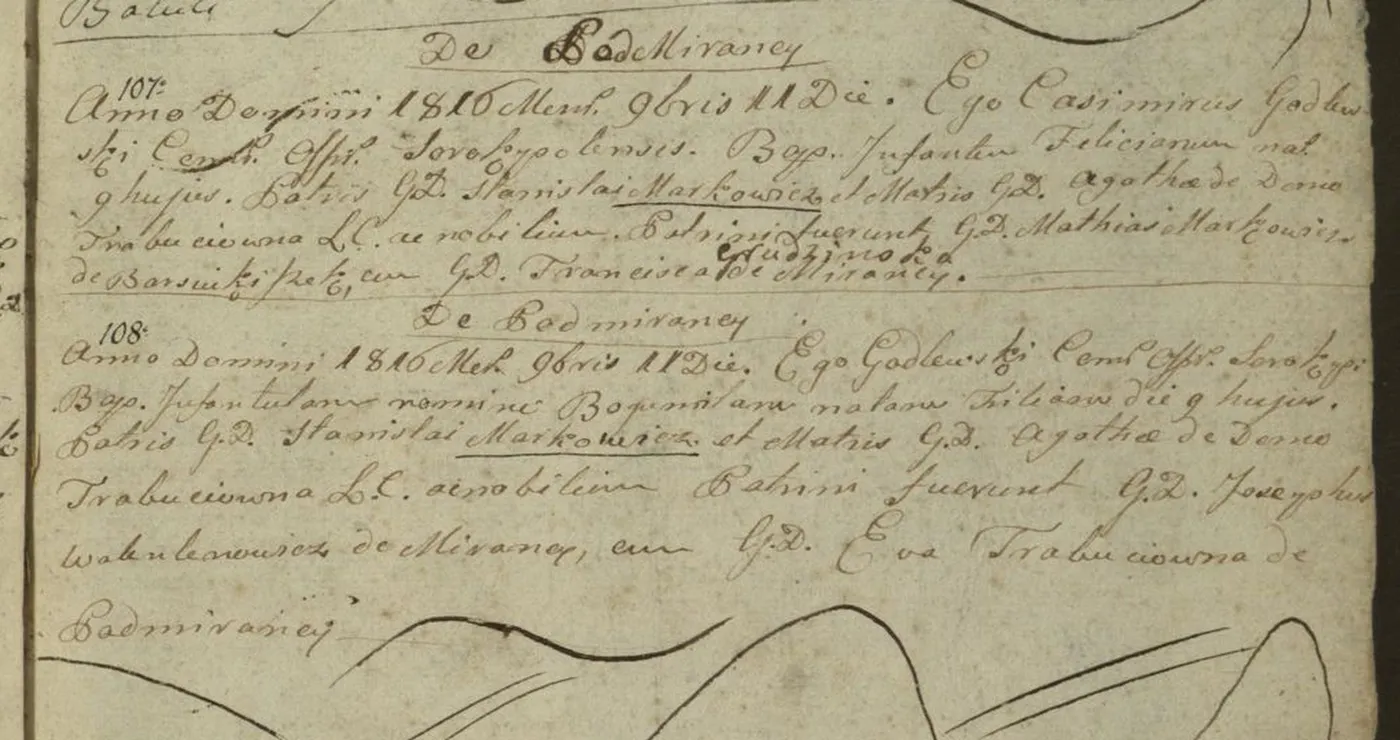
Original text (Latin): De Podmirancy. 107. Anno Domini 1816 Mens. 9bris 11 Die. Ego Casimirus Godlewski Comm. Offr. Sorokpolensis. Bap[tisa]vi Infantem Felicianum nat[um] die 9 hujus. Patris G.D. Stanislai Markowicz et Matris G.D. Agathae de Domo Trabuciowna L.C. ae nobilium. Patrini fuerunt G.D. Mathias Markowicz de Barsuikiszek, cum G.D. Francisca Rudzinska[?] de Mirancy. De Podmirancy. 108. Anno Domini 1816 Mens. 9bris 11 Die. Ego Godlewski Comm. Offr. Sorokp. Bap[tisa]vi Infantulam nomine Bogumiłam natam Filiam die 9 hujus. Patris G.D. Stanislai Markowicz et Matris G.D. Agathae de Domo Trabuciowna L.C. ae nobilium. Patrini fuerunt G.D. Josephus Walentenowicz de Mirancy, cum G.D. Eva Trabuciowna de Podmirancy.
In English: From Podmirańce. Entry 107. In the Year of Our Lord 1816, on the 11th day of November. I, Kazimierz Godlewski, commendary of Sorokpol, baptised an infant named Felicjan, born on the 9th day of this month, son of the well-born Stanisław Markowicz and the well-born Agata née Trabuć, a lawful married couple, nobles. The godparents were the well-born Maciej Markowicz of Barsukiszki and the well-born Franciszka Rudzińska (surname uncertain) of Mirańce. From Podmirańce. Entry 108. In the Year of Our Lord 1816, on the 11th day of November. I, Godlewski, commendary of Sorokpol, baptised an infant named Bogumiła, a daughter born on the 9th day of this month, whose father is the well-born Stanisław Markowicz and mother the well-born Agata née Trabuć, a lawful married couple, nobles. The godparents were the well-born Józef Walentynowicz of Mirańce and the well-born Ewa Trabuć of Podmirańce.
A commendary was a priest who ran a parish in place of the parish priest. Bogumiła's godmother was Ewa Trabuć, Agata's younger sister. The godfather was Józef Walentynowicz of Mirańce. Sixty-eight years later Stanisław's grandson Bolesław married Zofia Walentynowicz.
| Child | Birth | Later life |
|---|---|---|
| Józef | most probably 3 December 1807, Andrulańce | no longer alive in 1830 |
| Justyn Mateusz | 23 October 1810, Andrulańce | his godfather was his uncle Wincenty Trabuć. Justyn died on 29 September 1812 in Andrulańce, aged 2 |
| Tadeusz | 15 March 1814, Andrulańce | Bolesław's father |
| Felicjan | 9 November 1816, Mirańce | died 31 March 1828 in Lipowo of smallpox, aged 11 |
| Bogumiła | 9 November 1816, Mirańce | never married, was godmother to two of her nieces. Died 26 December 1860 in Popieliszki, aged 44 |
Stanisław died on 26 February 1827 in Mirańce. Two days later he was buried in Sorokpol. The priest recorded his age as 55, but according to the baptism record of 1779 Stanisław was 47. In those days the age of the deceased was estimated by eye.
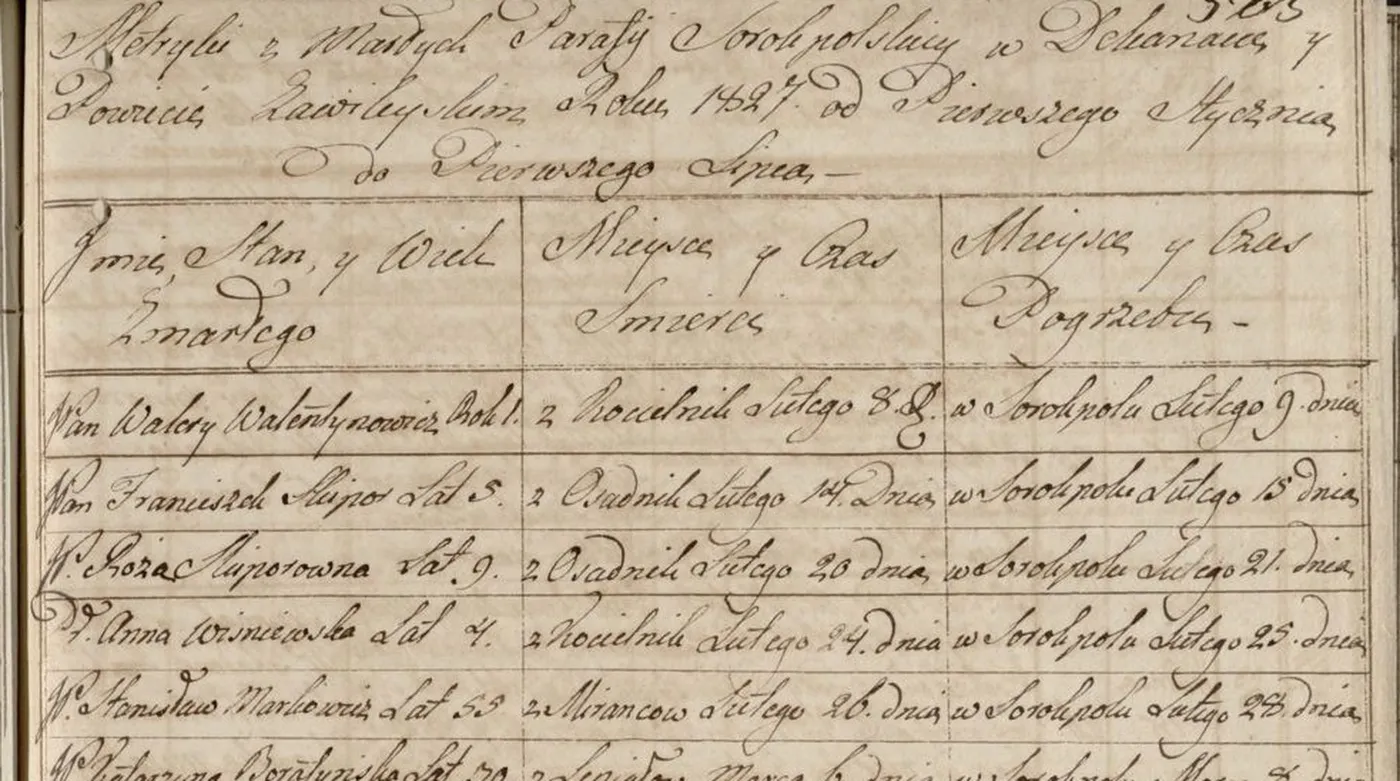
Original text (Polish): Metryki z Martwych Parafij Sorokpolskiey w Dekanacie y Powiecie Zawileyskim w Roku 1827. od Pierwszego Stycznia do Pierwszego Lipca. Imie, Stan, y Wiek Zmarłego. Mieysce y Czas Smierci. Mieysce y Czas Pogrzebu. […] JP. Stanisław Markowicz Lat 55. z Mirancow Lutego 26. dnia. w Sorokpolu Lutego 28. dnia
In English: Death records of the parish of Sorokpol in the deanery and district of Zawilejski in the year 1827, from 1 January to 1 July. Columns: name, estate and age of the deceased, place and time of death, place and time of burial. Line five: the Honourable Master Stanisław Markowicz, aged 55, of Mirańce, died 26 February, buried in Sorokpol on 28 February.
In almost all records from 1807 to 1830 Stanisław and his family are recorded as nobility. The exception is Felicjan's death record of 1828 from the parish of Korkożyszki, in which the family is recorded as free people. Two years later the same church again recorded Agata as “well-born”.
We know Stanisław's parents from the registers of the parish of Podbrzezie. We know his grandfather and great-grandfather from a decree of nobility of 1819. They are described in the following parts of the chapter.
The widow returns to the Trabuć country
After her husband's death Agata moved with the children to the zaścianek of Lipowo in the parish of Korkożyszki. Her sister Ewa lived there. Within three years, one after another, there died in Lipowo: Ewa (4 September 1827, of fever), eleven-year-old Felicjan (31 March 1828, of smallpox) and finally Agata herself (5 May 1830, of fever).
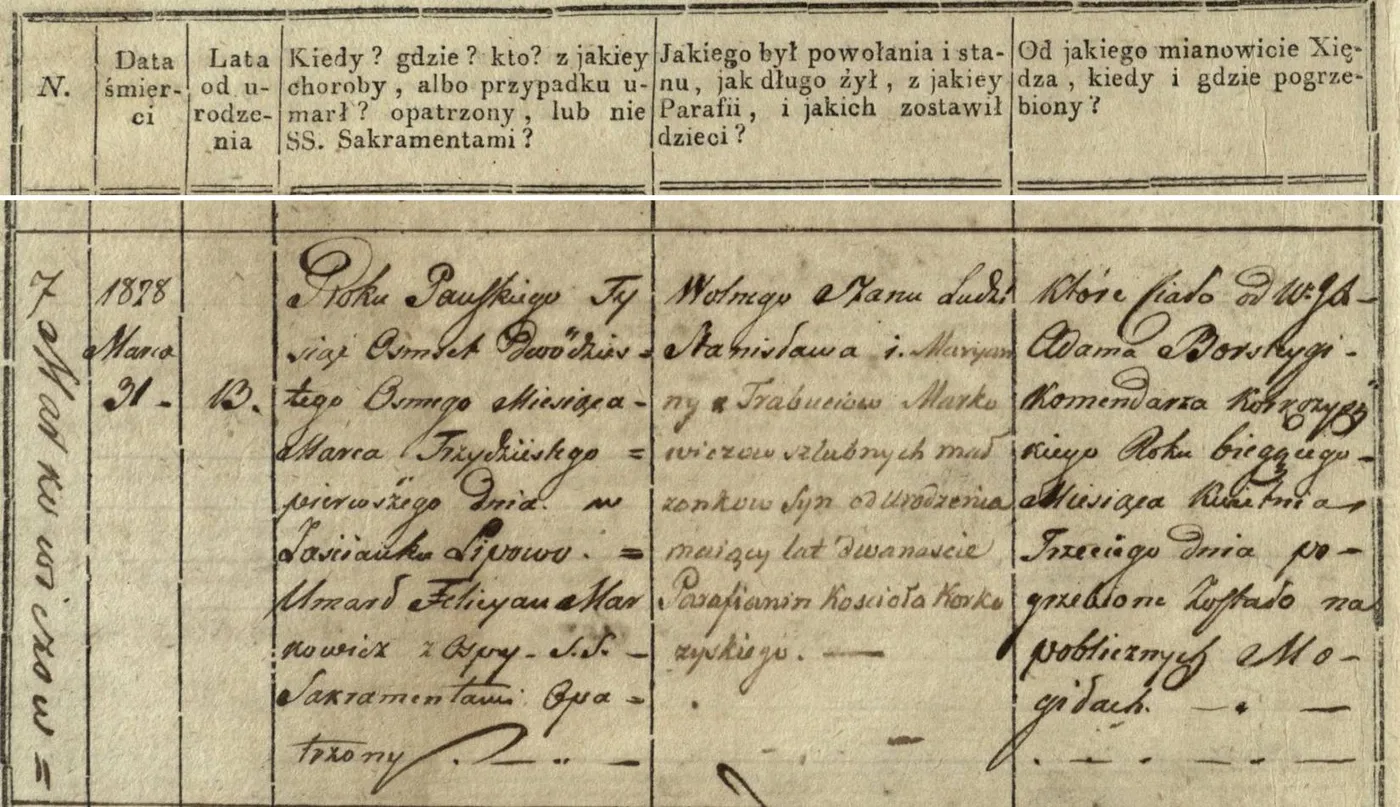
Original text (Polish): 7. 1828 Marca 31. 13. Roku Pańskiego Tysiąc Osmset Dwódziestego Osmego Miesiąca Marca Trzydziestego pierwszego dnia w Zaścianku Lipowo Umarł Felicyan Markowicz z Ospy. SS. Sakramentami Opatrzony. Wolnego Stanu Ludzi Stanisława i Maryanny z Trabuciow Markowiczow szlubnych małzonkow Syn od Urodzenia maiący lat dwanaście Parafianin Kościoła Korkożyskiego. Które Ciało od WJX. Adama Borsteygi[?] Komendarza Korkożyskiego Roku biegącego Miesiąca Kwietnia Trzeciego dnia pogrzebione zostało na pobliznych Mogiłach
In English: Entry 7. Died 31 March 1828, aged 13. In the Year of Our Lord 1828, on the thirty-first day of March, in the zaścianek of Lipowo, Felicjan Markowicz died of smallpox, fortified with the holy sacraments. Son of people of free estate, Stanisław and Marianna née Trabuć, the lawfully wedded Markowicz couple, aged twelve, a parishioner of the Korkożyszki church. His body was buried on the third of April of this year in the nearby cemetery by the priest Adam Borsteyga (surname uncertain), commendary of Korkożyszki.
In this record the priest wrote the mother's name as Marianna, not Agata. In the age column he entered 13 years. In the text he wrote twelve. Felicjan was born in November 1816, so he was eleven years and not quite five months old.
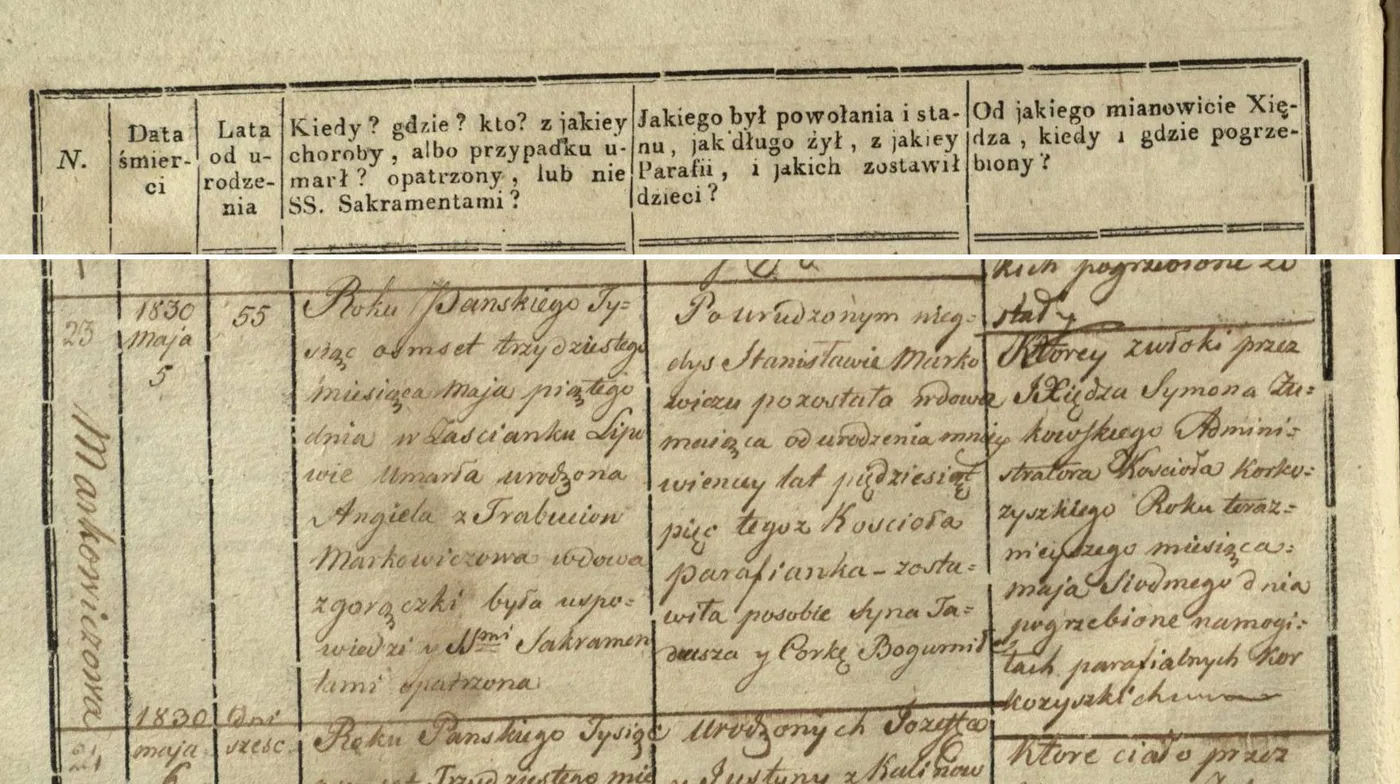
Original text (Polish): 23. 1830 maja 5. 55. Roku Pańskiego Tysiąc osmset trzydziestego miesiąca maja piątego dnia w Zaścianku Lipowie Umarła urodzona Angiela z Trabuciow Markowiczowa wdowa z gorączki była u spowiedzi y SSmi Sakramentami opatrzona. Po urodzonym niegdys Stanisławie Markowiczu pozostała wdowa maiąca od urodzenia mniey wiencey lat pięćdziesiąt pięc tegoz Kościoła parafianka, zostawiła po sobie Syna Tadeusza y Corkę Bogumiłę. Ktorey zwłoki przez JXiędza Symona Żukowskiego Administratora Kościoła Korkożyszkiego Roku teraznieyszego miesiąca maja Siodmego dnia pogrzebione na mogiłach parafialnych Korkożyszkich
In English: Entry 23. Died 5 May 1830, aged 55. In the Year of Our Lord 1830, on the fifth day of May, in the zaścianek of Lipowo, the well-born Angiela (that is, Agata) Markowicz née Trabuć, a widow, died of fever. She had been to confession and was fortified with the holy sacraments. Widow of the late well-born Stanisław Markowicz, aged about fifty-five, a parishioner of this church. She left a son Tadeusz and a daughter Bogumiła. Her body was buried on 7 May of this year in the parish cemetery in Korkożyszki by the priest Szymon Żukowski, administrator of the Korkożyszki church.
The priest wrote the dead woman's name as “Angiela”. Her husband, her maiden name and her two living children show that this is Agata. The 1795 revision list gives her age as 14, so in 1830 she was about 49. The death record gives about 55, because the priest wrote the age only roughly.
Of the five children of Stanisław and Agata, only Tadeusz and Bogumiła outlived their mother. Bogumiła never married. She died on 26 December 1860 in Popieliszki, where the family of her brother Tadeusz lived. She was buried in Sorokpol.
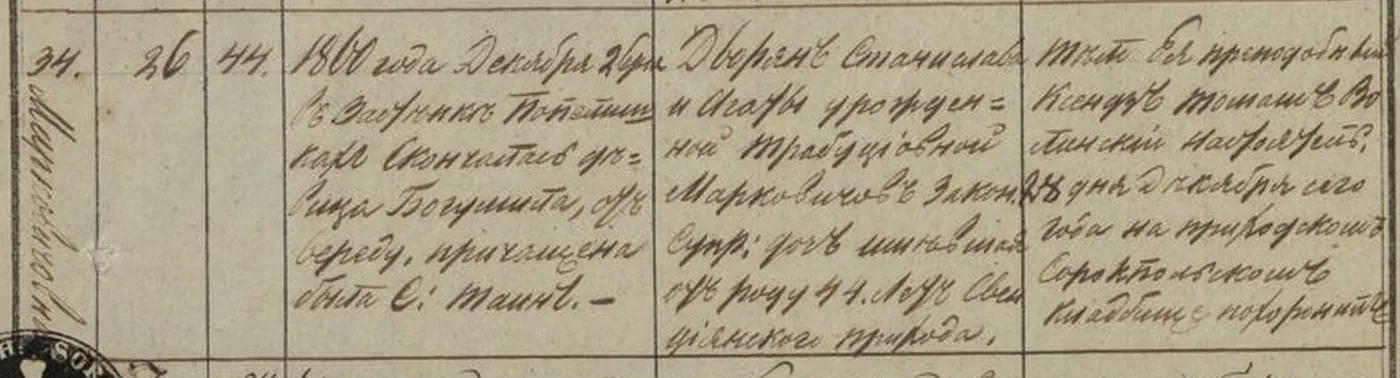
Original text (Russian): 34. 26. 44. 1860 года Декабря 26 дня въ Застѣнкѣ Попелишкахъ скончалась дѣвица Богумила отъ вереду, причащена была С: Таинъ. Дворянъ Станислава и Агаты урожденной Трабуціовной Марковичовъ Закон: Супр: дочь, имѣвшая отъ роду 44 лѣтъ, Свенціянскаго прихода. Тѣло Ея преподобный Ксендзъ Томашъ Волинскій Настоятель 28 дня Декабря сего года на приходскомъ Сорокпольскомъ Кладбище похоронивъ.
In English: Entry 34. Died on the 26th, aged 44. On the 26th day of December 1860, in the zaścianek of Popieliszki, the maiden Bogumiła died of an abscess, having received the holy sacraments. She was the daughter of the noble Stanisław and Agata née Trabuć, lawful spouses Markowicz, aged 44, of the Święciany parish. Her body was buried on the 28th of December of that year in the Sorokpol parish cemetery by the Reverend Tomasz Woliński, parish priest.
This record, written thirty years after her mother's death, gives the mother's name just as the baptism records do: Agata née Trabuć.
How Stanisław lived
Stanisław was baptised in the parish of Podbrzezie, north of Vilnius. His parents still lived there in 1787, when he was eight. In 1807 he married in the Święciany parish. He often moved: first to Andrulańce, then to Mirańce. After his death the family moved to Lipowo. This was how leaseholders lived, that is people who farmed land rented from its owner. Other members of the Markowicz family appear around him. Ignacy was Tadeusz's godfather. Maciej of Barsukiszki was Felicjan's godfather. We write about the Markowicz coat of arms below.
The decree of the Markowicz family of the Bończa coat of arms, 1819
After the partitions, the Russian authorities ordered the Polish nobility to prove their descent. A family appeared before the nobility office of its governorate, in our case in Vilnius. There it showed its documents: parish records, deeds of sale and pledge of land, certificates from offices. From these the office drew up a pedigree and issued a ruling, called a decree or a proof of nobility. The Markowicz family of the Bończa coat of arms received two such decrees.
The first decree is dated 16 June 1806. It concerned only two brothers, Andrzej and Onufry, who held land on lease in the Giedrojcie parish from a priest, a canon of Smolensk. Relatives from other branches of the family were not named at that time. The second decree explains why: they were left out because at the time of the first proof of nobility they had no contact with Andrzej and Onufry. Andrzej himself put this right. On 26 October 1811 he issued a family document for his relatives, in which he acknowledged them as members of the same family and described who descended from whom. Five days later the document was entered in the books of the castle court in Vilnius.
On 16 December 1819 the nobility office in Vilnius recognised as nobles the relatives who proved their descent on the basis of this document. The decree lists each of them by name and says who his father was. In doing so it refers to the baptism records. Among those recognised are Stanisław with his sons and his brother Ignacy. The copy of the decree we use was issued to the family on 11 November 1821.
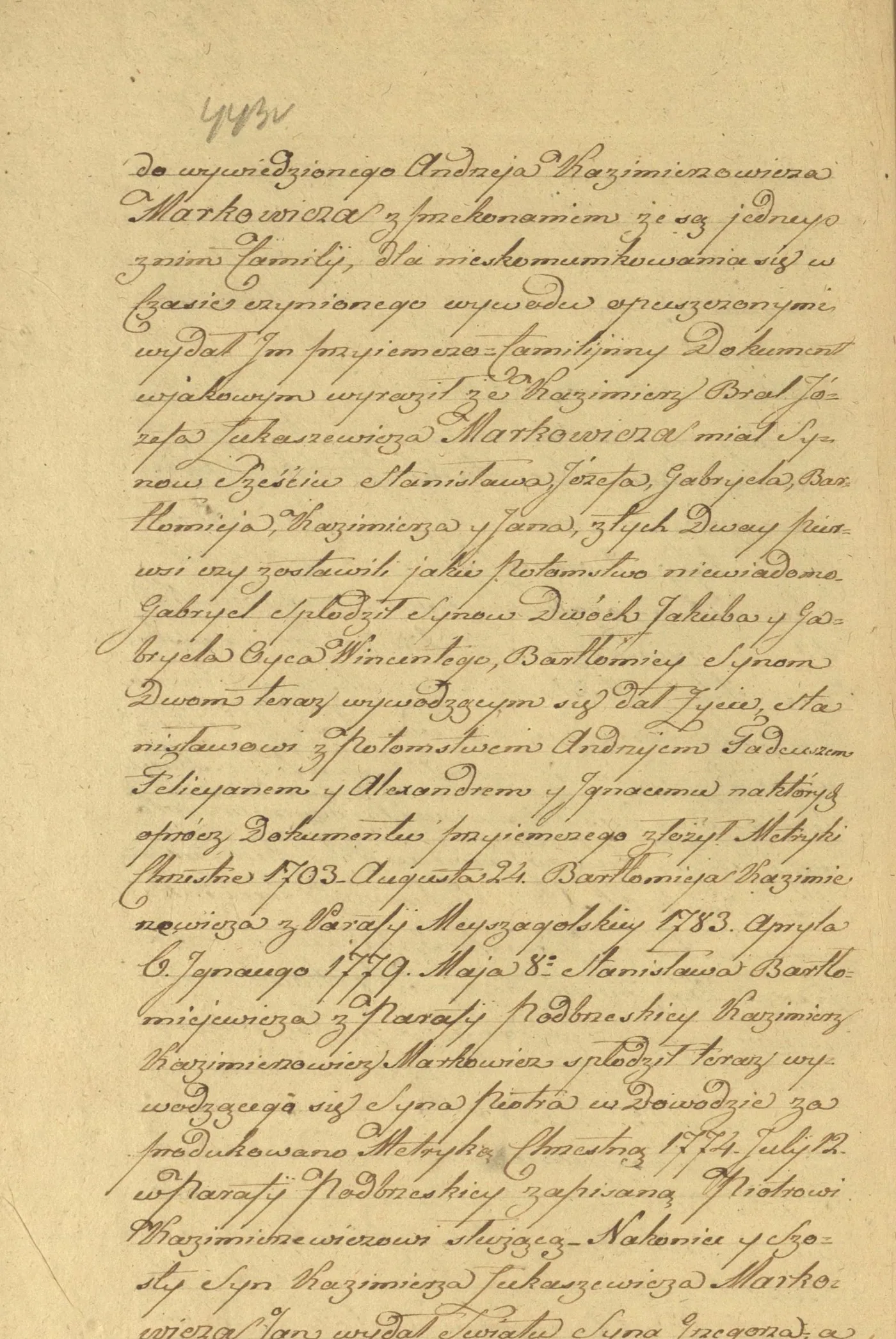
Original text (Polish): Kazimierz Brat Jozefa Łukaszewicza Markowicza miał Synow Sześciu Stanisława, Jozefa, Gabryela, Bartłomieja, Kazimierza y Jana […] Bartłomiey Synom Dwom teraz wywodzącym się dał Zycie, Stanisławowi z Potomstwem Andrzejem Tadeuszem Felicyanem y Alexandrem y Jgnacemu na ktorych oprocz Dokumentu przyiemczego złozył Metryki Chrzestne 1703 Augusta 24. Bartłomieja Kazimierzewicza z Parafij Meyszagolskiey 1783. Apryla 6. Jgnacego 1779. Maja 8. Stanisława Bartłomiejewicza z Parafij Podbrzeskiey
In English: Kazimierz, brother of Józef Markowicz, son of Łukasz, had six sons: Stanisław, Józef, Gabriel, Bartłomiej, Kazimierz and Jan. Bartłomiej had two sons who are now proving their nobility: Stanisław with his offspring, namely with Andrzej, Tadeusz, Felicjan and Aleksander. The second son was Ignacy. Besides the family document, baptism records were submitted for them: of Bartłomiej son of Kazimierz of 24 August 1703 from the Mejszagoła parish, of Ignacy of 6 April 1783 and of Stanisław son of Bartłomiej of 8 May 1779 from the Podbrzezie parish.
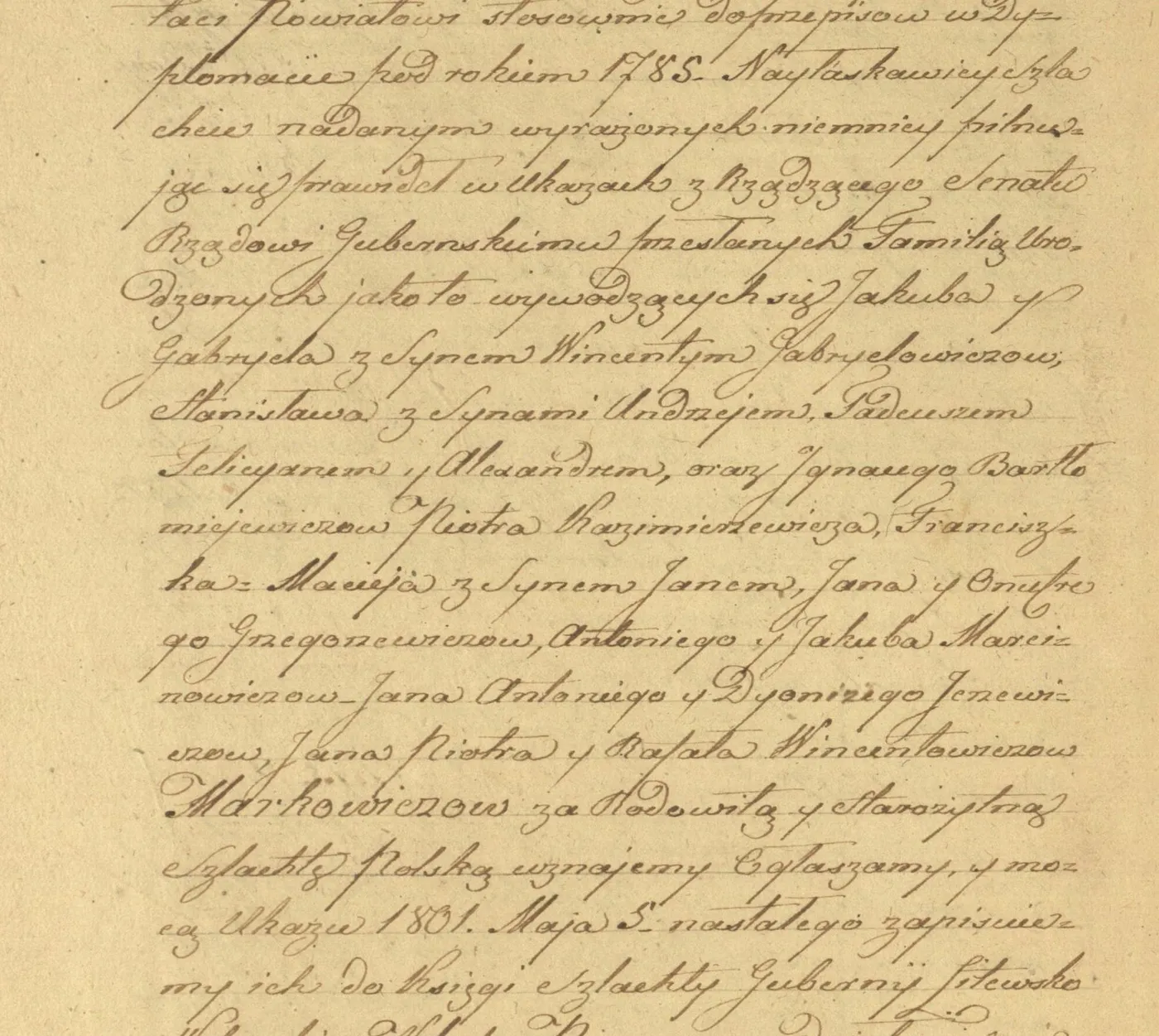
Original text (Polish): Familią Urodzonych jakoto wywodzących się Jakuba y Gabryela z Synem Wincentym Gabryelowiczow, Stanisława z Synami Andrzejem, Tadeuszem Felicyanem y Alexandrem oraz Jgnacego Bartłomiejewiczow Piotra Kazimierzewicza, Franciszka-Macieja z Synem Janem, Jana y Onufrego Grzegorzewiczow, Antoniego y Jakuba Marcinowiczow. Jana Antoniego y Dyonizego Jerzewiczow, Jana Piotra y Rafała Wincentewiczow Markowiczow za Rodowitą y Starozytną Szlachtę Polską uznajemy Ogłaszamy
In English: We recognise and declare as native and ancient Polish nobility the family of the well-born Markowicz, who are proving their nobility. They are: Jakub and Gabriel with his son Wincenty, sons of Gabriel. Stanisław with his sons Andrzej, Tadeusz, Felicjan and Aleksander together with Ignacy, sons of Bartłomiej. Piotr son of Kazimierz. Franciszek Maciej with his son Jan, Jan and Onufry, sons of Grzegorz. Antoni and Jakub, sons of Marcin. Jan, Antoni and Dionizy, sons of Jerzy. Jan, Piotr and Rafał, sons of Wincenty.
Tadeusz and Felicjan in the decree are the sons of Stanisław and Agata, born in 1814 and 1816. Andrzej and Aleksander are known only from the decree. Ignacy, Stanisław's brother, was Tadeusz's godfather in 1814. The decree also contains names of relatives that the Sorokpol parish registers record in the same years: Maciej, Franciszek, Jan, Rafał and Antoni. Maciej Markowicz of Barsukiszki was Felicjan's godfather in 1816. Grzegorz, father of Franciszek Maciej and Jan in the decree, was Stanisław's first cousin on his father's side, that is the son of his uncle Jan.
All those recognised were entered in the first part of the nobility register of the Vilnius governorate.
The whole family in the decree
The decree describes the descendants of three sons of Łukasz: Kazimierz, Józef and Marcin. Our family descends from Kazimierz. The dates in the table are the baptism dates given in the decree.
| Branch | Who belonged to it according to the decree |
|---|---|
| Kazimierz, son of Łukasz | Six sons: Stanisław, Józef, Gabriel, Bartłomiej, Kazimierz and Jan. The decree says nothing about the children of Stanisław and Józef |
| Gabriel, son of Kazimierz | Sons Jakub and Gabriel. The younger Gabriel had a son Wincenty |
| Bartłomiej, son of Kazimierz | Baptised 24 August 1703 in the parish of Mejszagoła. Sons: Stanisław (8 May 1779) with his sons Andrzej, Tadeusz, Felicjan and Aleksander. Also Ignacy (6 April 1783), both baptised in the parish of Podbrzezie |
| Kazimierz, son of Kazimierz | Son Piotr, baptised 12 July 1774 in the parish of Podbrzezie |
| Jan, son of Kazimierz | Son Grzegorz, baptised 29 May 1760 in the parish of Szeszole. Grzegorz's sons: Franciszek Maciej (22 February 1787) with his son Jan, Jan (19 June 1791) and Onufry (14 October 1806), baptised in the parish of Podbrzezie |
| Józef, son of Łukasz | Józef had a son Kazimierz. This Kazimierz's sons, Andrzej and Onufry, received a decree in 1806 |
| Marcin, son of Łukasz | Sons Marcin, Wincenty (6 January 1760) and Stanisław (20 April 1762). The younger Marcin had sons Jerzy (10 May 1776), Antoni (2 June 1779) and Jakub (6 August 1782). Jerzy had sons Jan (1798), Antoni (1800) and Dionizy (1802). Wincenty had sons Jan (1789), Piotr (1792) and Rafał (1795), baptised in the parish of Glinciszki |
For one of these relatives we know how much land he had. Franciszek Maciej, son of Grzegorz, held 44 desyatinas in 1847 in the zaścianek of Staniszki in the Łyntupy parish, that is about 48 hectares. This is given by Czesław Malewski, a historian of the nobility of the Święciany district.
People in the decree
The session at which the decree was passed was chaired by Mikołaj Abramowicz (1788-1835), marshal of the nobility of the Vilnius district in 1817-1819. At that time he was standing in for the marshal of the whole governorate. He owned Worniany and was a co-owner of the Dubrowlany estates. In 1812, when Napoleon entered Lithuania, he served in the Commission of the Provisional Government, that is in Napoleon's administration of Lithuania.
The 1821 copy was signed by Eustachy Karol Karp, marshal of the nobility of the Vilnius governorate and heir of Johaniszkiele. He worked for education. He was one of the founders of the Vilnius Typographical Society, which published books. He also sat on the funds commission of Vilnius University.
The copy was also signed by the secretary Józef Strumiłło (1774-1847). For twenty-four years, from 1801 to 1825, he was secretary of the nobility of the Vilnius governorate. Today he is remembered for something else. In 1811 he founded a famous garden on the outskirts of Vilnius. In 1820 he published the book “Ogrody północne” (Northern Gardens), from which people in Lithuania learnt gardening for several decades. In 1826 he was arrested for his links with the Patriotic Society and was imprisoned in Warsaw, St Petersburg and Shlisselburg.
Bartłomiej Markowicz and Anna née Baniewicz, Stanisław's parents
| Who they were | Bartłomiej and Anna were the parents of Stanisław Markowicz |
| Bartłomiej | son of Kazimierz. The decree gives his baptism record of 24 August 1703 from the parish of Mejszagoła |
| Anna | née Baniewicz |
| Home | the village of Niemenczynka in the parish of Podbrzezie |
| Children | Stanisław (1779), Józefata (c. 1781), Ignacy Wincenty (1783), Jerzy Wojciech (1785), Rachela Antonina (1787) |
| Bartłomiej's brothers | Stanisław, Józef, Gabriel, Kazimierz and Jan |
| Status | nobility of the Bończa coat of arms |
Bartłomiej was the fourth of Kazimierz Markowicz's six sons. The 1819 decree states that he was baptised in the parish of Mejszagoła and his sons in the neighbouring parish of Podbrzezie. Both parishes lie north of Vilnius, less than thirty kilometres from the city.
Mejszagoła is mentioned in the sources from 1254. The chronicler Jan Długosz, author of the “Annals” of the 15th century, writes about it. He records that in the forest near the castle and village of Mejszagoła the Grand Duke Olgierd, father of King Władysław Jagiełło, was burnt on a pagan pyre. The duke was burnt together with his best horse, in a cloak embroidered with pearls and in a silver gilt belt. Under the year 1387 Długosz lists the first seven parish churches that Jagiełło founded after the baptism of Lithuania. Mejszagoła stands second on this list, with Niemenczyn right after it. Długosz adds that the king left Polish priests in these churches. A hundred years after Długosz, Maciej Stryjkowski repeated the same list in Polish in his chronicle of Poland and Lithuania, printed in 1582.

Original text (Polish): k temu siedm kościołów parochialnych plebańskich z dostatecznym nadanim w Litwie fundował: pierwszy w Wilkomeriej, w Missogole, w Niemenczynie, w Miednikach, w Krewie, w Bolciach i w Hajnie, które też kościoły królowa Jadwiga dosić hojnie klejnotami, srebrem i krzyżami, także ornatami kosztownymi z skarbu własnego nadała.
In English: Moreover, he founded seven parish churches in Lithuania and endowed them well: the first in Wiłkomierz, the next in Mejszagoła, in Niemenczyn, in Miedniki, in Krewo, in Obolce and in Hajna. Queen Jadwiga generously endowed these churches with jewels, silver and crosses as well as with costly vestments from her own treasury.
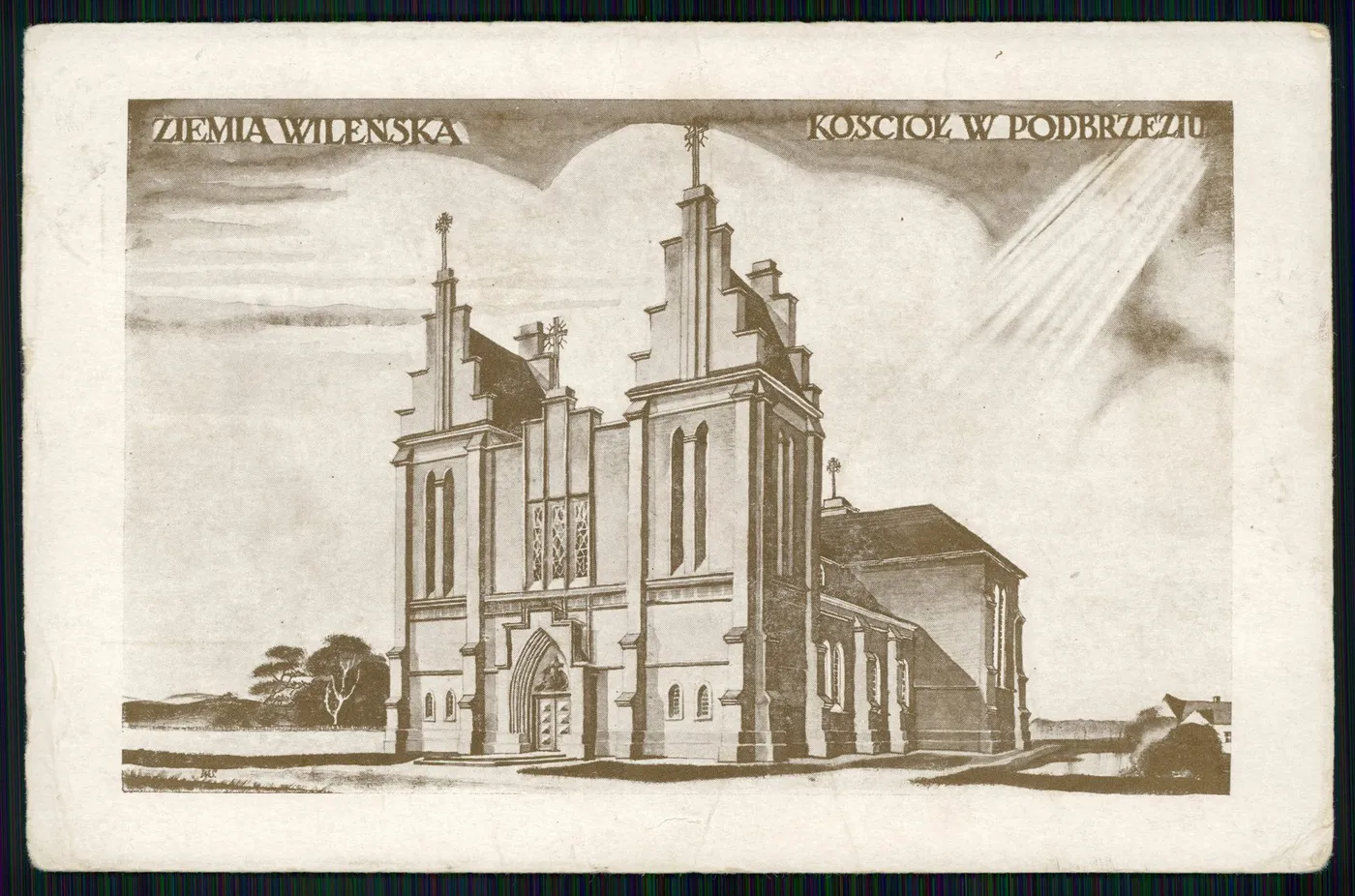
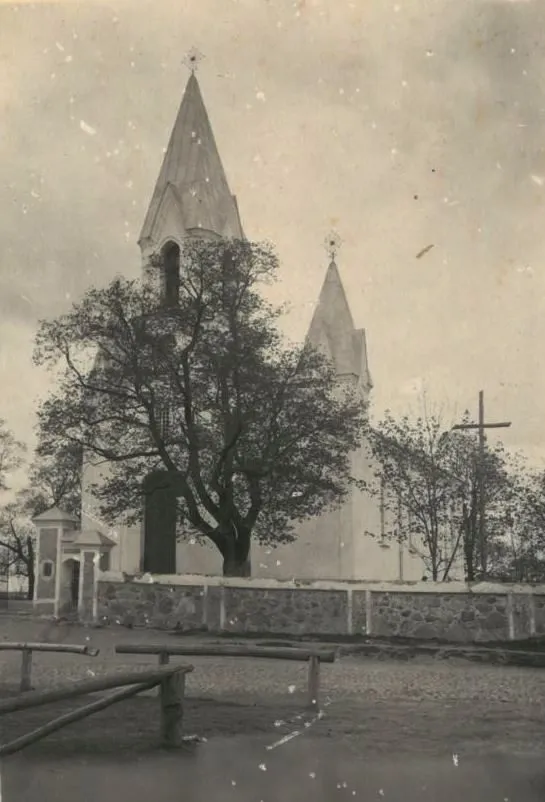
The church in Podbrzezie was built in 1484 by the Bishop of Vilnius. The small town belonged to the bishops until about 1784. In 1865 the Russian authorities closed the parish and turned the church into an Orthodox church.
We know the name of Bartłomiej's wife from the baptism register of the Podbrzezie parish. The register begins in 1782, so Stanisław's baptism of 1779 is not in it. It does, however, contain the baptisms of three of his younger brothers and sisters. The parents were living in the village of Niemenczynka at the time. In the margin of each record the priest wrote the name of the village and the number of the record.
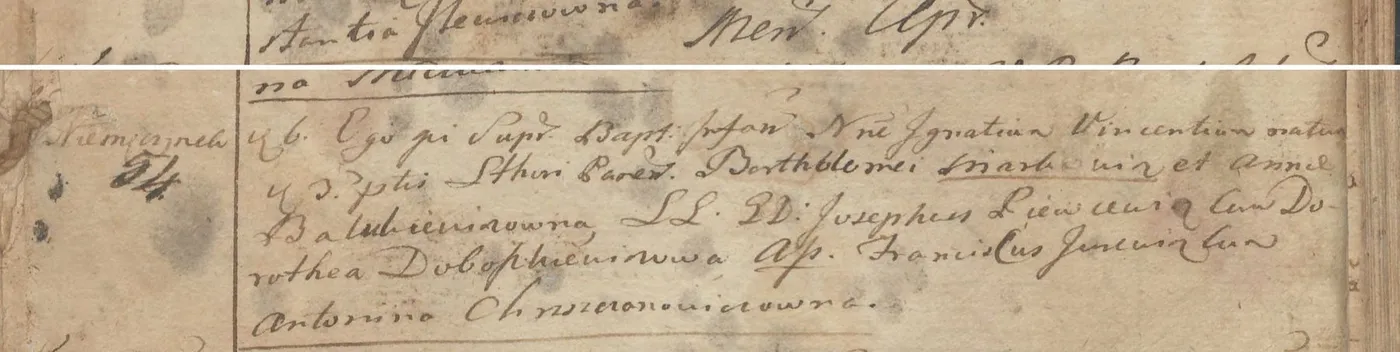
Original text (Latin): Mens. Apr. […] Niemczynek. 54. d. 6. Ego qui Supra Bapt. Infan. Nne Ignatium Vincentium natum d. 3. pntis Lthori Paren. Bertholomei Markiewicz et Anne Ba[…]iewiczowna, LL. GD. Josephus Liewcewicz[?] cum Dorothea Doboszkiewiczowa. Ass. Franciscus Jurewicz[?] cum Antonina Chrzczonowiczowna.
In English: Month of April. Village of Niemenczynka. Entry 54. On the 6th day, I, the same priest as above, baptised a child named Ignacy Wincenty, born on the 3rd day of this month of the lawful marriage of the parents Bartłomiej Markowicz and Anna Baniewicz (in this record the mother's surname is written unclearly). The godparents holding the child at baptism were the well-born Józef Liewcewicz (surname uncertain) and Dorota Doboszkiewicz. Assisting were Franciszek Jurewicz (surname uncertain) and Miss Antonina Chrzczonowicz.
There were two pairs of witnesses at this baptism. The first held the child at the font, the second assisted. The day of baptism, the child's name and the father's name are the same as those given in the 1819 decree. So the decree refers to this very record. The priest wrote the father's surname as Markiewicz. In the Podbrzezie parish this family was written both ways, Markiewicz and Markowicz.
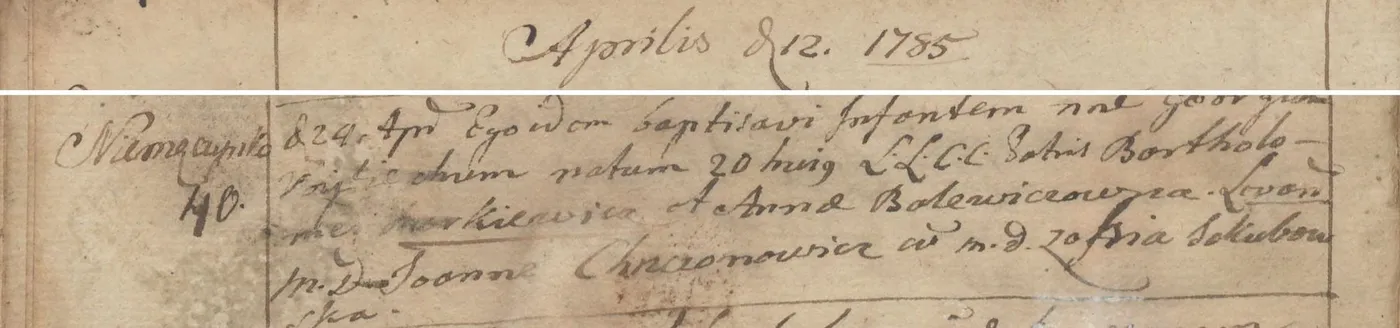
Original text (Latin): Aprilis d 12. 1785. […] Niemczynka. 40. d 24. Apr. Ego idem baptisavi Infantem nne Georgium Woyciechum natum 20 huius LLCC Patris Bartholomei Morkiewicz et Anne Bolewiczowna. Levan. M.D. Joanne Chrzczonowicz cu M.D. Zofia Sekulowska[?].
In English: Heading: 12 April 1785. Village of Niemenczynka. Entry 40. On the 24th day of April I, the same priest, baptised a child named Jerzy Wojciech, born on the 20th day of this month, son of the lawful spouses Bartłomiej Markowicz and Anna Baniewicz (the priest wrote the surnames as Morkiewicz and Bolewiczowna). The godparents holding the child at baptism were the Magnificent Lord Jan Chrzczonowicz and the Magnificent Lady Zofia Sekułowska (surname uncertain).
The abbreviation “M.D.” is the Latin “Magnificus Dominus”, in English the Magnificent Lord. This was how wealthier nobles and officials were addressed. In the same register the priest wrote this way about, among others, a cavalry captain of Vilnius and a treasurer of Livonia. The surname Chrzczonowicz also appears in the record of 1783, where Miss Antonina Chrzczonowicz assisted at Ignacy's baptism.
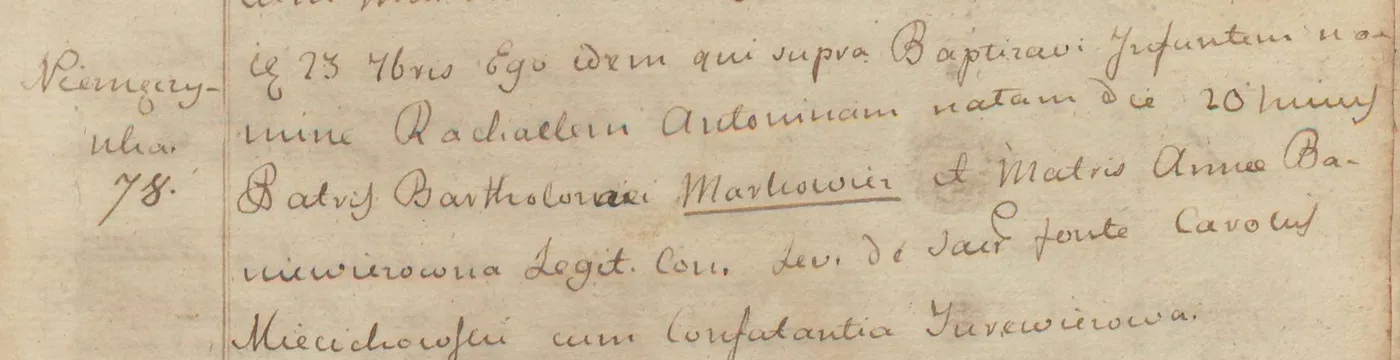
Original text (Latin): Niemęczynka. 78. Die 23 7bris Ego idem qui supra Baptizavi Infantem nomine Rachaelem Antoninam natam die 20 huius Patris Bartholomaei Markowicz et Matris Annae Baniewiczowna Legit. Con. Lev. de Sacr. fonte Carolus Miecichowski cum Constantia Jurewiczowa.
In English: Village of Niemenczynka. Entry 78. On the 23rd day of September I, the same priest as above, baptised a child named Rachela Antonina, born on the 20th day of this month, daughter of the lawful spouses: the father Bartłomiej Markowicz and the mother Anna Baniewicz. The godparents holding her at holy baptism were Karol Miecichowski and Konstancja Jurewicz.
The priest wrote Anna's maiden name slightly differently each time. It is clearest in the record of 1787: Baniewiczowna.
| Child | Baptism | What we know about them |
|---|---|---|
| Stanisław | 8 May 1779, Podbrzezie parish | husband of Agata née Trabuć, father of Tadeusz. The date of baptism is given by the 1819 decree. |
| Józefata | c. 1781 | known from the 1795 revision list, in which she is 14 |
| Ignacy Wincenty | 6 April 1783, Podbrzezie parish | born in Niemenczynka. In 1814 he was Tadeusz's godfather. The 1819 decree recognised him as a nobleman. |
| Jerzy Wojciech | 24 April 1785, Podbrzezie parish | born 20 April in Niemenczynka |
| Rachela Antonina | 23 September 1787, Podbrzezie parish | born 20 September in Niemenczynka |
We do not know when or where Bartłomiej and Anna died. Their death records are not in the register of the dead of the Podbrzezie parish for 1782 to 1819. It does, however, contain two members of the Markowicz family who bear the names of Bartłomiej's brothers. Gabriel Markowicz died on 16 March 1794 in the village of Brodziszki, aged 61. Kazimierz Markowicz died on 14 January 1805 in Pikieliszki, aged about 70. Five years earlier, on 1 April 1800, Franciszka Markowicz died in Pikieliszki. She was 60.
The 1795 revision list: the nobility in the village of Niemenczynek
In December 1795, right after the third partition, the Russian authorities made a list of the whole population. The village of Niemenczynek then belonged to the manor farm of Kuna, which the chamberlain Jan Chocki held in pledge. The list divides the villagers into three groups: free people, nobles living on peasant holdings and finally innkeepers and lodgers. An innkeeper kept a tavern, while a lodger had no house of his own and lived with someone else. There were no serfs in the village at all, that is peasants belonging to the owner of the estate. Bartłomiej and his family stand in the group of the nobility.
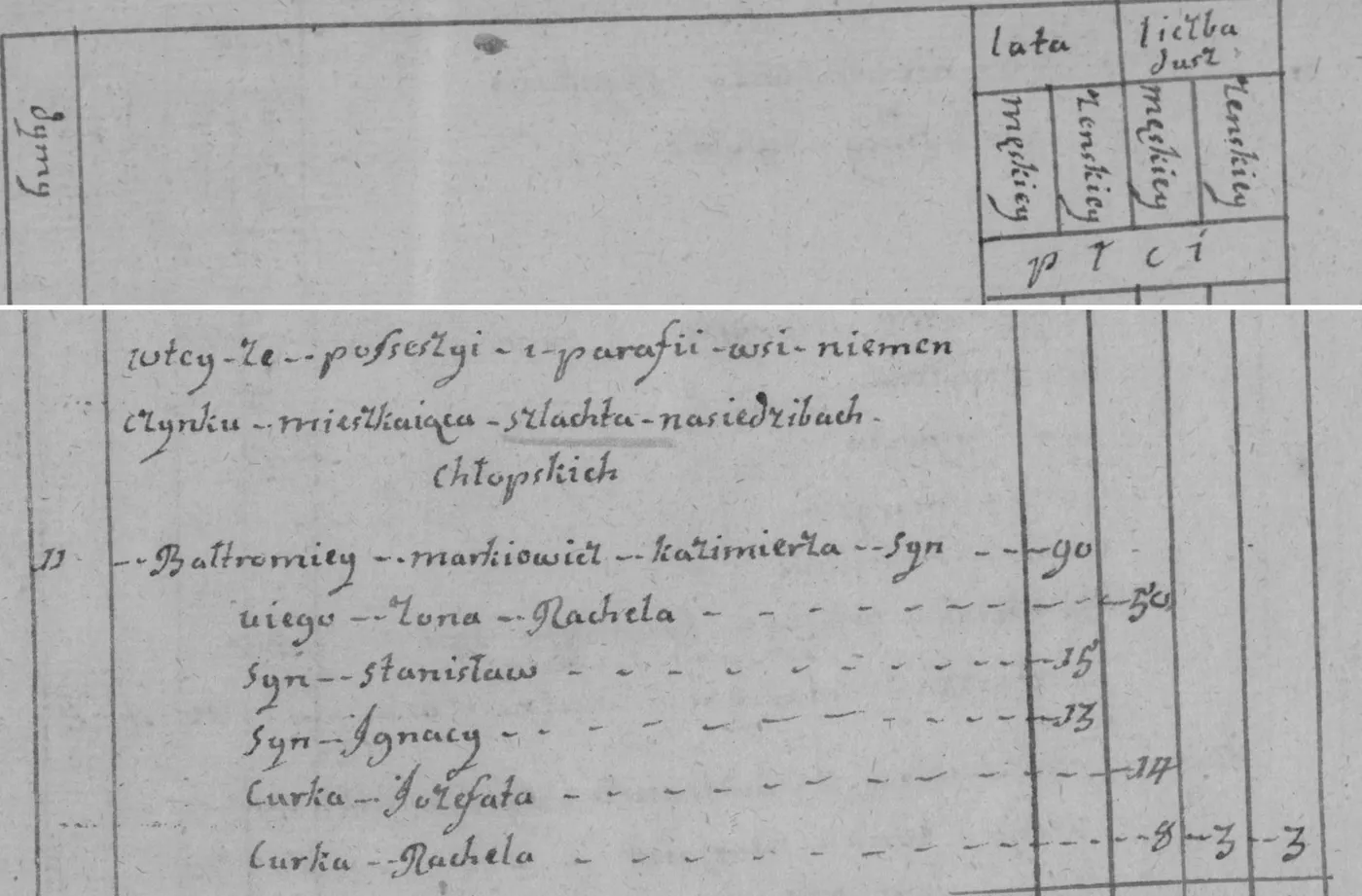
Original text (Polish): wtey-że possessyi i parafii wsi niemenczynku mieszkaiąca szlachta nasiedzibach chłopskich. 11. Bałtromiey markiowicz kazimierza syn 90. u iego żona Rachela 50. Syn Stanisław 15. Syn Jgnacy 13. Curka Jozefata 14. Curka Rachela 8.
In English: Nobility living on peasant holdings in the village of Niemenczynek, in the same estate and the same parish. House 11. Bartłomiej Markowicz, son of Kazimierz, aged 90. His wife Rachela, aged 50. Son Stanisław, aged 15. Son Ignacy, aged 13. Daughter Józefata, aged 14. Daughter Rachela, aged 8.
The list confirms what the decree says: Bartłomiej was the son of Kazimierz and had sons Stanisław and Ignacy. The ages of Stanisław, Ignacy and Rachela match their baptisms to the year. We also learn of a daughter Józefata, born about 1781, that is before the surviving baptism register begins. Jerzy Wojciech, baptised in 1785, is not on the list. The clerk wrote Bartłomiej's wife as Rachela, while the baptism records give Anna. He gave Bartłomiej's age as 90, which agrees with the year of baptism 1703 given by the decree.
It was this list that the family cited in 1819. On 22 December 1805 the treasury office in Vilnius certified to the family that in the 1795 revision list the Markowicz family had been recorded as nobility.
The notice of the owner of Niemenczynka, 1816
In March 1816 the Vilnius newspaper “Kuryer Litewski” printed a notice from Ludwik Bohusz Siestrzeńcewicz, owner of the estates of Niemenczynka, Kuny and Parnuszki in the Vilnius district. An official count of the population was then under way throughout the empire. In the notice the owner listed people whom he regarded as his serfs who had run away from the estate. He asked that no one enter them in the revision list at their own place. He wanted to enter them at Niemenczynka, because every serf recorded in the list belonged to the estate.
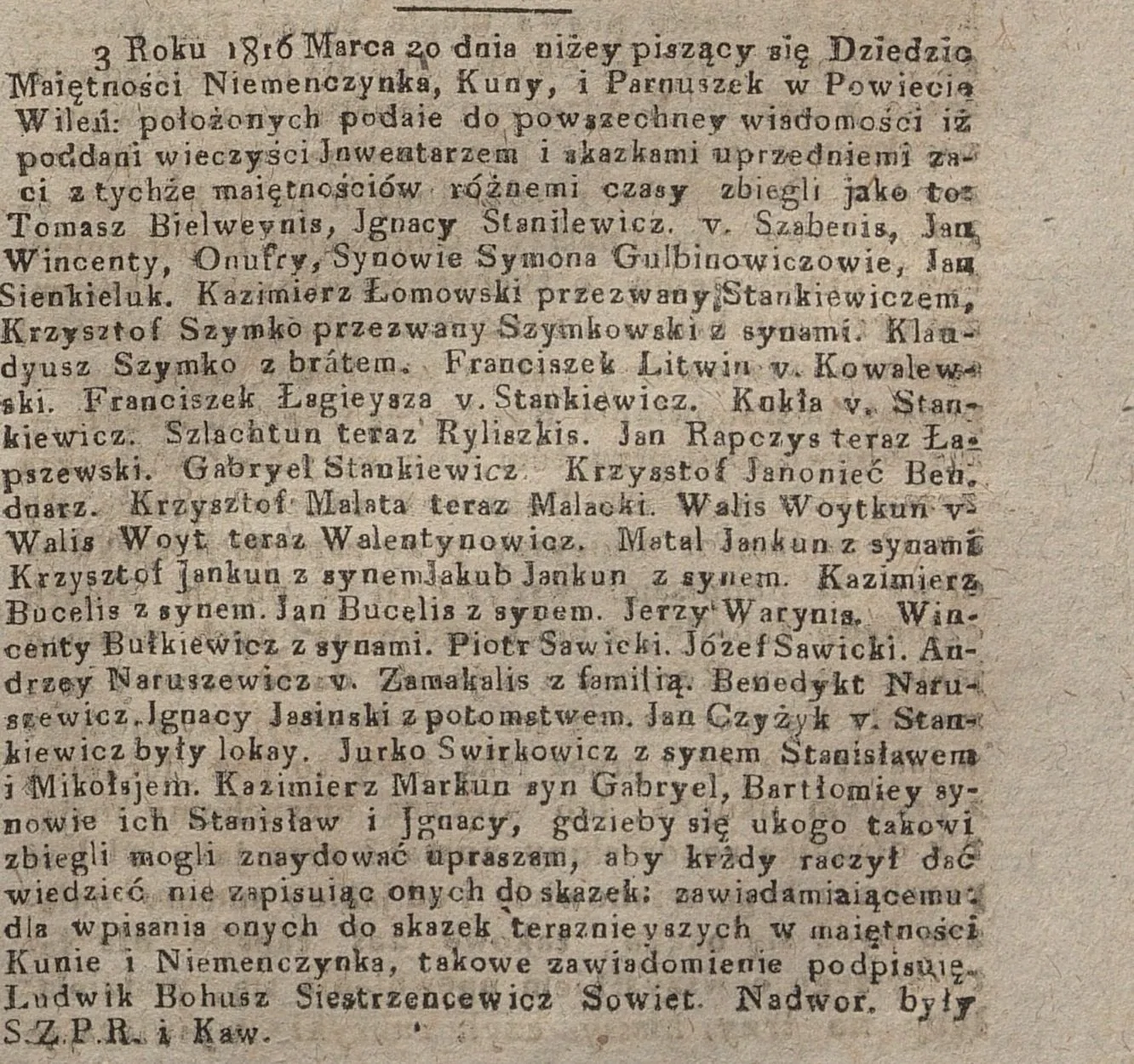
Original text (Polish): Roku 1816 Marca 20 dnia niżey piszący się Dziedzic Maiętności Niemenczynka, Kuny i Parnuszek w Powiecie Wileń: położonych podaie do powszechney wiadomości iż poddani wieczyści Jnwentarzem i skazkami uprzedniemi za[ię]ci z tychże maiętnościów różnemi czasy zbiegli jako to: Tomasz Bielweynis, Jgnacy Stanilewicz v. Szabenis […] Krzysztof Malata teraz Malacki. Walis Woytkun v. Walis Woyt teraz Walentynowicz […] Jurko Swirkowicz z synem Stanisławem i Mikołajem. Kazimierz Markun syn Gabryel, Bartłomiey synowie ich Stanisław i Jgnacy, gdzieby się u kogo takowi zbiegli mogli znaydować upraszam, aby każdy raczył dać wiedzieć nie zapisuiąc onych do skazek: zawiadamiaiącemu: dla wpisania onych do skazek teraznieyszych w maiętności Kunie i Niemenczynka, takowe zawiadomienie podpisuię. Ludwik Bohusz Siestrzencewicz Sowiet. Nadwor. były S.Z.P.R. i Kaw.
In English: On 20 March 1816 the undersigned owner of the estates of Niemenczynka, Kuny and Parnuszki in the Vilnius district makes it publicly known that from these estates, at various times, serfs have run away who were entered in the inventory and in the previous revision lists, namely: (here over thirty names follow, some with a note of what the person is now called), Kazimierz Markun, son Gabriel, Bartłomiej, their sons Stanisław and Ignacy. I ask everyone with whom these runaways may be staying to let me know and not to enter them in the revision list, as they are to be entered in the present revision list on the estates of Kuny and Niemenczynka. Signed Ludwik Bohusz Siestrzeńcewicz, court councillor.
The last entry on the list names Kazimierz Markun, Gabriel, Bartłomiej and their sons Stanisław and Ignacy. This is our family, recorded under a garbled surname. We recognise it by the first names, because only one Bartłomiej with sons Stanisław and Ignacy lived in Niemenczynek. His father was called Kazimierz and his brother Gabriel, just as the decree states.
So the owner claimed that the Markowicz family were his peasants who had left the estate. The revision lists say otherwise. In 1795 the state revision list recorded Bartłomiej and his sons as nobility. At that time there was not a single serf in the whole village. Siestrzeńcewicz took over Niemenczynek later. In his revision list of 1811 he entered as serfs several families who had been free in 1795. The Markowicz family are not in that list at all, neither among those present nor among the runaways. Nor are they in the list he submitted in August 1816, five months after the notice in the newspaper, even though he had announced that he would enter them there.
The notice was therefore an attempt to turn into serfs people who were not serfs. Next to other people on the same list the landowner noted what they were called now, for example “Walis Woyt now Walentynowicz”. There were many such disputes in Lithuania at the time, because the outcome decided whether a person was free. The Markowicz family had a certificate from the treasury office dated 1805. On 16 December 1819 the nobility office in Vilnius issued a decree recognising Stanisław, Ignacy and their relatives as nobility.
Kazimierz Markowicz, Stanisław's grandfather
| Who he was | Kazimierz was the father of Bartłomiej and the grandfather of Stanisław |
| Father | Łukasz Markowicz |
| Brothers | Józef and Marcin |
| Sons | Stanisław, Józef, Gabriel, Bartłomiej, Kazimierz and Jan |
| How we know of him | from the decree of 1819 |
We know Kazimierz only from the decree. The decree names him as one of the three sons of Łukasz and says that Łukasz left his sons a task: to redeem the family estate, which he himself had given in pledge. None of them managed it. Kazimierz had six sons and the largest part of the family named in the decree descends from him.
Kazimierz could not, however, have been Łukasz's own son. Łukasz died about 1584, while Bartłomiej, Kazimierz's son, was not baptised until 1703. Several more generations must therefore have lived between Łukasz and Kazimierz. The decree does not list them and we do not know their names either. That is why on the wall chart these two ancestors are joined by a line of red dots rather than an ordinary line.
The decree says more about Kazimierz's brother Józef. Józef was not able to redeem the estate and handed the task to his son, also called Kazimierz. On 7 January 1766 he made an official declaration on the matter in his own name and his son's. This younger Kazimierz, the nephew of our Kazimierz, swore an oath before the order commission in 1794, while the Commonwealth still existed. He was recorded there as a nobleman. It was his sons, Andrzej and Onufry, who received the first decree in 1806.
On 22 December 1805 the treasury office in Vilnius issued the family a certificate stating that in the revision list of 1795 the Markowicz family had been recorded as nobility. The decree cites this certificate as proof that the family had always been regarded as noble.
Łukasz Markowicz (mentioned under the year 1552)
| Who he was | Łukasz was the father of Kazimierz. The decree begins the Markowicz lineage with him |
| Estate | Stanielewszczyzna and Możelewszczyzna in the district of Vilnius, inherited from his forebears |
| 1552 | 23 February, a statement of claim in the Vilnius castle court naming Łukasz as the owner |
| 1577 | 22 December, Łukasz gives the estate in pledge to Siemienowicz for 40 kopa of Lithuanian groszy |
| Sons | Kazimierz, Józef and Marcin |
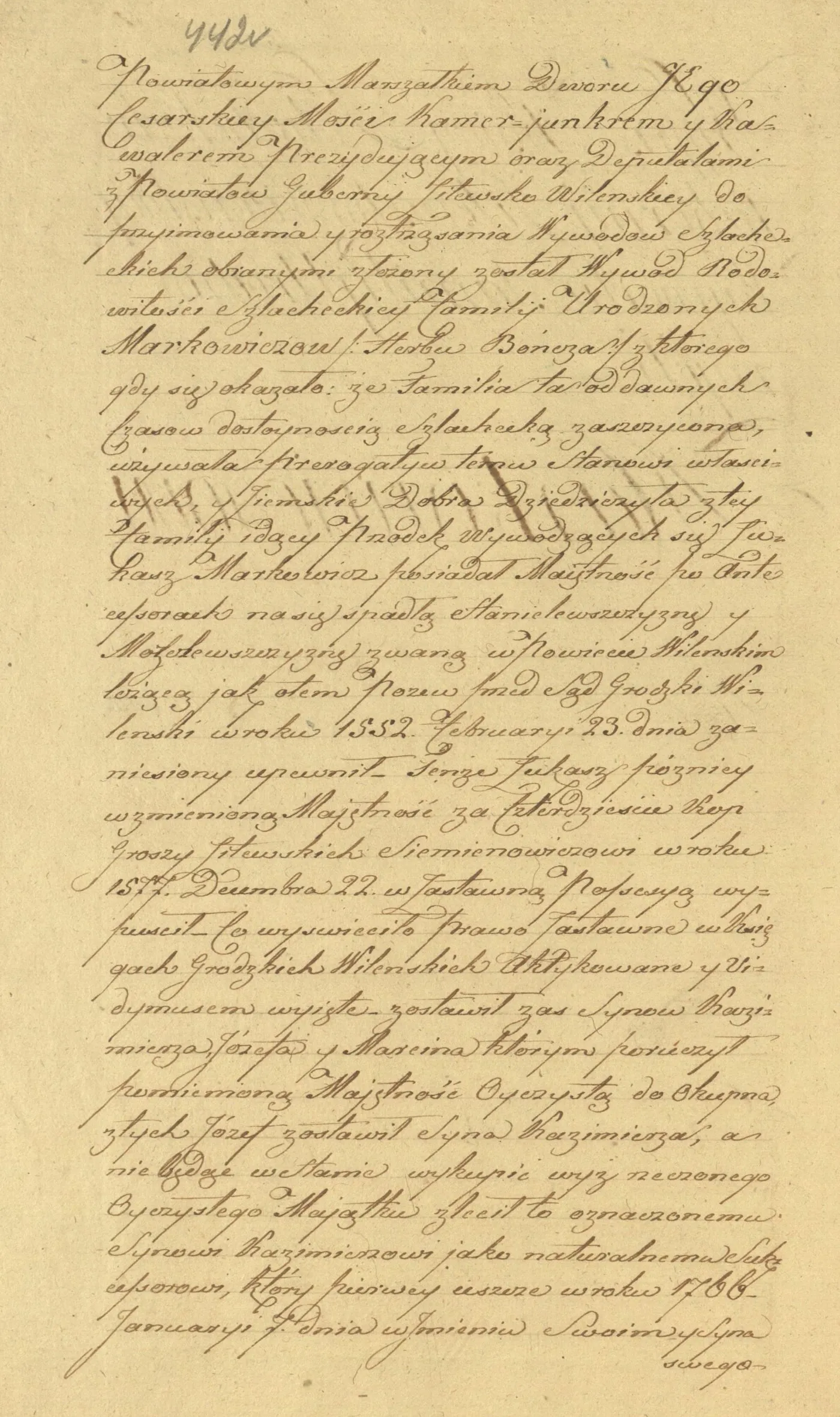
Original text (Polish): […] złozony został Wywod Rodowitości Szlacheckiey Familij Urodzonych Markowiczow /: Herbu Boncza :/ z ktorego gdy się okazało: że Familia ta oddawnych Czasow dostoynością Szlachecką zaszczycona, uzywała Prerogatyw temu Stanowi własciwych, y Ziemskie Dobra Dziedziczyła z tey Familij idący Przodek Wywodzących się Łukasz Markowicz posiadał Maiętność po Antecessorach na się spadłą Stanielewszczyznę y Możelewszczyznę zwaną w Powiecie Wilenskim lezącą jak otem Pozew przed Sąd Grodzki Wilenski w roku 1552 Februaryi 23 dnia zaniesiony upewnił. Tenze Łukasz pozniey wzmienioną Maiętność za Czterdziestu kop Groszy Litewskich Siemienowiczowi w roku 1577 Decembra 22 w Zastawną Possessyą wypuscił. Co wyswieciło Prawo Zastawne w Księgach Grodzkich Wilenskich Aktykowane y Vidymusem wyięte. zostawił zas Synow Kazimierza, Jozefa y Marcina ktorym poruczył pomienioną Maiętność Oyczystą do Okupna […]
In English: A proof of the noble descent of the family of the well-born Markowicz of the Bończa coat of arms has been submitted. It has shown that this family has enjoyed noble dignity since olden times, has made use of the privileges of that rank and has inherited landed property. The ancestor of those submitting the proof, Łukasz Markowicz, held an estate called Stanielewszczyzna and Możelewszczyzna, situated in the district of Vilnius, which had come to him from his forebears. This is attested by a statement of claim brought before the Vilnius castle court on 23 February 1552. The same Łukasz later gave this estate in pledge to Siemienowicz for forty kopa of Lithuanian groszy, on 22 December 1577. This is proved by the deed of pledge entered in the Vilnius castle court books and issued as an official copy. He left sons Kazimierz, Józef and Marcin, whom he charged with redeeming this paternal estate.
Łukasz is the earliest ancestor we know by name in our whole family. The decree says that the estate came to him “po Antecessorach”, that is, from his forebears. The decree does not give the names of those forebears. So the land was already in the family before Łukasz. The decree does not say how large the estate was, so we do not know how many hectares or how many villages it had. The only measure of its value is the sum of the pledge.
A pledge meant that the owner borrowed money and in return handed over his land for use until he repaid the debt. A kopa is sixty pieces, so forty kopa make 2,400 groszy. The family never repaid this sum and the estate stayed in other hands. Yet even the decree of 1819 repeats that Łukasz's descendants, although they are unable to redeem their patrimony, are always its “true heirs”.
What was it worth? The Lithuanian Statute of 1566, the code of laws of the Grand Duchy at the time, gives official prices for animals. A working horse cost one kopa of groszy, an ox 80 groszy, a cow 50 groszy, a sheep 15 groszy and a goose 3 groszy. Forty kopa would therefore buy forty working horses, or thirty oxen, or forty-eight cows. A dairy cow costs between 6,000 and 9,000 złoty in Poland today, so by the price of cattle this would be roughly 290,000 to 430,000 of today's złoty. This is only an approximation, because the prices of land, grain and animals changed at different rates over the centuries. For a landed estate it was not a large sum.
Scribes wrote the name of the estate in different ways. The decree of 1819 has Stanielewszczyzna and Możelewszczyzna, while the decree of 1806 gives them in a slightly different form. In October 1849 the marshal of the nobility of the Vilnius district asked in an official letter about the old estates of the Markowicz family and called them “Mozolewszczyzna or Markowszczyzna”. The second name sounds just like the family surname.
Czesław Malewski records a village called Staniewszczyzna in the parish of Giedrojcie in the years 1860 to 1871. In the same parish lived, in 1806, Andrzej and Onufry Markowicz, who received the first decree.
The chronicler Maciej Stryjkowski wrote about Giedrojcie in 1582. According to him Prince Giedrus, whose name means “Sun”, built a wooden castle on Lake Kiemont and named it after himself. His principality began two miles from the Wilia and reached as far as the Dvina. Stryjkowski adds that in his day all that was left of the castle was a barely visible hillfort, because in Lithuania castles and towns were built of wood.
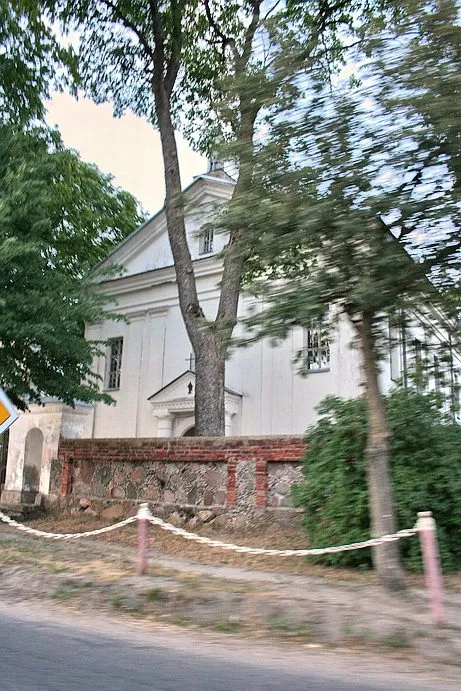
Łukasz Markowicz, mayor of Vilnius
In Vilnius in those same years there lived a man with the same first name and surname. Łukasz Markowicz, known as Mundius, was a merchant, a city councillor from 1545 and mayor of Vilnius in 1553. He signed himself as doctor of both laws, that is, a learned lawyer.
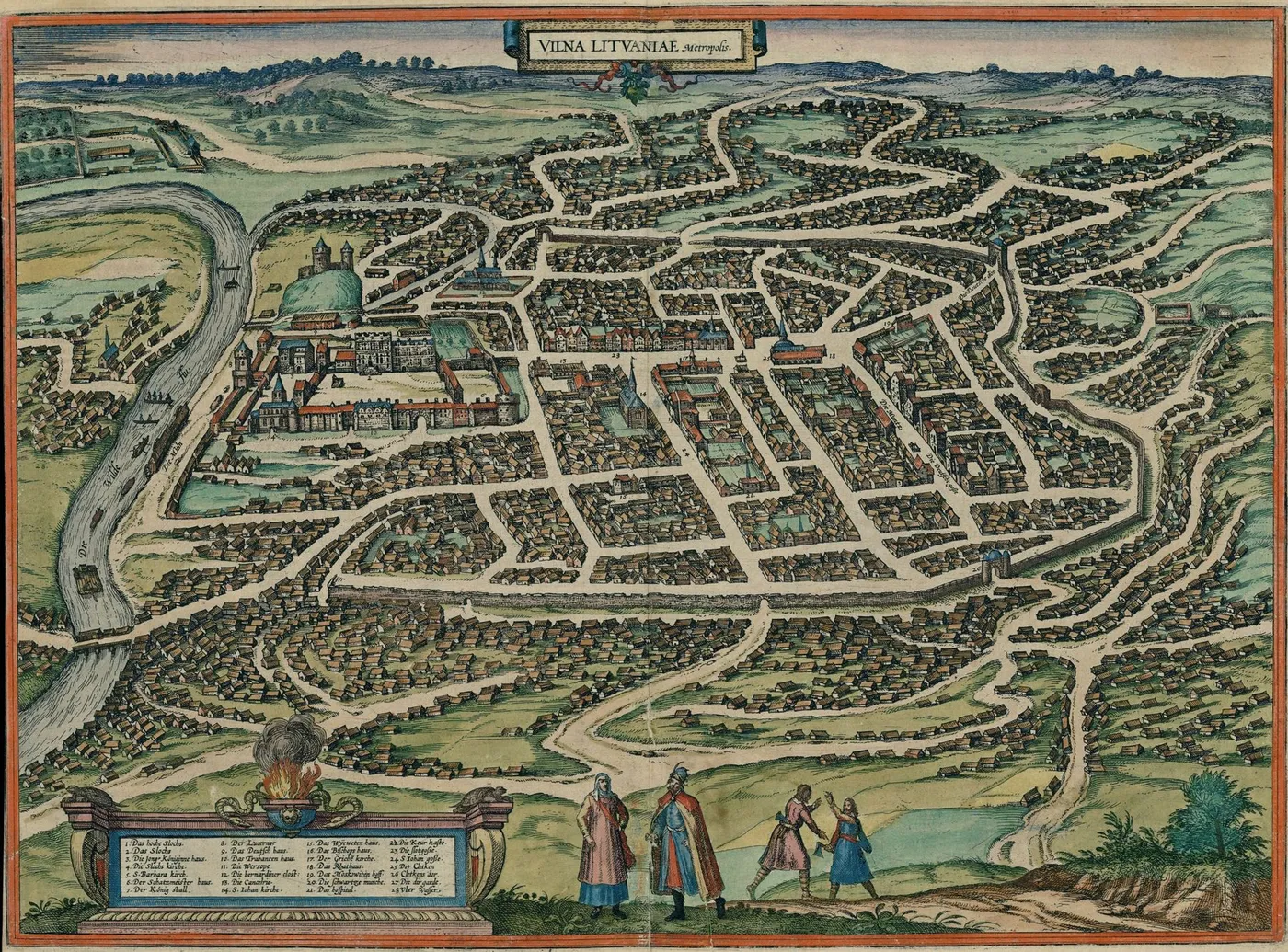
Łukasz's father was Marek Pietrowicz, a merchant and councillor of Vilnius. His mother was Dorota. The next section is about them.
Vilnius University Library holds two documents of this mayor. In the first, from 1567, “Łukasz Markowicz, mayor and doctor in the city of Vilnius” hands over to Mikołaj Siemionowicz empty land in the district of Vilnius, in Jurgielewszczyzna and Mozelewszczyzna. The second is a statement of claim before the court of the Vilnius governor for Łukasz Markowicz and his wife. The decree of 1819 speaks of the same things: a statement of claim of 1552, the Możelewszczyzna estate and Siemienowicz. So it looks as if the decree relies on the documents of this mayor and the Łukasz of the decree is most probably him.
The library shows the first of these documents online. It is a rough draft full of crossings-out and additions. It was written in Ruthenian, the language used at that time by the offices in Lithuania. In it Łukasz calls this land his “own patrimonial” land, that is, inherited from his father. He sells it to Siemionowicz for forty kopa of Lithuanian groszy. The document is dated 1567. The decree gives the same sum but speaks of a pledge and of the year 1577. On the last page someone added in Polish in the 18th century that the document had been entered in the castle court books in Vilnius.
The mayor led a stormy life. King Zygmunt August gave him the sole right to make and sell vodka in Vilnius, but the city never put this privilege into effect. He went to law with his sister and brother-in-law over an inheritance. After that he fought the city authorities in court for more than thirty years. He was removed from the council, lost his house and property and was imprisoned several times. In 1572 he fled Vilnius with his son and lived in exile until his death, among other places in Prussia. He was an Arian, meaning that he belonged to the most radical branch of the Reformation. He died about 1584. His writings were published in 2010 by the Lithuanian historians Aivas Ragauskas and Raimonda Ragauskienė.
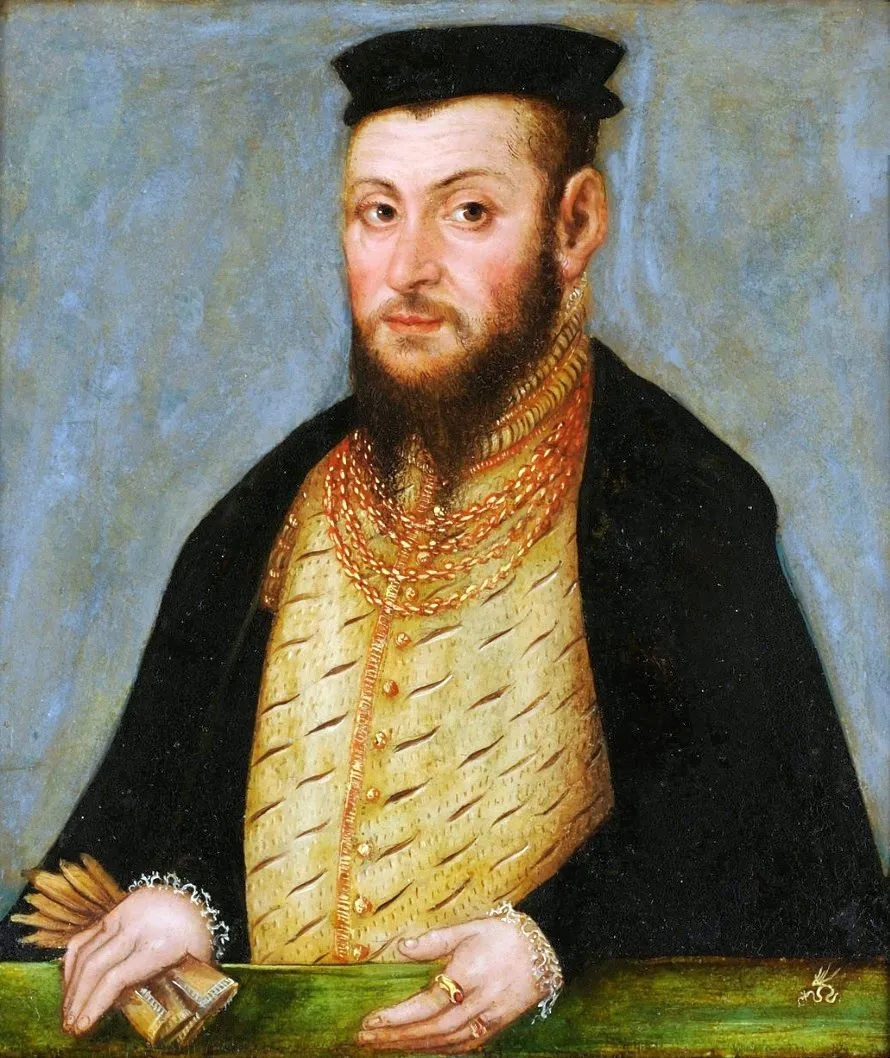
The decree calls Kazimierz, Józef and Marcin sons of Łukasz. If the Łukasz of the decree is the mayor, something does not add up here. The mayor died about 1584, while Bartłomiej, Kazimierz's son, was born in the 18th century. Several generations must have lived between them whom the decree does not name. Historians do not know the names of the mayor's children or what became of his descendants. So we do not know whether we descend from him in a direct line. It is very possible, because the decree cites the same matters that we know from the mayor's documents. There is also one trace older than the decree: in 1560 a Jan Markowicz appears in court with the mayor. He was a serf of the Bishop of Vilnius from near Mejszagoła and historians regard him as the mayor's relative. Bartłomiej was baptised in Mejszagoła. Later our whole family lived on the bishop's estate of Podbrzezie.
What early writers said about Mayor Łukasz
Mayor Łukasz was written about by his enemies, the king, foreign officials and a later historian. Łukasz himself also left writings. Thanks to this we hear about him from several sides.
Stanisław Lubieniecki, the historian of the Polish Brethren, known as Arians, wrote about him. In his history of the Polish Reformation, published in Latin in 1685, he described Łukasz's journey to Moravia. The Moravian Brethren lived there, holding everything in common. Łukasz stayed with them for several weeks and after his return told the Polish Arians about them. Lubieniecki also says that Łukasz later settled, together with other brethren from Lithuania, in Raków, a small town in Lesser Poland founded in 1569, which became the capital of the Polish Arians.
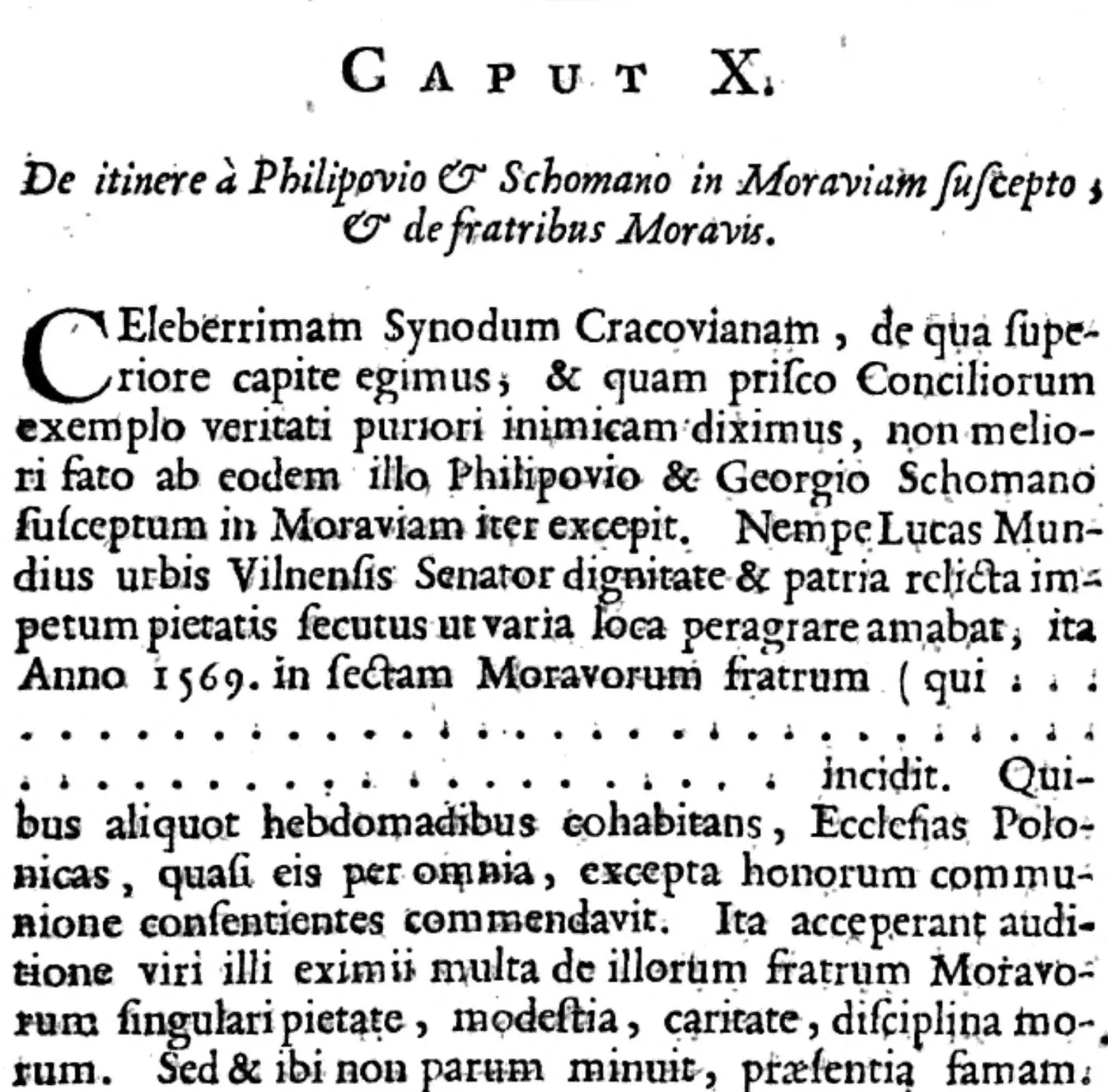
Original text (Latin): Nempe Lucas Mundius urbis Vilnensis Senator dignitate & patria relicta impetum pietatis secutus ut varia loca peragrare amabat […] Anno 1569. in sectam Moravorum fratrum […] incidit. Quibus aliquot hebdomadibus cohabitans, Ecclesias Polonicas […] commendavit.
In English: Now Łukasz Mundius, a councillor of the city of Vilnius, abandoned his office and his homeland. He followed an impulse of piety and liked to wander from place to place. In the year 1569 he came to the community of the Moravian Brethren. He lived with them for several weeks and commended the Polish congregations of the faithful to them.
Lubieniecki places this journey in 1569, but the Arians' own notes mention it a year earlier. In the autumn of 1568 the Arians gathered for a synod at Pełsznica near Kraków. The notes from this synod say, in Polish, that “one Mundius, a burgher of Vilnius” came from Moravia at that time, “strangely commending the sect of communists”. The Moravian Brethren were then called communists because they held their property in common. Some listeners believed Łukasz “with comfort”, while others did so “niebarzo”, old Polish for “not very much”. So Łukasz promised that the Moravian Brethren would send their envoys to Poland.
The voice of Łukasz's enemies survives in verse. Piotr Rojzjusz was a Spaniard, a lawyer and a poet at the court of King Zygmunt August. He was a friend of the Vilnius wójt Augustyn Rotundus, with whom Łukasz was in dispute. Rojzjusz wrote four spiteful little Latin poems against Łukasz. In them he played on the name Mundius, because the Latin word “mundus” means both “world” and “clean”. From these poems we learn two things. Łukasz wrote his complaints in Polish. By the time of this dispute he was already an old man.
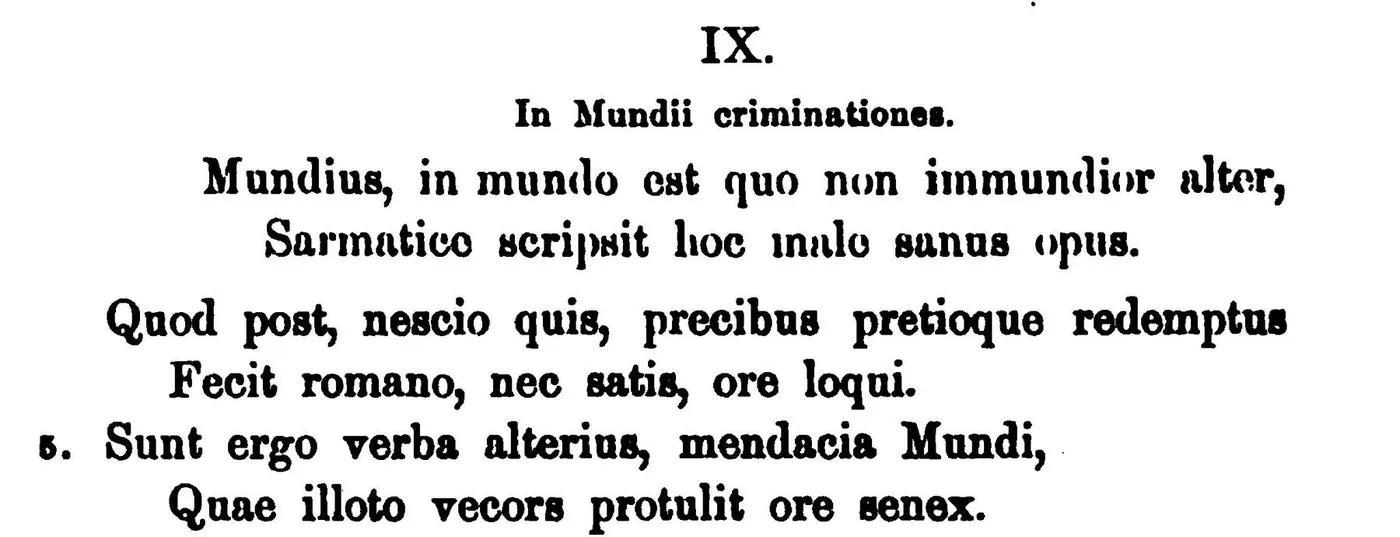
Original text (Latin): Mundius, in mundo est quo non immundior alter, Sarmatico scripsit hoc male sanus opus. Quod post, nescio quis, precibus pretioque redemptus Fecit romano, nec satis, ore loqui. Sunt ergo verba alterius, mendacia Mundi, Quae illoto vecors protulit ore senex.
In English: Mundius, than whom there is no one more unclean in the world, wrote this work in Polish, out of his wits. Then someone, I know not who, won over by pleas and payment, made this work speak Latin, but not very skilfully. So the words are someone else's but the lies are Mundius's. A mad old man uttered them with unwashed lips.
King Zygmunt August mentioned Łukasz in a letter to Mikołaj Radziwiłł the Red in February 1571. He called him “Łukasz Gorzałka, formerly mayor of Vilnius” and “a man of restless mind”. The nickname came from the royal privilege to make and sell vodka, as gorzałka is an old Polish word for vodka. The king wrote that for several years Łukasz had been slandering the whole city council in writing and that he had once again left a biting note in the town hall.
The king's letter was a reply to a question from the voivode. Mikołaj Radziwiłł the Red, voivode of Vilnius, had put Łukasz in prison for this note and asked the king what punishment he deserved. The king replied that he would give no guidance, because judging was the voivode's business. He added that he trusted the voivode to decide the case according to the law.
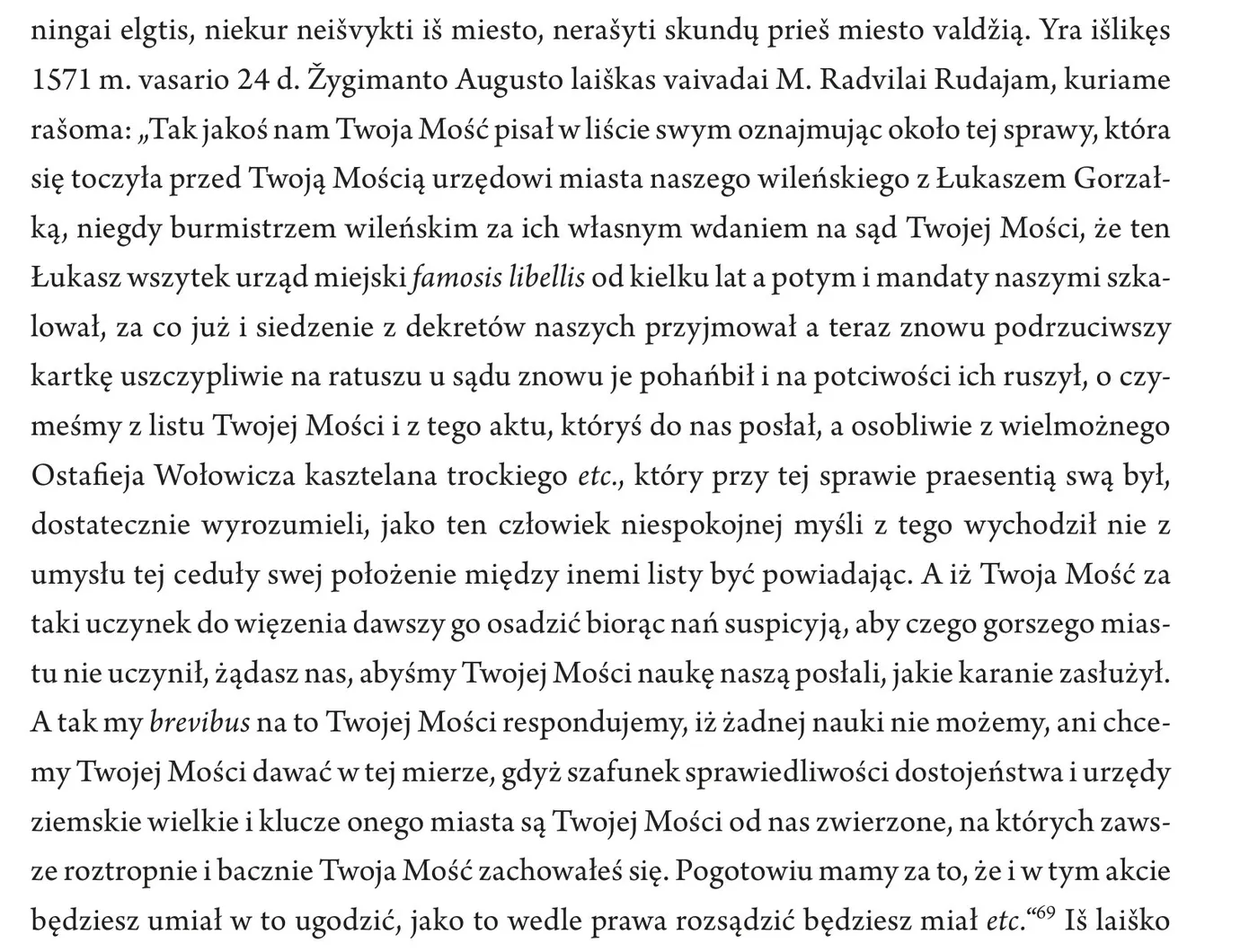
Original text (Polish): Tak jakoś nam Twoja Mość pisał w liście swym oznajmując około tej sprawy, która się toczyła przed Twoją Mością urzędowi miasta naszego wileńskiego z Łukaszem Gorzałką, niegdy burmistrzem wileńskim za ich własnym wdaniem na sąd Twojej Mości, że ten Łukasz wszytek urząd miejski famosis libellis od kielku lat a potym i mandaty naszymi szkalował, za co już i siedzenie z dekretów naszych przyjmował a teraz znowu podrzuciwszy kartkę uszczypliwie na ratuszu u sądu znowu je pohańbił i na potciwości ich ruszył […] dostatecznie wyrozumieli, jako ten człowiek niespokojnej myśli z tego wychodził nie z umysłu tej ceduły swej położenie między inemi listy być powiadając. A iż Twoja Mość za taki uczynek do więzenia dawszy go osadzić biorąc nań suspicyją, aby czego gorszego miastu nie uczynił, żądasz nas, abyśmy Twojej Mości naukę naszą posłali, jakie karanie zasłużył. A tak my brevibus na to Twojej Mości respondujemy, iż żadnej nauki nie możemy, ani chcemy Twojej Mości dawać w tej mierze […] Pogotowiu mamy za to, że i w tym akcie będziesz umiał w to ugodzić, jako to wedle prawa rozsądzić będziesz miał.
In English: Your Grace wrote to us in your letter about the case that was heard before Your Grace between the council of our city of Vilnius and Łukasz Gorzałka, former mayor of Vilnius. Both parties themselves submitted it to Your Grace's judgement. For several years this Łukasz slandered the whole city council with offensive writings. Later he did so also with our royal summonses. He has already sat in prison for this by our judgements. Now he has again left a biting note in the town hall, in the court. Once again he has disgraced them and harmed their good name. We have well understood how this man of restless mind excused himself: he said that he had placed this note of his among other papers unintentionally. Your Grace ordered him to be imprisoned for this deed, suspecting that he might do something worse to the city. Your Grace asks us to send guidance as to what punishment he has deserved. We answer briefly that we neither can nor wish to give any guidance in this matter. We are certain that in this matter too Your Grace will be able to judge according to the law.
What was written on this note we do not know. The note has not survived and nobody copied it. The king's letter tells us only that Łukasz left it in the town hall, in the room of the municipal court, that it was spiteful and that it insulted the city officials. Łukasz himself explained that he had not done it on purpose and that the note had ended up among other papers by chance.
The historians who published Łukasz's writings suppose that he came to the town hall at that time to deliver a speech against the city authorities, or that he was handing out this speech written on paper. It is easy to guess what it might have been about, because for twenty years Łukasz had been repeating the same thing: that the city had unlawfully taken from him his office of mayor, his house and his property. He paid dearly for the note. As he later wrote himself, he spent about a year and a half in prison in Vilnius castle, together with common criminals.
Łukasz himself described his fortunes differently from his opponents. In 1562 he declared before an official that he had bought himself some land in Poland and was moving there “as an exile, because I cannot obtain justice here”. Ten years later he wrote in Latin to the Duke of Prussia that he had left Vilnius secretly, without household or servants, “only with this one son of mine”. For the journey he had barely managed to get one horse and a cart. In February 1576 he entered his name in the register of the university of Rostock on the Baltic as Łukasz Mundius, “of Vilnius in the Grand Duchy of Lithuania, doctor of both laws, exile”. A doctor of both laws is a learned lawyer, an expert in both secular and church law.
In 1584 an official of the Duke of Prussia added a note on a letter in which Łukasz asked for help: “Doctor Łukasz Mundius, former mayor of Vilnius, defended the freedom of the city of Vilnius for so long that he lost everything he had”.
The memory of Łukasz survived in books. In 1841 Józef Ignacy Kraszewski wrote about him in his history of Vilnius. The Polish Biographical Dictionary has a separate entry on him under the name Mundius.
Marek Pietrowicz (d. before 1530) and Dorota, Łukasz's parents
The father of Mayor Łukasz was called Marek Pietrowicz, that is, Marek son of Piotr. He was a merchant and a councillor of Vilnius. We know him from several documents written on parchment, which are now kept in the library of the Lithuanian Academy of Sciences in Vilnius. He is also mentioned in a book of the royal chancery.
In May 1513 three brothers named Januszkowicz, boyars (Lithuanian knights) from near Mejszagoła, sold to “Marek Pietrowicz, councillor of the city of Vilnius” their shares of the manor at Podbrzezie. This is the same area in which our Markowicz family lived in the 18th century. Marek did not keep this land for long. After a dozen or so years he sold it to a kniaź, that is, a prince, named Gliński, who sold it on in 1542.
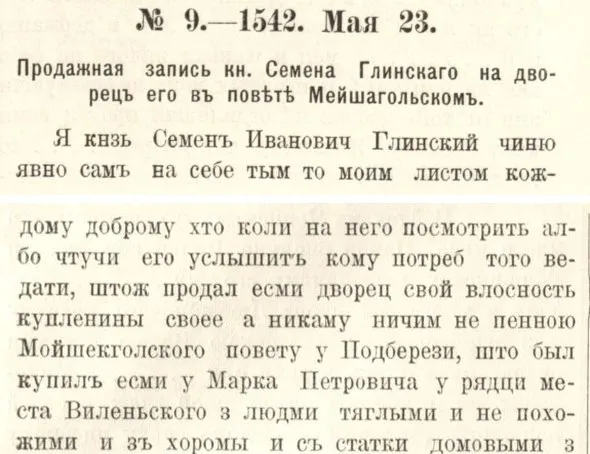
Original text (ruski, czyli dawny język urzędowy Wielkiego Księstwa Litewskiego, a nie rosyjski): Я кнзь Семенъ Иванович Глинский чиню явно самъ на себе тым то моим листом кождому доброму хто коли на него посмотрить албо чтучи его услышить кому потреб того ведати, штож продал есми дворец свой влосность купленины своее а никаму ничим не пенною Мойшекголского повету у Подберези, што был купилъ есми у Марка Петровича у рядци места Виленьского з людми тяглыми и не похожими
In English: I, Kniaź Semen Iwanowicz Gliński, make known by this my letter to every good person who shall ever look upon it or hear it read, that I have sold my manor at Podbrzezie in the district of Mejszagoła. It is my own purchased land, which I have pledged to no one. I bought it from Marek Pietrowicz, councillor of the city of Vilnius, together with the serfs.
Marek also had land near Onikszty, a small town about a hundred kilometres north of Vilnius. In 1561 Łukasz claimed it as his patrimony. A royal official questioned old people of the town about the matter. They testified that Queen Helena had given Marek this land “for service” and that he later moved to Vilnius and settled there. The land was called Markuszki after his name. Łukasz said that it was noble land and that his father had served the king in war on account of it, even though Marek himself lived in Vilnius. He also produced a letter of King Zygmunt the Old of February 1509. In it the king pardoned Marek the penalty for not going to war. Queen Helena is the subject of a separate section later in this chapter.
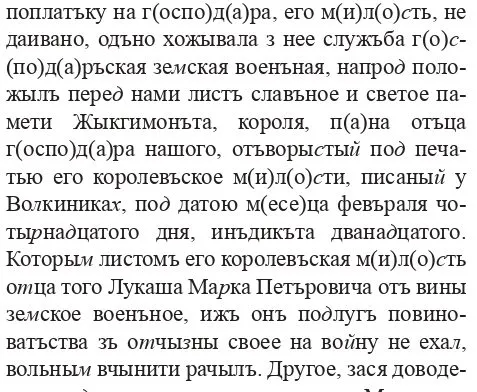
Original text (ruski, czyli dawny język urzędowy Wielkiego Księstwa Litewskiego, a nie rosyjski): Которым листомъ его королевъская милость отца того Лукаша Марка Петъровича отъ вины земское военъное, ижъ онъ подлугъ повиноватъства зъ отчызны своее на войну не ехал, вольным вчынити рачылъ.
In English: By this letter His Royal Majesty was pleased to release the father of this Łukasz, Marek Pietrowicz, from the land penalty for war, because he did not go to war although he was obliged to do so from his patrimony.
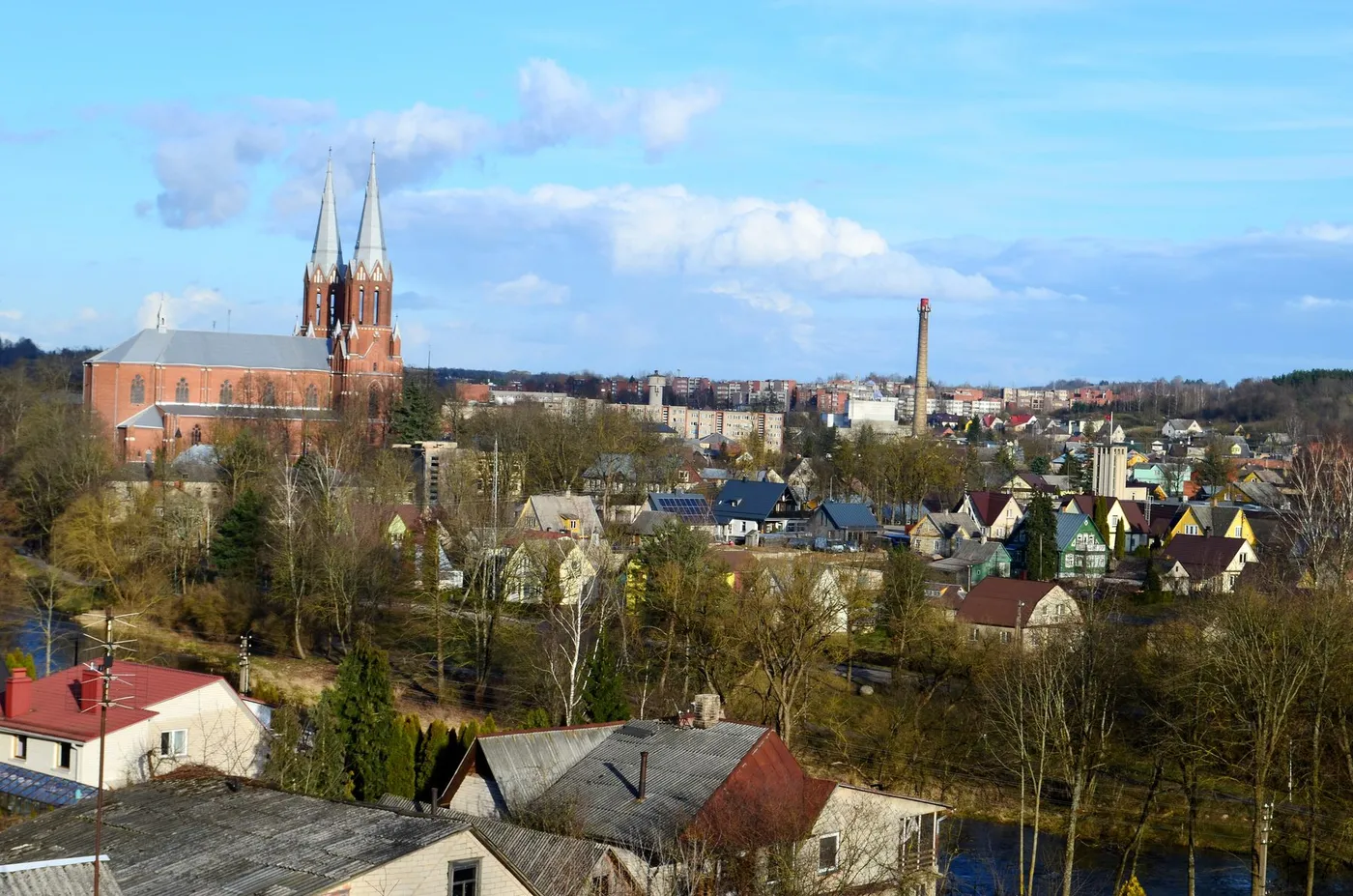
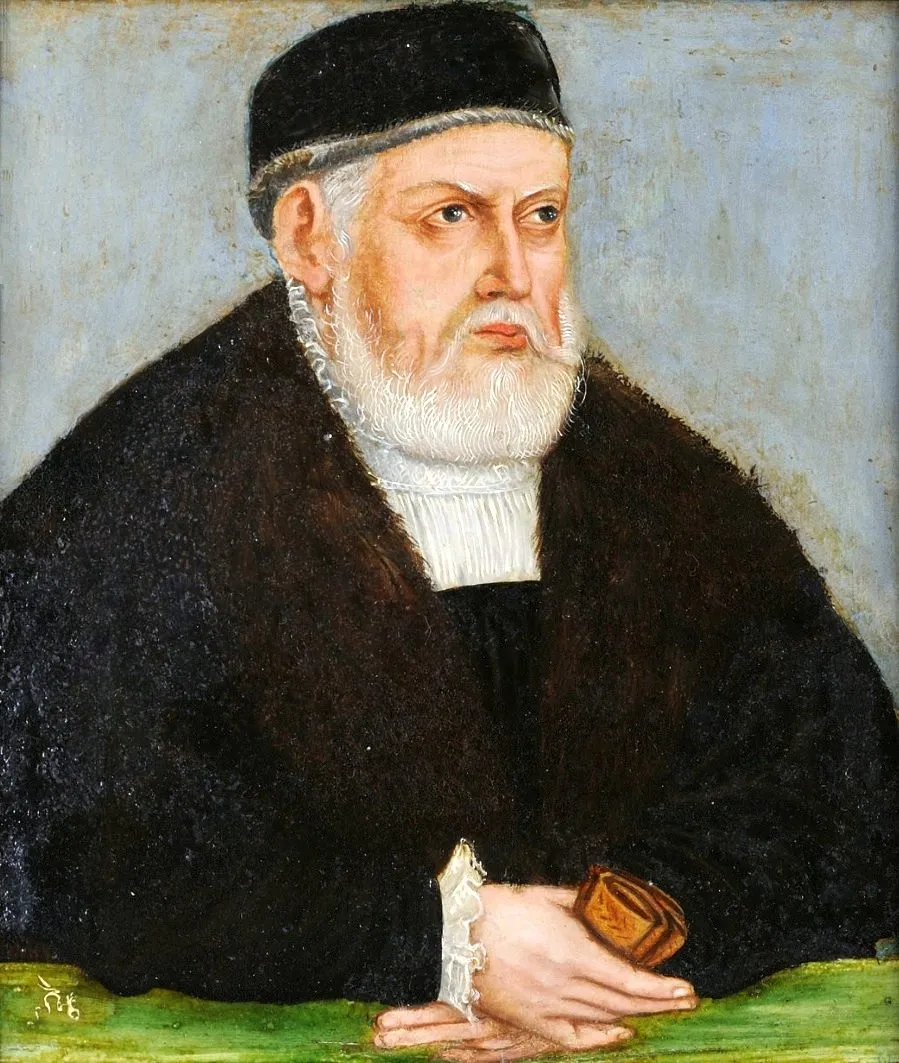
Marek wrote a will. In January 1521 it was confirmed by the nuncio. The document calls Marek “a burgher and merchant of Vilnius”. In his will Marek left the rent from his stall. He divided it into four parts: one for the town, one for the confraternity at St John's Church, one for a Mass for his own soul and the souls of his ancestors and one for the poor.
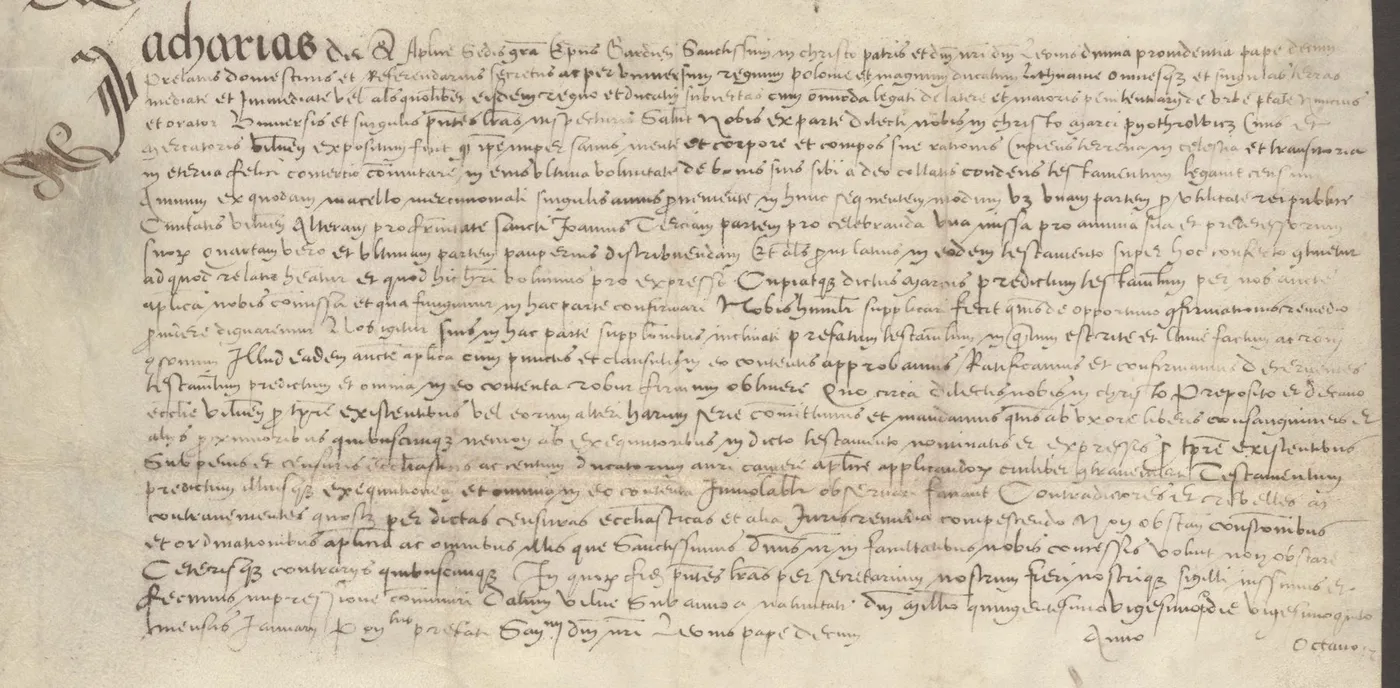
Original text (łacina, skróty pisarza rozwinięte): Nobis ex parte dilecti nobis in Christo Marci Pyothrowicz Civis et Mercatoris Vilnensis expositum fuit, quod ipse nuper sanus mente et corpore et compos sue rationis, Cupiens terrena in celestia et transitoria in eterna felici commercio commutare, in eius ultima voluntate de bonis suis sibi a deo collatis condens testamentum legavit censum annuum ex quodam macello mercimoniali singulis annis provenientem in hunc qui sequitur modum, videlicet unam partem pro utilitate rei publice Civitatis Vilnensis, Alteram pro fraternitate sancti Joannis, Terciam partem pro celebranda una missa pro anima sua et predecessorum suorum, quartam vero et ultimam partem pauperibus distribuendam. […] Datum Vilne Sub anno a nativitate domini Millesimo quingentesimo vigesimo primo, die vigesimo quinto mensis Januarii.
In English: On behalf of our beloved in Christ Marek Pyothrowicz, burgher and merchant of Vilnius, it was set before us that not long ago, sound in mind and body, he wished by a happy exchange to give earthly things for heavenly ones and passing things for eternal ones. He therefore disposed in his last will of the goods that God had given him. In his will he left the yearly rent from a certain merchant's stall. The rent is to be divided every year as follows: one part for the benefit of the town of Vilnius, the second for the confraternity of St John, the third for the saying of one Mass for his soul and the souls of his ancestors, the fourth and last to be given out to the poor. […] Given at Vilnius in the year of the Lord's birth one thousand five hundred and twenty-one, on the twenty-fifth day of January.
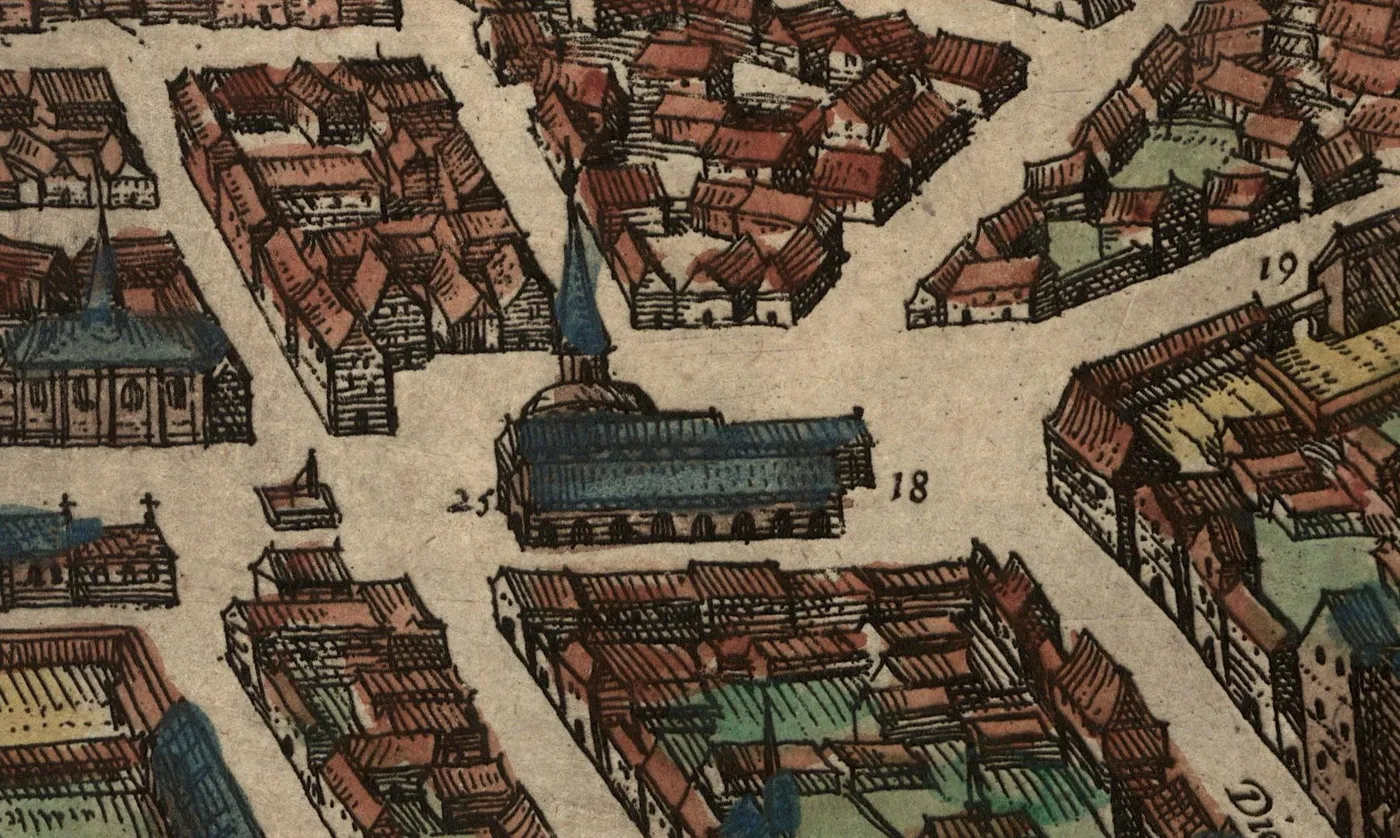
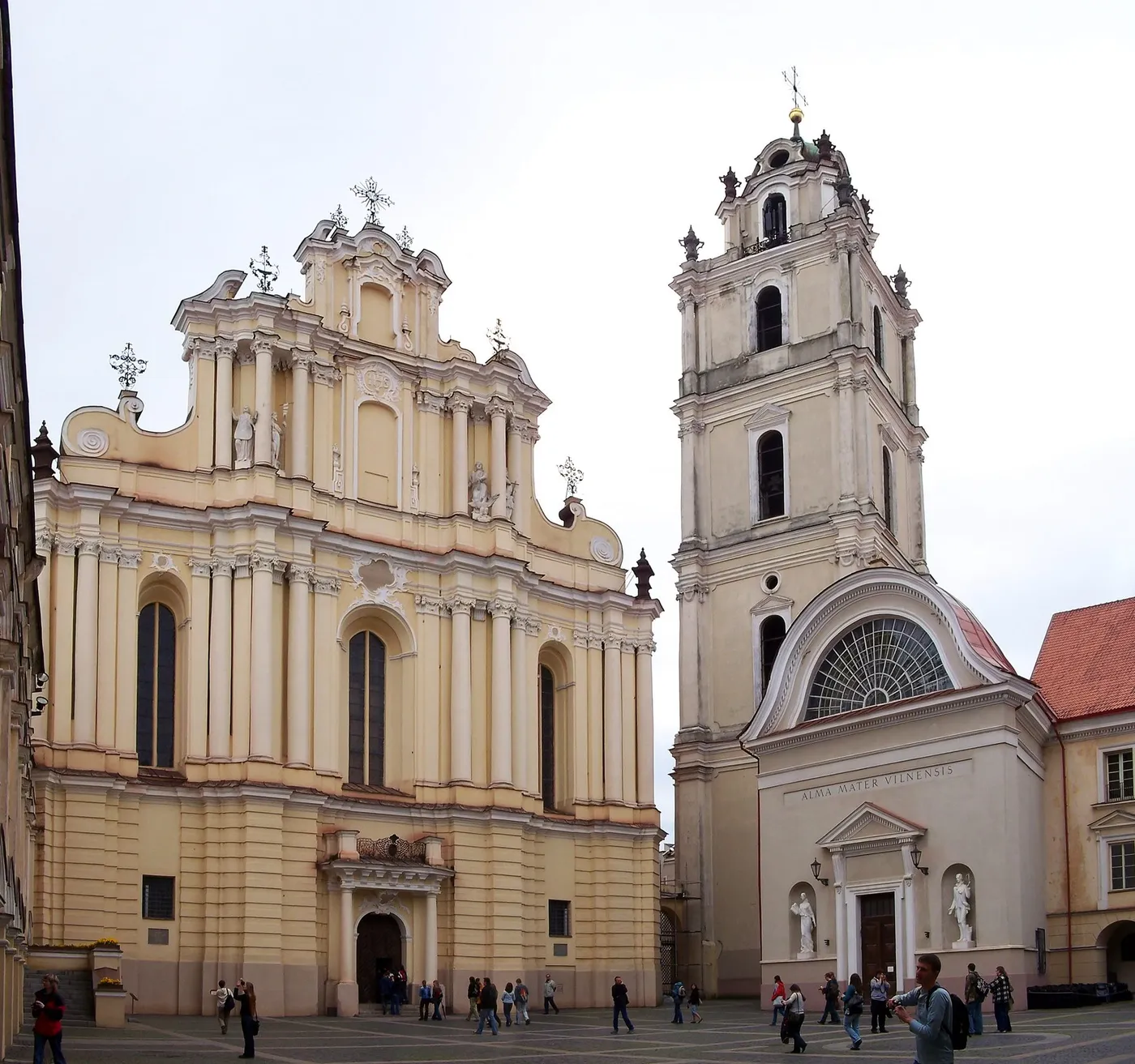
The widow Dorota and the daughters
Marek died before 1530. In January 1530 his widow Dorota paid out the dowry of their daughter Marta: a hundred kopas of groszy, pearls, silver belts and garments. Marta married Jan Organista, who owned a town house in Biskupia Street. The other daughter, Katarzyna, married Jan Dubinga. Dorota left a will and died about 1546.
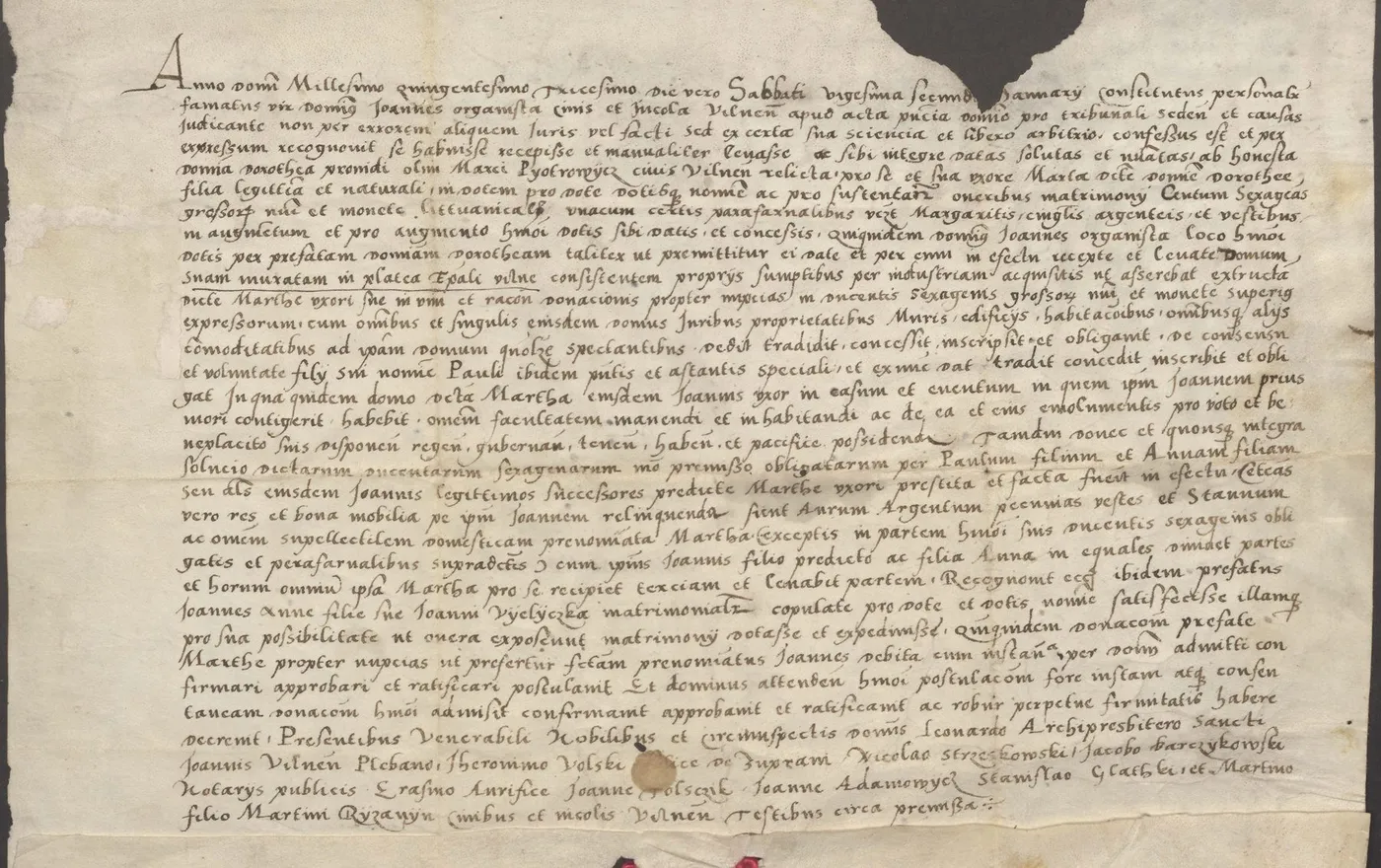
Original text (łacina, skróty pisarza rozwinięte): Anno Domini Millesimo Quingentesimo Tricesimo, die vero Sabbati, vigesima secunda Januarii. Constitutus personaliter famatus vir, dominus Joannes Organista, civis et incola Vilnensis […] recognovit se habuisse, recepisse et manualiter levasse […] ab honesta domina Dorothea, providi olim Marci Pyotrowycz civis Vilnensis relicta, pro se et sua uxore Marta, dicte domine Dorothee filia legittima et naturali, in dotem […] Centum Sexagenas grossorum numeri et monete Lituanicalis unacum certis parafarnalibus, videlicet Margaritis, cingulis argenteis et vestibus.
In English: In the year of the Lord one thousand five hundred and thirty, on Saturday, the twenty-second of January. There appeared in person the honourable man, Master Jan Organista, burgher and resident of Vilnius […] He acknowledged that he had received and taken into his hands […] from the honest Lady Dorota, widow of the late Marek Pyotrowycz, a worthy burgher of Vilnius, for himself and for his wife Marta, the lawful and own daughter of this Lady Dorota, as a dowry […] one hundred kopas of groszy in Lithuanian count and coin, together with the trousseau, namely pearls, silver belts and garments.
What were a hundred kopas of groszy worth? A hundred kopas is six thousand groszy. According to the official prices in the Lithuanian Statute of 1566, the same ones used above to convert the sum in Łukasz's document, they would buy a hundred work horses, or seventy-five oxen, or a hundred and twenty cows. A dairy cow costs 6 to 9 thousand złoty in Poland today, so by the price of cattle this would be from about 720 thousand to about a million of today's złoty. On top of that came the pearls, silver belts and garments. This is only an approximation, because the Statute was written thirty-six years after the dowry was paid and prices changed over the centuries at different rates. Marta's dowry was two and a half times larger than the forty kopas of groszy in the document of her brother Łukasz.
Piotr, Marek's father (15th century)
All we know about Piotr is that he was Marek's father. The name Pietrowicz itself tells us so, because it means “son of Piotr”. Piotr lived in the 15th century. No surviving document mentions him by first name and surname. He is the earliest person on the whole wall chart.
Queen Helena, from whom Marek received land
Who was Queen Helena? She was born in 1476, the daughter of Grand Prince Ivan III of Moscow and of Sophia of the Palaiologos family, the last emperors of Byzantium. In February 1495 in Vilnius she married the Grand Duke of Lithuania, Alexander Jagiellon. The marriage was made after a war between Lithuania and Moscow and was meant to secure the peace. Helena kept her Orthodox faith, as her father had stipulated before the wedding. When Alexander became King of Poland in 1501, she was not crowned because of her religion, although she was called queen. Helena and Alexander had no children. Alexander died in 1506. Helena stayed in Lithuania as a widow and held her own estates there, among them Onikszty. In them she gave land to people who served her. This is how Marek received land, most probably between 1507 and 1513. Helena died in 1513.
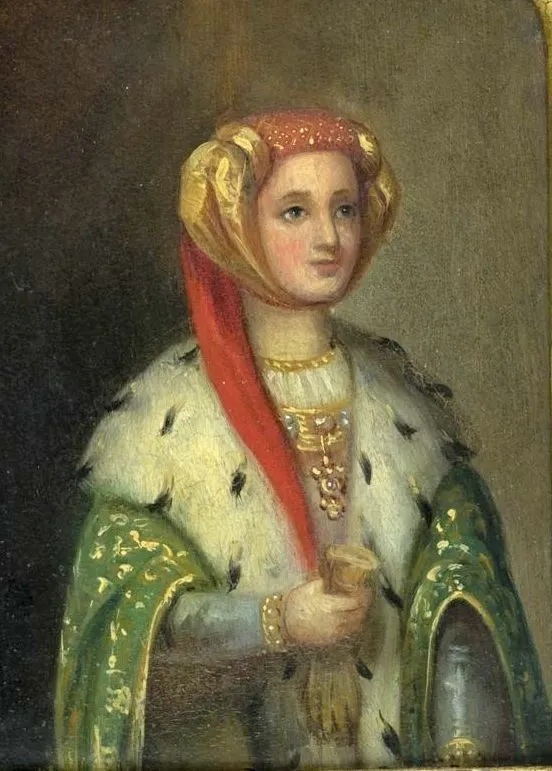
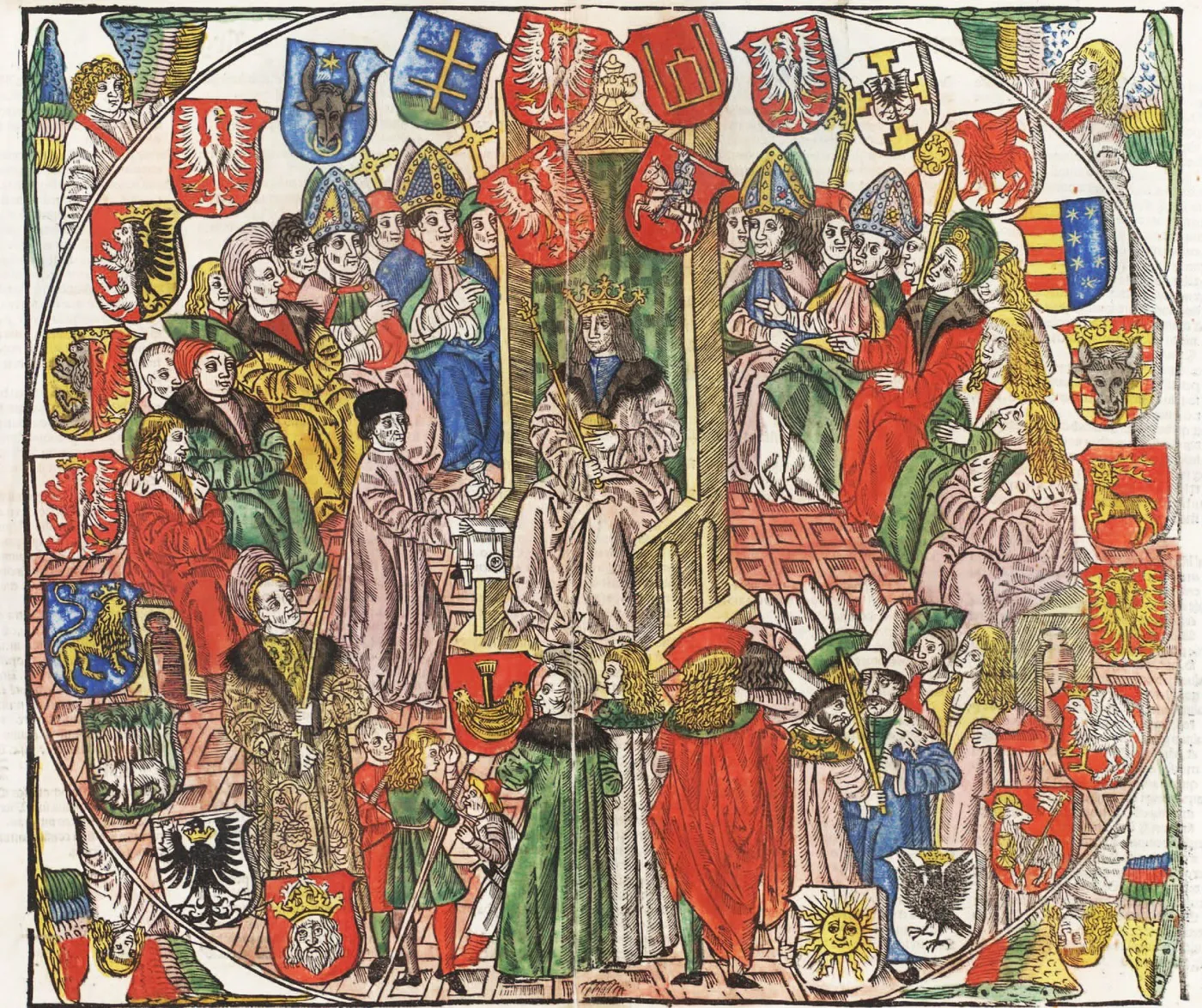
Antoni Trabuć and Marianna née Dauksza, Agata's parents
| Who they were | Antoni and Marianna were the parents of Agata, the wife of Stanisław Markowicz |
| Antoni | son of Jerzy. The 1795 revision list gave his age as 45, so he was born c. 1750. The proof of nobility gives a baptism record of 1 May 1722. He was still alive in 1820. |
| Marianna | née Dauksza, born c. 1755 |
| Home | the village of Dworciszki in Strunojcie parish, later Korkożyszki parish |
| Children | Marcin, Wincenty, Jakub, Agata, Konstancja, Ewa, Maciej |
| Coat of arms | Jelita, confirmed in Vilnius on 27 August 1820 |
In 1795 officials recorded the inhabitants of the governorate. In Dworciszki they entered Antoni's household among the free people, that is, people who were nobody's serfs.
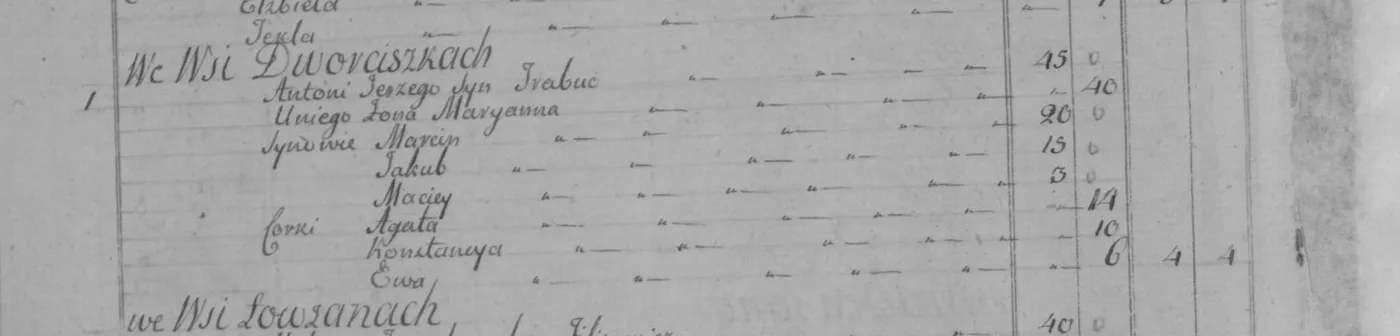
Original text (Polish): We Wsi Dworciszkach, Antoni Jerzego Syn Trabuc 45, uniego Żona Maryanna 40, Synowie Marcin 20, Jakub 15, Maciey 3, Corki Agata 14, Konstancya 10, Ewa 6
In English: In the village of Dworciszki: Antoni Trabuć, son of Jerzy, aged 45. His wife Marianna, aged 40. Sons: Marcin 20, Jakub 15, Maciej 3. Daughters: Agata 14, Konstancja 10, Ewa 6.
The list names six children. The seventh, Wincenty, is not in the 1795 revision list. We know him from the proof of nobility of 1820, where he is named as Antoni's son. We also know him from the parish records of Agata's children, at whose baptisms he was godfather.
| Child | Age in the 1795 revision list | What we know about them |
|---|---|---|
| Marcin | 20 years | in 1810, together with his brothers, took a manor farm in Korkożyszki parish in pledge |
| Wincenty | not in the list | named in the proof of nobility of 1820. He was godfather to Justyn Mateusz in 1810 and most probably also to Józef in 1807. He died in 1838 and left no children |
| Jakub | 15 years | named in the proof of nobility with his son Nikodem Wincenty. He married again in 1840 in Korkożyszki |
| Agata | 14 years | wife of Stanisław Markowicz |
| Konstancja | 10 years | married in 1815 in Korkożyszki |
| Ewa | 6 years | never married. In 1816 she was godmother to Bogumiła. She died on 4 September 1827 in Lipowo |
| Maciej | 3 years | named in the proof of nobility with his son Tomasz. He married in 1814 in the village of Trabucie. The witness was his brother-in-law Stanisław Markowicz. He married a second time in 1833 in Janiszki |
We know the maiden name of Agata's mother from the marriage records of her brothers. Maciej's marriage record of 1833 calls him the son of “the well-born Antoni and Maryanna née Dasko Trabuć”. Jakub's marriage record of 1840 writes the name more clearly: née Dauksza.
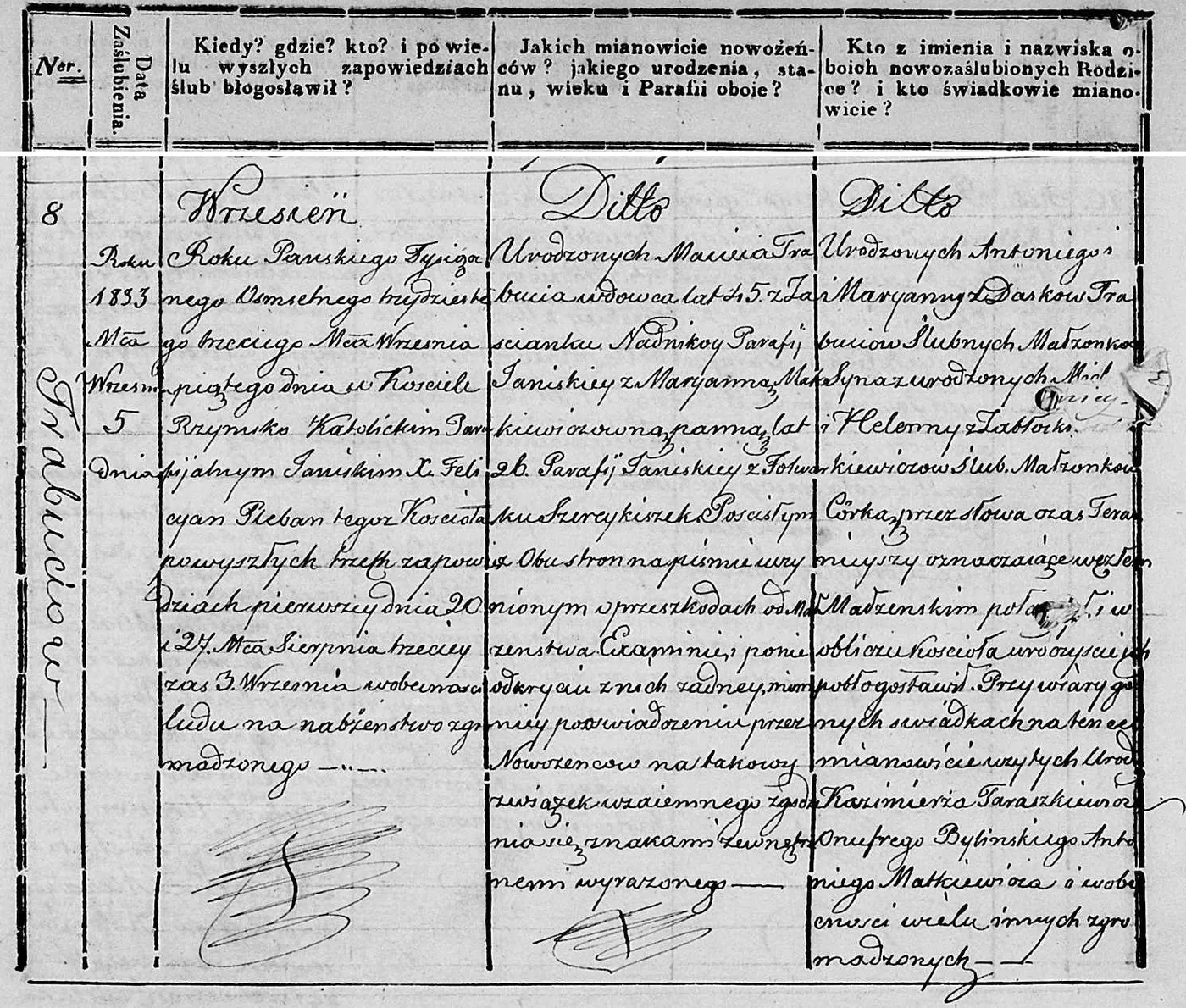
Original text (Polish): 8. Roku 1833 Mca Wrześn. 5 dnia. Roku Panskiego Tysiącznego Osmsetnego trzydziestego trzeciego Mca Września piątego dnia w Kosciele Rzymsko Katolickim Parafijalnym Janiskim X. Felicyan Pleban tegoz Kościoła po wyszłych trzech zapowiedziach pierwszey dnia 20 i 27. Mca Sierpnia trzeciey zas 3. Września wobecnosci ludu na nabozenstwo zgromadzonego Urodzonych Macieia Trabucia wdowca lat 45. z Zascianku Nadnikoy[?] Parafij Janiskiey z Maryanną Matkiewiczowną panną lat 26. Parafij Janiskiey z Folwarku Szercykiszek[?]. Po scisłym z Obu stron na pismie uczynionym o przeszkodach od Małzenstwa Examinie i ponieodkryciu z nich zadney, niemniey poswiadczeniu przez Nowozencow na takowy związek wzaiemnego zgodzenia się znakami zewnętrznemi wyrazonego Urodzonych Antoniego i Maryanny z Daskow[?] Trabuciow Ślubnych Małzonkow Syna z urodzonych Mich[ała] i Helenny z Zabłocki[ch Mat]kiewiczow Ślub. Małzonkow Corką przez słowa czas Teraznieyszy oznaczaiące węzłem Małzenskim poł[ączył] i w obliczu Koscioła uroczyscie ich pobłogosławił. Przy wiary godnych swiadkach na ten cel mianowicie wzytych Urodz. Kazimierza Taraszkiewicza Onufrego Bylinskiego Antoniego Matkiewicza i wobecnosci wielu innych zgromadzonych
In English: Entry 8. On the 5th day of September 1833. In the year of the Lord 1833, on the fifth day of September, in the Roman Catholic parish church of Janiszki, the Reverend Felicjan, parish priest of this church, after three banns announced before the people gathered for divine service (the first on 20 August, the second on 27 August, the third on 3 September), joined in the bond of marriage the well-born Maciej Trabuć, widower aged 45, of the zaścianek of Nadnikoy (name uncertain) in Janiszki parish, with the well-born Marianna Matkiewicz, maiden aged 26, of the manor farm of Szercykiszki (name uncertain) in the same parish. Beforehand both had been strictly examined in writing about impediments to marriage. None was found. The couple confirmed by outward signs that both consented to this union. He is the son of the well-born Antoni and Marianna née Dasko, lawful spouses Trabuć. She is the daughter of the well-born Michał and Helena née Zabłocki, lawful spouses Matkiewicz. The priest solemnly blessed them in the face of the Church. The witnesses were the well-born Kazimierz Taraszkiewicz, Onufry Byliński and Antoni Matkiewicz. Many others who had gathered were also present.
The proof of nobility of 1820
After the partitions the Russian authorities ordered the Polish nobility to prove their descent. A family appeared before the office in its own governorate, which for us meant Vilnius. There it showed its documents: parish records, deeds of purchase and sale of land, certificates. The office drew up a pedigree from them and issued a decision. Such a document was called a proof of nobility. The Trabuć family received such a decision on 27 August 1820. Antoni with his sons Wincenty, Jakub and Maciej, together with two of his more distant relatives, were recognised as ancient Polish nobility and entered in the first class of the governorate's book of the nobility.
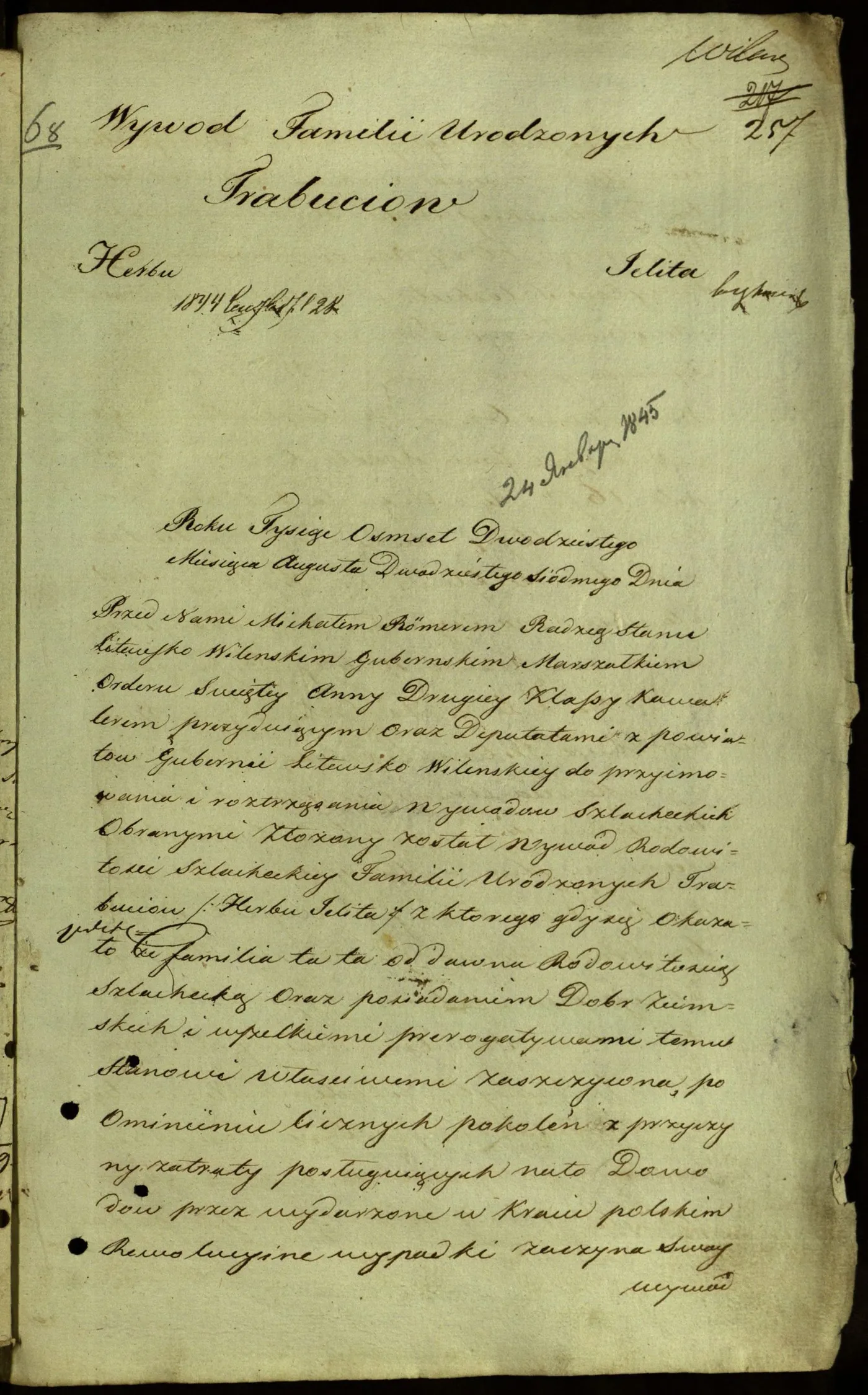
Original text (Polish): Wywod Familii Urodzonych Trabuciow Herbu Jelita. Roku Tysiąc Osmset Dwodziestego Miesiąca Augusta Dwodziestego Siodmego Dnia. Przed Nami Michałem Römerem Radzcą Stanu Litewsko Wilenskim Gubernskim Marszałkiem Orderu Swiętey Anny Drugiey Klassy Kawalerem prezyduiącym Oraz Deputatami z powiatow Gubernii Litewsko Wilenskiey do przyimowania i roztrząsania Wywodow Szlacheckich Obranymi Złożony został Wywod Rodowitosci Szlacheckiey Familii Urodzonych Trabuciow /: Herbu Jelita :/ z ktorego gdy się Okazało że familia ta od dawna Rodowitoscią Szlachecką Oraz posiadaniem Dobr Ziemskich i wszelkiemi prerogatywami temu Stanowi własciwemi zaszczycona, po Ominieniu licznych pokolen z przyczyny zatraty posługuiących nato Dowodow przez wydarzone w Kraiu polskim Rewolucyine wypadki zaczyna Swoy wywod
In English: Proof of nobility of the family of the well-born Trabuć, of the Jelita coat of arms. On the 27th day of August 1820. Before us, Michał Römer, Councillor of State, Governorate Marshal of Lithuania-Vilnius, Knight of the Order of St Anne of the second class and presiding officer, as well as before the deputies elected from the districts of the Lithuania-Vilnius governorate to receive and examine proofs of nobility, there was submitted the proof of noble descent of the family of the well-born Trabuć, of the Jelita coat of arms. It appeared from it that this family has long enjoyed noble descent, the possession of landed estates and all the privileges of that estate. It passes over many generations, because the necessary evidence was lost during the revolutionary events in the Polish land. It begins its proof (continued on the next page).
On the second page the proof of nobility lists Antoni's ancestors. It states plainly that Antoni was the son of Jerzy, the grandson of Maciej and the great-grandson of Andrzej.
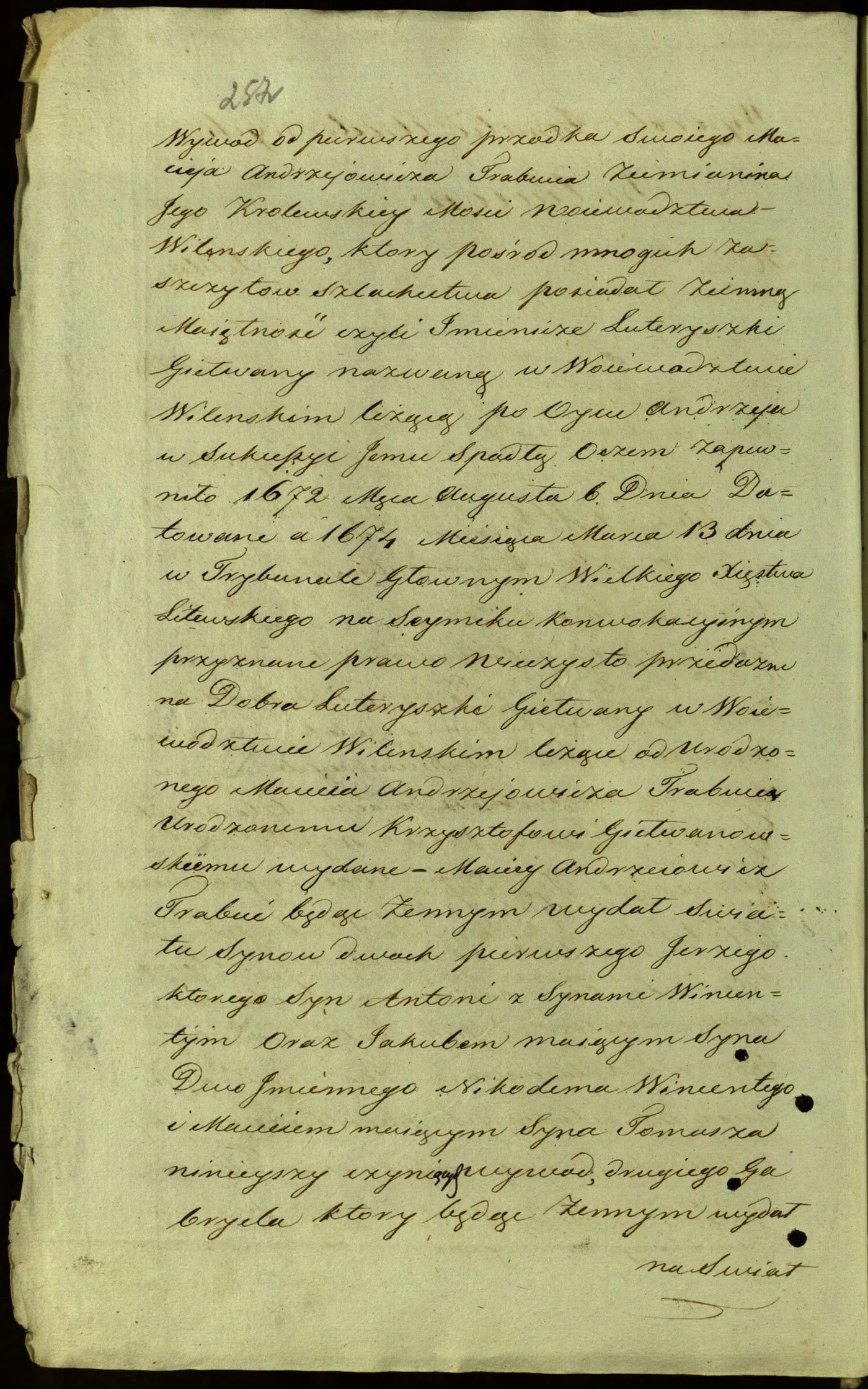
Original text (Polish): Wywod od pierwszego przodka Swoiego Macieja Andrzejowicza Trabucia Ziemianina Jego Krolewskiey Mosci Woiewodztwa Wilenskiego, ktory posrod mnogich zaszczytow Szlachectwa posiadał Ziemną Maiętność czyli Imienicze Luteryszki Gietwany nazwaną w Woiewodztwie Wilenskim leżącą po Oycu Andrzeju w Sukcessyi Jemu Spadłą. O czem zapewniło 1672 Mca Augusta 6 Dnia Datowane a 1674 Miesiąca Marca 13 dnia w Trybunale Głownym Wielkiego Xięstwa Litewskiego na Seymiku konwokacyinym przyznane prawo Wieczysto przedażne na Dobra Luteryszki Gietwany w Woiewodztwie Wilenskim leżące od Urodzonego Macieia Andrzejowicza Trabucia Urodzonemu Krzysztofowi Gietwanowskiemu wydane. Maciey Andrzeiowicz Trabuć będąc Żennym wydał Swiatu Synow dwoch pierwszego Jerzego którego Syn Antoni z Synami Wincentym Oraz Jakubem maiącym Syna Dwo Jmiennego Nikodema Wincentego i Macieiem maiącym Syna Tomasza ninieyszy czynią wywod, drugiego Gabryela ktory będąc Żennym wydał na Swiat
In English: The proof begins with the first ancestor, Maciej Trabuć, son of Andrzej, a landowner of His Royal Majesty in the Vilnius voivodeship. Among the many honours of nobility he possessed a landed estate called Luteryszki Gietwany, situated in the Vilnius voivodeship, which came to him by inheritance from his father Andrzej. This is attested by the deed of perpetual sale of the estate of Luteryszki Gietwany, issued on 6 August 1672 by the well-born Maciej Trabuć, son of Andrzej, to the well-born Krzysztof Gietwanowski and confirmed on 13 March 1674 in the Chief Tribunal of the Grand Duchy of Lithuania at the convocation dietine. Maciej Trabuć, son of Andrzej, was married and had two sons. The first was Jerzy. Jerzy's son Antoni submits this proof together with his sons: Wincenty, Jakub (father of a son with two names, Nikodem Wincenty) and Maciej (father of Tomasz). Maciej's second son was Gabriel, who was married and had (continued on the next page).
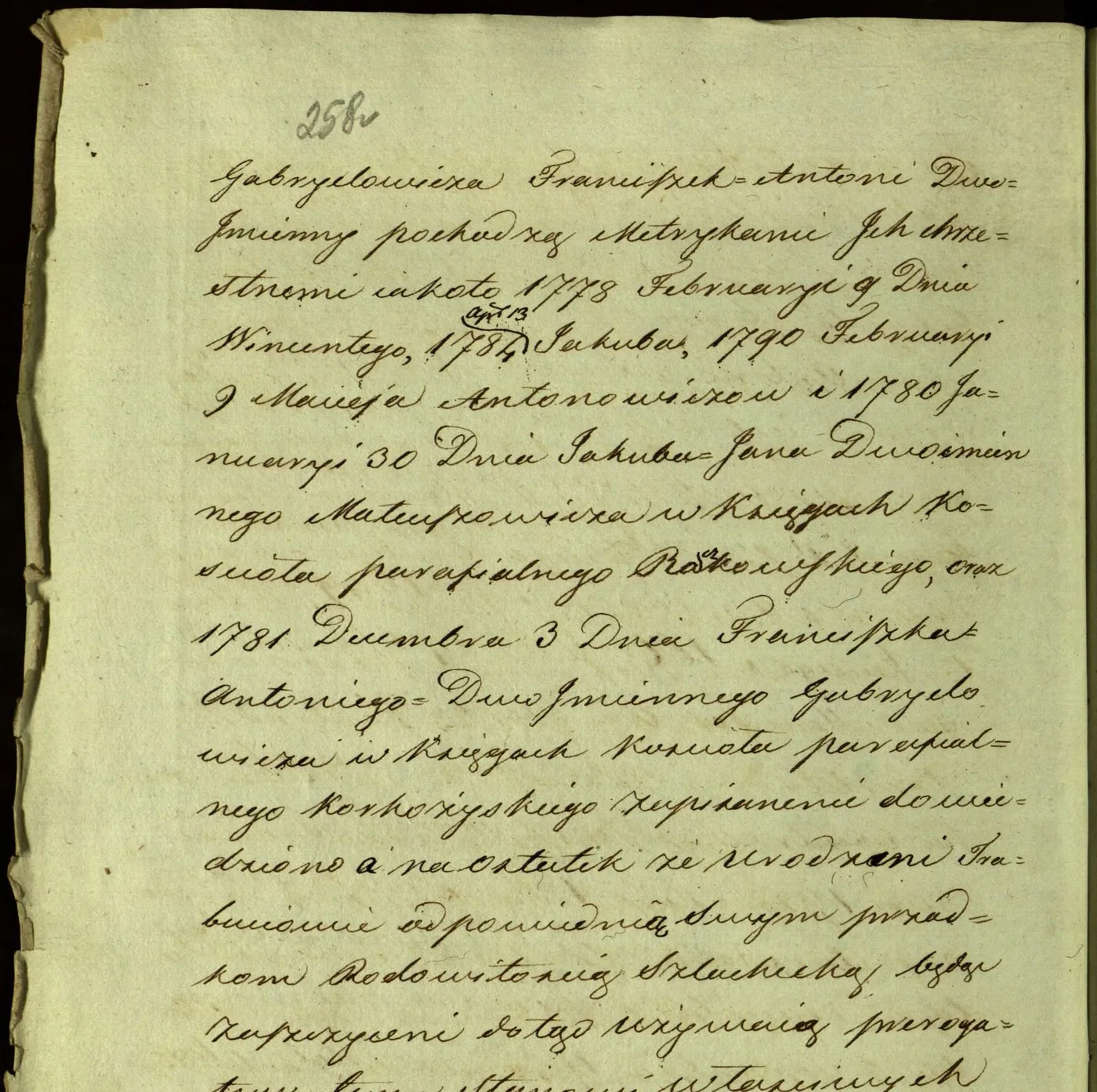
Original text (Polish): Na Swiat Synow dwoch pierwszego Mateusza ktorego Syn Jakub=Jan Dwo Jmienny iest wywodzącym się, drugiego Gabryela ktorego Syn Dwo Jmienny Franciszek Antoni z Synem Justynem rowniez iest wywodzącym się, o iakowey niezaprzeczoney prawdzie dostatecznie upewniły następne pisma Dowody a mianowicie 1649 Maja 1° Jerzego i 1660 Julii 24 Gabryela Synow Macieja Andrzejowicza Metryki Chrzestne w Księgach Koscioła parafialnego Michaliskiego Zapisane Oraz 1722 Maja 1 Dnia Metryka chrztu Antoniego Jerzewicza w Xięgach tegoż koscioła zapisana, niemniey […]
In English: Gabriel had two sons. The first was Mateusz, whose son with two names, Jakub Jan, submits this proof. The second was Gabriel, whose son with two names, Franciszek Antoni, together with his son Justyn, also submits this proof. This undeniable truth was confirmed by the following written evidence: the baptism records of the sons of Maciej, son of Andrzej, entered in the registers of the parish church in Michaliszki, of Jerzy of 1 May 1649 and of Gabriel of 24 July 1660, as well as the baptism record of Antoni, son of Jerzy, of 1 May 1722, entered in the registers of the same church, as well as (the proof then lists the parish records of the second branch of the family).
So the proof of nobility gives Antoni a baptism record of 1722, while the 1795 revision list gave his age as 45. According to the list Antoni would have been born about 1750, almost thirty years after the baptism given in the proof. These dates do not fit together, so there may in reality have been one more generation between Jerzy and Antoni.
How Antoni and his sons lived
The Trabuć family were petty nobility without land of their own. Maciej sold the only estate we know of in 1672. His descendants farmed other people's land. The proof of nobility lists the agreements made by Antoni's sons. In 1810 Marcin, Wincenty, Jakub and Maciej took a manor farm in Korkożyszki parish in pledge for three years. A pledge meant that the owner borrowed money and in return handed over the land for use. Two years later the family held a zaścianek on lease from Michał Kostrowicki. Jakub Trabuć took land on lease from Antoni Łappa, president of the chief court in Vilnius.
The proof of nobility also mentions that one of the Trabuć family served for eight years as a guard on the estates of Prince Dominik Radziwiłł, owner of Nieśwież and Ołyka. This is the same Radziwiłł who raised his own regiment of uhlans, marched on Moscow with Napoleon in 1812 and died of his wounds a year later. The certificate of this service is dated 23 April 1807.
The proof of nobility was signed by Michał Römer (1778-1853), marshal of the nobility of the Vilnius governorate. He himself bore the Jelita coat of arms, the same one he confirmed for the Trabuć family. In 1812 Napoleon appointed him president of Vilnius. Later Römer headed the Vilnius Charitable Society. For his part in the Patriotic Society he was imprisoned in 1826-1830 and then exiled to Voronezh.
The Łappa family of the Junosza coat of arms owned the large estate of Bojarele in Korkożyszki parish. The zaścianek leased from Kostrowicki was called Wiłkomusze. The Trabuć family were still living there between 1820 and 1849, according to Czesław Malewski.
Two villages called Trabucie, the same name as the family, still exist today, one near Korkożyszki and the other near Święciany. A geographical dictionary from the end of the 19th century describes one of them as a noble zaścianek on a small river of the same name, on the Orniany estate of the Tyszkiewicz family. In one of them, in Korkożyszki parish, Maciej Trabuć was married in 1814.
This was the first marriage of Maciej, Agata's youngest brother. One of the three witnesses was his brother-in-law Stanisław Markowicz. Five weeks later a son, Tadeusz, was born to Stanisław and Agata in Andrulańce.
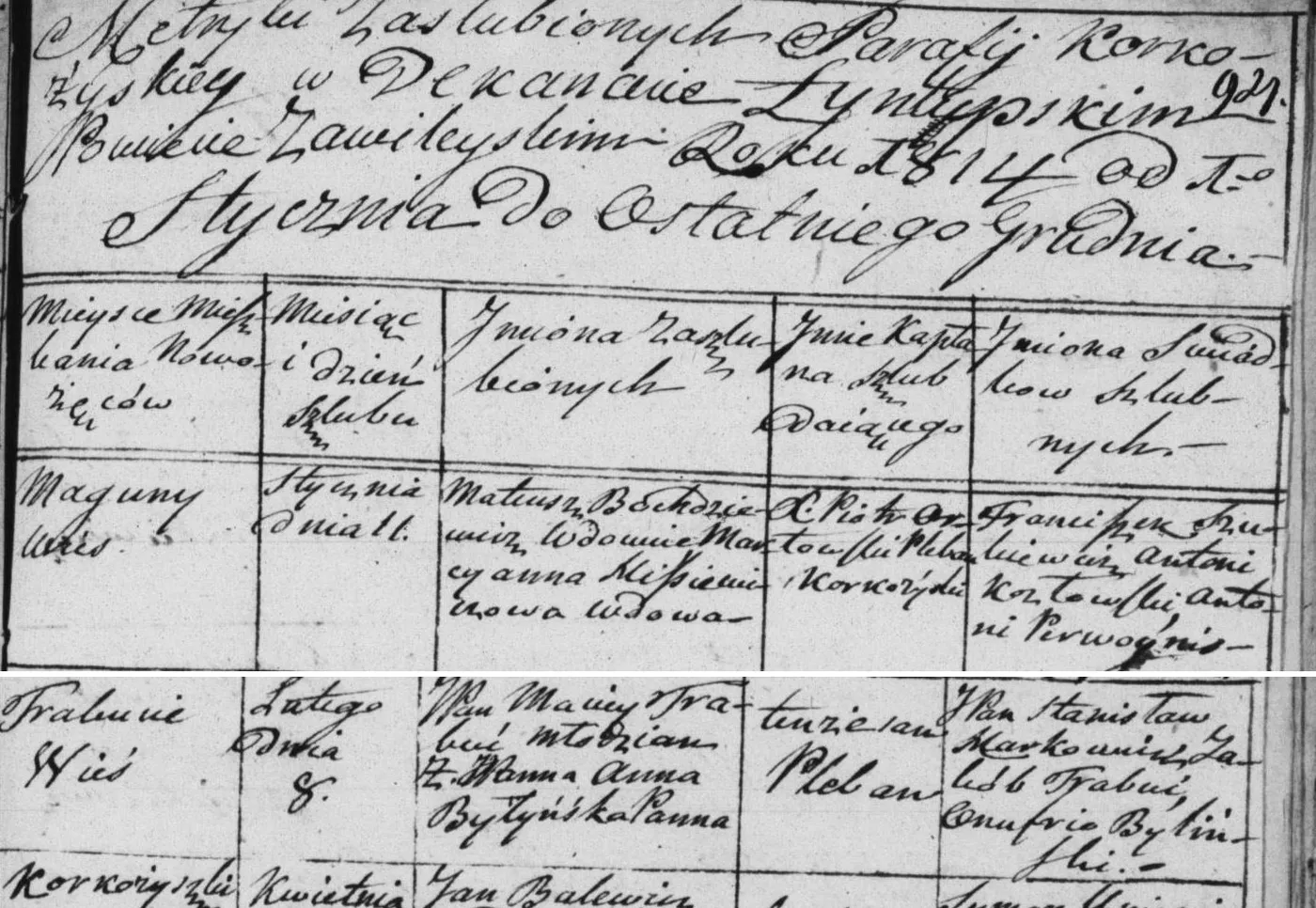
Original text (Polish): Trabucie Wieś / Lutego Dnia 8. / WPan Maciey Trabuć młodzian z Panną Anną Bytyńską[?] / tenże sam Pleban / JPan Stanisław Markowicz, Jakób Trabuć, Onufrio Byliń[ski]
In English: Place: the village of Trabucie. Day of the marriage: 8 February. The couple: the noble Mr Maciej Trabuć, bachelor, with Miss Anna Bylińska (the surname is written unclearly in the record). The marriage was performed by the same parish priest as in the previous entry. Witnesses: Mr Stanisław Markowicz, Jakub Trabuć and Onufry Byliński.
Jerzy Trabuć (baptised 1649)
| Who he was | according to the proof of nobility Jerzy was Antoni's father and Agata's grandfather |
| Baptism | 1 May 1649, the church in Michaliszki |
| Father | Maciej Trabuć, son of Andrzej |
| Brother | Gabriel, baptised 24 July 1660 in Michaliszki |
We know Jerzy from two documents. The proof of nobility of 1820 gives the day of his baptism and calls him Antoni's father. The 1795 revision list records Antoni as “son of Jerzy”. Michaliszki, where Jerzy was baptised, is a small town on the river Wilia, today in Belarus, not far from the border with Lithuania. Jerzy's brother Gabriel was the forefather of the second branch of the Trabuć family, which proved its nobility together with Antoni in 1820.
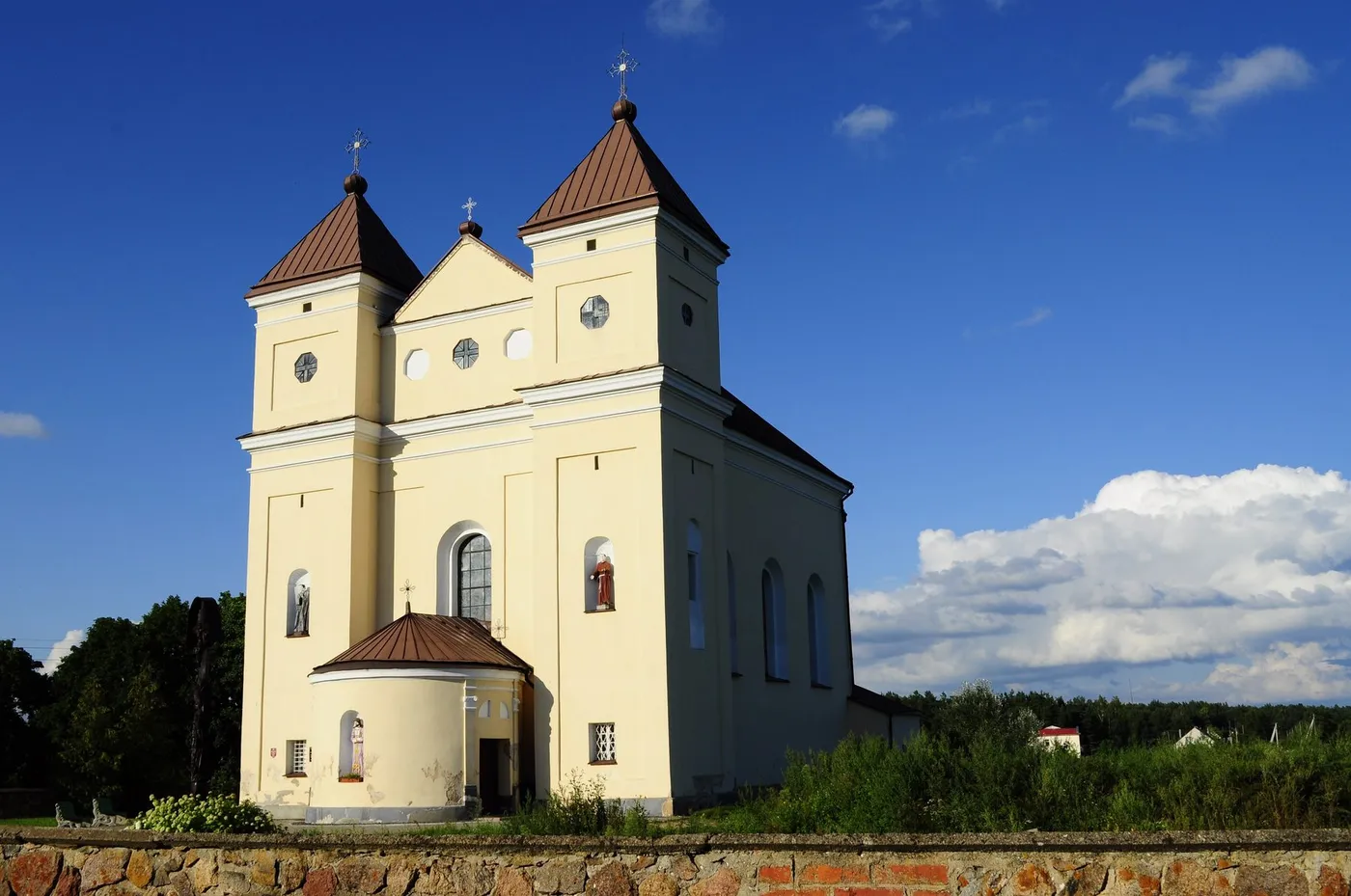
Maciej Trabuć (living in 1672)
| Who he was | Maciej was Jerzy's father |
| Father | Andrzej Trabuć |
| Status | landowner of His Royal Majesty in the Vilnius voivodeship, that is, a nobleman with land of his own |
| Estate | Luteryszki Gietwany, inherited from his father and sold on 6 August 1672 to Krzysztof Gietwanowski |
| Sons | Jerzy (1649) and Gabriel (1660) |
Maciej is the first ancestor with whom the Trabuć family began their proof of nobility. The sale of the estate was confirmed on 13 March 1674 in the Chief Tribunal of the Grand Duchy of Lithuania, the highest court of the nobility in Lithuania. We give the name of the estate as it is written in the proof, but the clerk wrote the letter “ł” almost the same as “t”. The place meant is Loteryszki in Giełwany, a settlement of petty nobility a few dozen kilometres north-west of Vilnius (today Gelvonai in Lithuania). This is confirmed by the hearth tax list of 1690, a tax paid on every house. Eighteen years after the sale a Mr Giełwanowski pays tax there “from Loteryszki”, for one house. So it was a small estate, one of more than thirty shares into which this settlement was divided. Giełwany lies about ninety kilometres from Michaliszki, where we meet the Trabuć family later.
Andrzej Trabuć (living c. 1600)
| Who he was | Andrzej was Maciej's father |
| Estate | Luteryszki Gietwany in the Vilnius voivodeship |
| How we know of him | from one sentence of the proof of nobility of 1820 |
About Andrzej the proof of nobility says only that the estate came to Maciej “po Oycu Andrzeju w Sukcessyi”, that is, by inheritance from his father Andrzej. The proof gives no date for Andrzej. The earliest date in the proof is 1649, when Maciej had a son baptised. So Maciej was born about 1625 at the latest. His father Andrzej lived about 1600. Andrzej Trabuć is the earliest ancestor of Agata whom we know by name.
The Jelita coat of arms of the Trabuć family
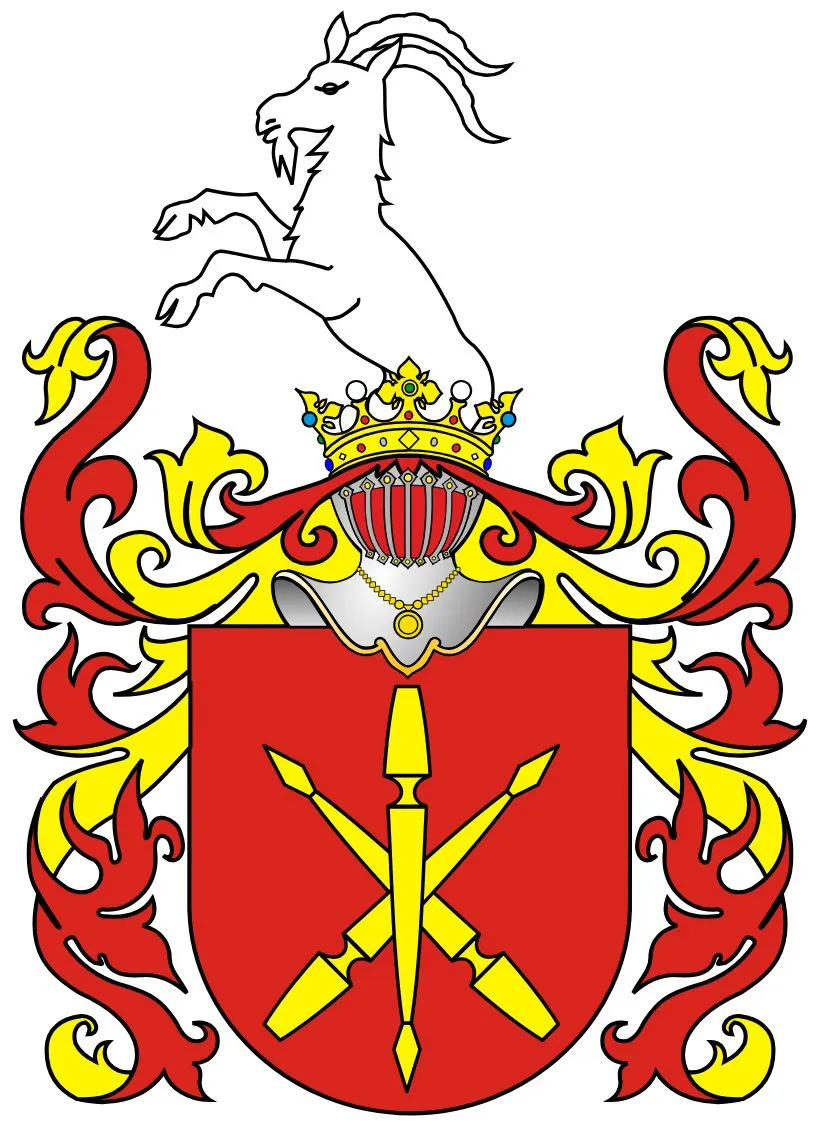
A coat of arms was a mark of nobility. Anyone who proved before the authorities that he was a nobleman also stated his coat of arms. The Jelita coat of arms shows three golden lances on a red shield: two crossed diagonally and the third upright, point down. Above the helmet there is half a goat. Legend says that the arms date from the battle of Płowce in 1331. King Władysław the Elbow-high is said to have found the knight Florian Szary there, pierced by three lances of the Teutonic Knights. As a reward he is said to have granted him this sign. The name of the arms sounds strange, but it means exactly what it says: jelita, that is, entrails. According to the legend the wounded Florian was holding in his own entrails with his hands after they had spilled from his torn belly. The king asked him whether he was suffering greatly. The knight is said to have answered that a bad neighbour in the village hurts more than a wound. The three lances on the shield recall the ones that pierced him. Earlier the same sign was called Koźlerogi (Goat's Horns), after the goat above the helmet. Many families used the Jelita arms, among them the Zamoyski family. The Trabuć family proved their right to these arms in Vilnius on 27 August 1820. Agata brought them to the Markowicz family as the arms of her own family.
The story of Florian Szary was written down by Jan Długosz, in his “Annals” under the year 1331 and in his list of the arms of the Polish knighthood. Długosz tells it a little differently from the popular version of the legend: the family already bore three spears in its arms before the battle. After Płowce it only changed the name from Koźle Rogi to Jelita. Bartosz Paprocki, author of the first printed Polish armorials, repeated the same in 1584. Długosz added one sentence about the people who bear the arms: they are modest and fond of dogs and hunting. In 1413 at Horodło on the Bug, Poland and Lithuania renewed their union. Polish knightly families then shared their coats of arms with Lithuanian boyars. The Jelita arms were taken at that time by the boyar Gerdud. Since then the arms have been known in Lithuania.
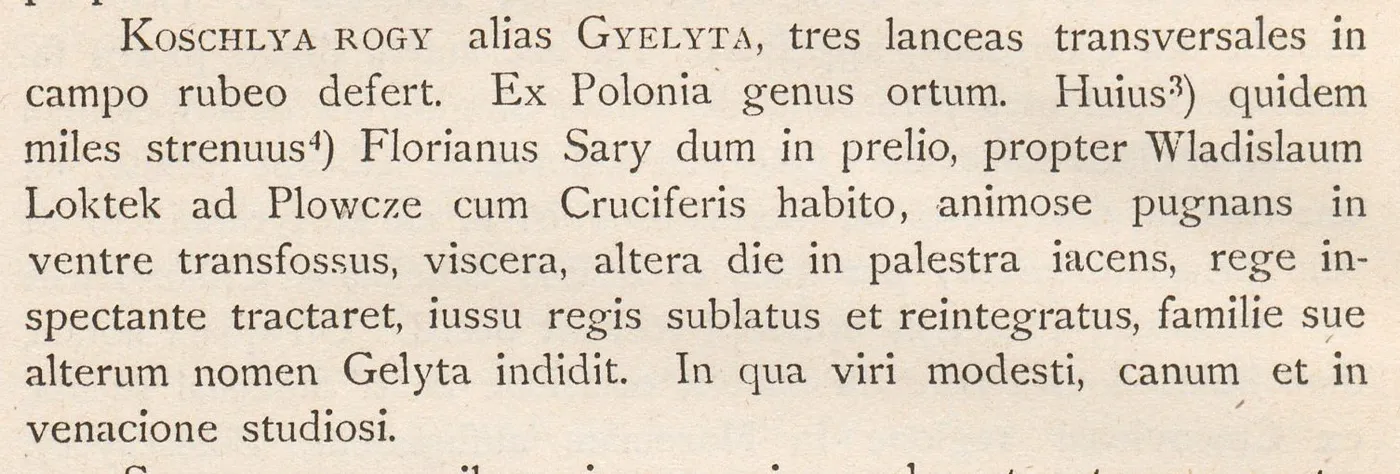
Original text (Latin): Koschlya rogy alias Gyelyta, tres lanceas transversales in campo rubeo defert. Ex Polonia genus ortum. Huius quidem miles strenuus Florianus Sary dum in prelio, propter Wladislaum Loktek ad Plowcze cum Cruciferis habito, animose pugnans in ventre transfossus, viscera, altera die in palestra iacens, rege inspectante tractaret, iussu regis sublatus et reintegratus, familie sue alterum nomen Gelyta indidit. In qua viri modesti, canum et in venacione studiosi.
In English: Koźle Rogi, otherwise Jelita, bears in a red field three spears laid crosswise. The family comes from Poland. A brave knight of this family, Florian Szary, fought valiantly in the battle of King Władysław the Elbow-high against the Teutonic Knights at Płowce and was pierced through the belly. The next day he lay on the battlefield and before the king's eyes held his own entrails in his hands. By the king's order he was lifted up and healed. He gave his family a second name, Jelita. The men of this family are modest, devoted to dogs and to hunting.
The Bończa coat of arms and the Markowicz family
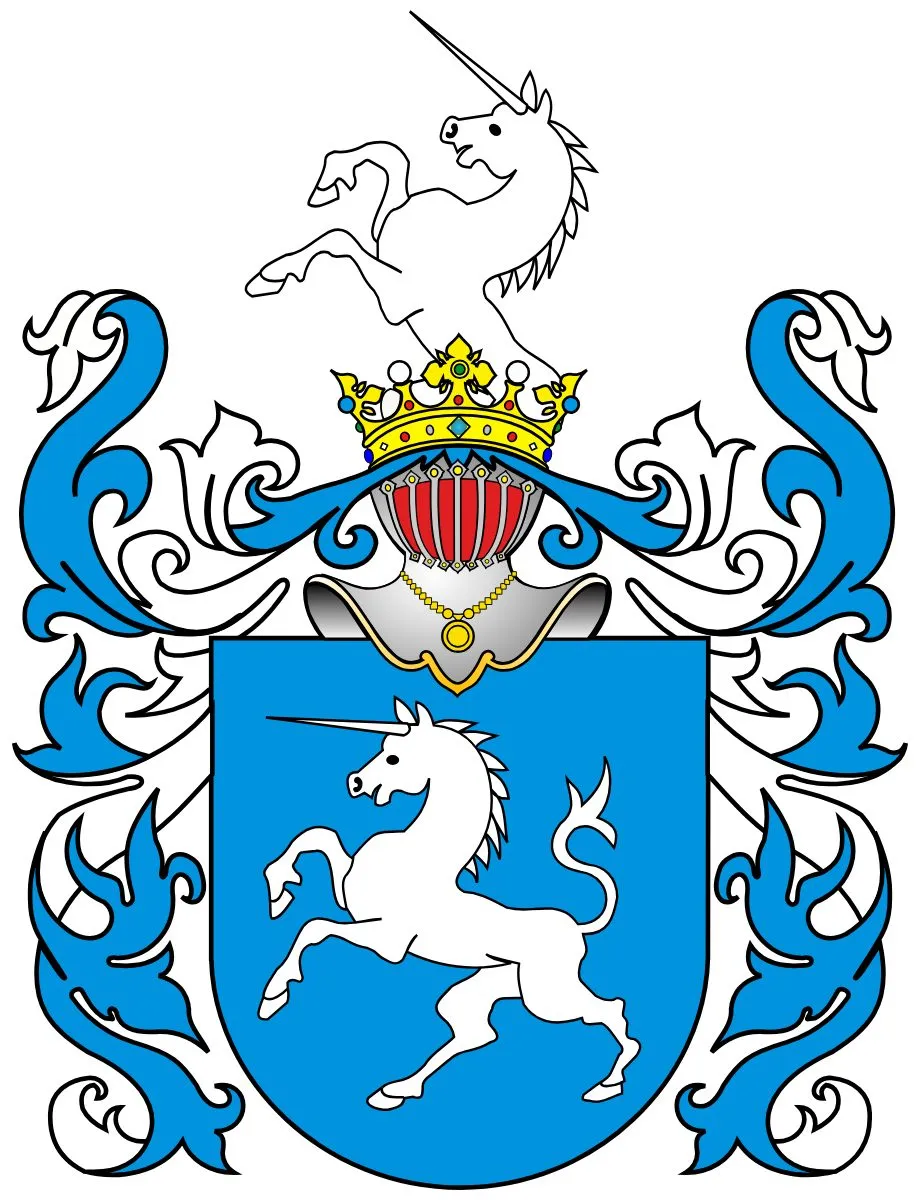
The Bończa coat of arms shows a white unicorn on a blue shield. The Markowicz family of the Bończa coat of arms had their nobility confirmed in Vilnius twice. The first decree, of 16 June 1806, concerned only two brothers, Andrzej and Onufry, sons of Kazimierz. The second decree, of 16 December 1819, covered their relatives, among them Stanisław Markowicz with his sons. Both decrees trace the family back to Łukasz Markowicz, who had an estate in the Vilnius district. The playwright Aleksander Fredro sealed with the same arms. Tadeusz, Dominik's grandfather, is named in the decree of 1819.
The arms were described in the 15th century by Jan Długosz. In his armorial Bończa stands under the name Jednorożec (Unicorn). Długosz writes that the family came to Poland from Italy and called itself Bonacza, that is “good time”. From this word Bończa was made over time. In 1584 Bartosz Paprocki repeated that the arms were “brought from Italy to Poland at the time when the Christian faith first began to flourish”. Old authors described the sign itself in this way. They did not name families from Lithuanian zaścianki, such as ours.
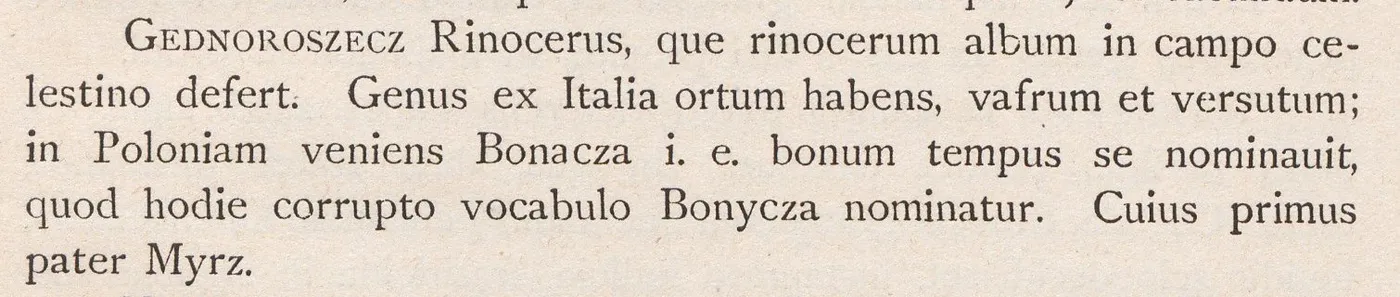
Original text (Latin): Gednoroszecz Rinocerus, que rinocerum album in campo celestino defert. Genus ex Italia ortum habens […] in Poloniam veniens Bonacza i. e. bonum tempus se nominauit, quod hodie corrupto vocabulo Bonycza nominatur. Cuius primus pater Myrz.
In English: Jednorożec (Unicorn), which bears a white unicorn in a blue field. A family originating from Italy. When it came to Poland, it called itself Bonacza, that is good time, which today in a corrupted word is pronounced Bonycza. Its first father was Myrz.
In old Poland the king was elected by the whole nobility. The names of the voters were afterwards printed in the collection of laws. In the list of those who elected King Jan Kazimierz in 1648 the name Markowicz appears. Among the electors from the Vilnius voivodeship stands Stanisław Markowicz. The list gives neither his district nor his arms, so it is impossible to say whether he belonged to our family.
Czesław Malewski, a historian of the nobility of the Święciany district, counts among this family the Markowicz families of Obkorty, Wojtkuny, Mirańce and Kocielniki, that is, from the same villages and years in which our family lived. This is his assessment, based on the same church registers that this chronicle uses.
The family kept the memory of its noble origins. , Alina's daughter, told us that the Markowicz family were “of a higher lineage”.
Sources
The most important facts in this chapter have their own document. The abbreviation LVIA stands for the Lithuanian State Historical Archives in Vilnius.
| Document | Where it is held |
|---|---|
| Baptism records of Alina's children, 1950-1957 | baptism registers of the church in Powiewiórka (Podbrodzie parish), records 3/1950, 49/1951, 17/1954, 3/1956, 18/1957 |
| Marriage record of Alina and Antoni, 1949 | Civil Registry Office in Podbrodzie, record 10. Translation of 1959 and a copy from Iława in the family's collection |
| Antoni declared dead, 1973 | District Court in Iława, decision of 23 August 1973. Copy in the family's collection |
| Death record of Alina, 2014 | Civil Registry Office in Ostróda, record 16/2014 |
| Family gravestone | cemetery in Iława |
| Documents on the land in Obkorty and the compensation | decisions of the Warmian-Masurian Voivode of 10 December 2020 and 18 January 2024, court decisions in Iława (1990) and Ostróda (2023). Copies in 's collection |
| Baptism of Dominik, 1897 | LVIA, fond 604, inventory 37, book 128, Święciany parish, record 256 |
| Baptism of Leokadia, 1900 | LVIA, fond 604, inventory 37, book 134, Mielegiany parish, record 143 |
| Parish census of Sorokpol, 1909 | transcript published on the genealogia.lt website, zaścianek Wojtkuny, house no. 39 |
| Marriage of Bolesław and Zofia, 1884 | LVIA, fond 604, inventory 37, book 112, Święciany parish, record 30 |
| Baptism of Bolesław, 1851 | baptism register of St Raphael's parish in Vilnius, record 59. Image on the FamilySearch website |
| Baptism of Antoni Markowicz, 1862 | LVIA, fond 772, inventory 1, book 7, Sorokpol parish, record 20 |
| Marriage of Tadeusz and Urszula, 1840 | LVIA, fond 604, inventory 37, book 57, Święciany parish, record 42 |
| Baptisms and deaths of Tadeusz's children, 1843-1864 | LVIA, fond 604, inventory 37, books 63, 75, 77 and 85 |
| Baptisms of Tadeusz (1814) and Justyn Mateusz (1810) | baptism register of Janiszki parish, FamilySearch film 1426345, images 283 and 271 |
| Death of Justyn Mateusz (1812) and a marriage of 16 November 1813 with Stanisław as a witness | LVIA, fond 604, inventory 10, book 58. Register of Janiszki parish for 1802-1818 (FamilySearch film 7793570, images 366 and 322) |
| Marriage of Stanisław and Agata, 1807 | LVIA, fond 3007, inventory 29, book 19, Święciany parish, record 7 |
| Baptism of the twins, 1816 | LVIA, fond 772, inventory 1, book 1, Sorokpol parish, records 107 and 108 |
| Death of Stanisław, 1827 | LVIA, fond 604, inventory 37, book 21, list of the dead of Sorokpol parish |
| Deaths of Ewa Trabuć, Felicjan and Agata, 1827-1830 | LVIA, fond 748, inventory 1, book 2, Korkożyszki parish, records 3/1827, 7/1828 and 23/1830 |
| Death of Bogumiła, 1860 | LVIA, fond 604, inventory 37, book 81, Sorokpol parish, record 34 |
| Revision list of 1795, Dworciszki | LVIA, fond 515, inventory 15, book 50 |
| Marriages of Maciej Trabuć (1814 and 1833) and Jakub (1840) | LVIA, fond 604, inventory 10, book 103. Marriage register of Janiszki parish (FamilySearch film). LVIA, fond 604, inventory 37, book 57 |
| Proof of nobility of the Trabuć family of the Jelita coat of arms, 1820 | LVIA, fond 391, inventory 1, volume 990, fols. 257-260 |
| Baptisms of Ignacy Wincenty (1783), Jerzy Wojciech (1785) and Rachela Antonina (1787) | LVIA, fond 3007, inventory 15, book 1. Baptism register of Podbrzezie parish for 1782-1790, records 54/1783, 40/1785 and 78/1787 |
| Deaths of Gabriel (1794), Franciszka (1800) and Kazimierz (1805) Markowicz | LVIA, fond 3007, inventory 15, book 23. Register of the dead of Podbrzezie parish for 1782-1819 |
| Revision list of 1795, village of Niemenczynek (Bartłomiej Markowicz and his family) | LVIA, fond 515, inventory 15, book 23, fol. 50 |
| Lists of the Purnuszki and Niemenczynek estates of 1811 and 1816 | LVIA, fond 515, inventory 15, books 191 and 267 |
| Notice by the owner of Niemenczynka, 1816 | “Kuryer Litewski” 1816, no. 26, National Library of Poland (Polona) |
| Łukasz Markowicz, mayor of Vilnius | A. Ragauskas, R. Ragauskienė, the writings of Mayor Łukasz Markowicz from 1551-1584, Vilnius 2010. Catalogue of manuscripts of the Vilnius University Library, fond F5 |
| Old authors on Mayor Łukasz | Stanisław Lubieniecki, Historia Reformationis Polonicae, 1685, pp. 227 and 240. Piotr Rojzjusz, Carmina, ed. B. Kruczkiewicz, Kraków 1900, part II, pp. 218-219. Matriculation register of the University of Rostock, February 1576. Records of the synod at Pełsznica, ed. S. Zachorowski, “Reformacja w Polsce” 1921, no. 3, p. 233. J. I. Kraszewski, Wilno od początków jego do roku 1750, vol. 3, Vilnius 1841, pp. 113-114. Polish Biographical Dictionary, vol. XXII, 1977, entry “Mundius Łukasz” |
| List of the electors of King Jan Kazimierz, 1648 | Volumina Legum, ed. J. Ohryzko, St Petersburg 1859-1860, vol. IV, p. 100 |
| Jan Długosz on the Bończa and Jelita coats of arms | Insignia seu clenodia Regis et Regni Poloniae, ed. Z. Celichowski, Poznań 1885, pp. 19 and 22. Annals, book IX, year 1331 |
| Chroniclers on Mejszagoła and Giedrojcie | Jan Długosz, Annals, book X, year 1387. Maciej Stryjkowski, Kronika polska, litewska, żmódzka i wszystkiej Rusi, ed. Warsaw 1846, vol. 1, p. 318 and vol. 2, p. 80 |
| Bartosz Paprocki on the Bończa and Jelita coats of arms | Herby rycerstwa polskiego, 1584, ed. K. J. Turowski, Kraków 1858, pp. 254 and 601 |
| Proof of nobility of the Markowicz family of the Bończa coat of arms, 1806 | LVIA, fond 391, inventory 1, volume 861 |
| Letter of the marshal of the nobility of the Vilnius district on the estates of the Markowicz family, 18 October 1849 | LVIA, fond 391, inventory 4, file 1821 |
| Decree of the Markowicz family of the Bończa coat of arms of 16 December 1819 (Stanisław, his father Bartłomiej, grandfather Kazimierz and great-grandfather Łukasz) | LVIA, fond 391, inventory 8, file 2596, item 113, fols. 442 to 445. Copy issued on 11 November 1821 |
| Family stories | conversations with (Iława, 29 August 2026), with Romuald (June 2026) and 's account (August 2026) |
| Lists of the nobility of the Święciany and Vilnius districts, lists of marshals | works of Czesław Malewski |
| Biographies of the people who signed the decrees | Polish Biographical Dictionary (Eustachy Karol Karp), works of Czesław Malewski (Abramowicz, Römer), Wikipedia (Józef Strumiłło, Michał Römer) |
| Official prices of horses, oxen and cows in the 16th century | Statute of the Grand Duchy of Lithuania of 1566, chapter 13, articles 7 and 8 |
| Today's prices of dairy cows | farming websites agrofakty.pl and mojarola.pl, as of 2026 |
| Mejszagoła, Podbrzezie, Trabucie | Geographical Dictionary of the Kingdom of Poland, 1880-1902, Wikipedia |