Records for a citizenship case
Polish citizenship by descent: who qualifies and what you need
Many Americans, Britons and Canadians have a Polish grandparent or great-grandparent and ask whether that makes them Polish. Polish law sets no limit on the number of generations. A child of a Polish citizen is a Polish citizen by birth (article 14 of the Polish Citizenship Act of 2 April 2009).
What decides your case is whether Polish citizenship passed from your ancestor to each generation down to you without a break. This guide shows where the line usually breaks under the laws of 1920, 1951 and 2009 and the three official steps from a confirmation of citizenship to a Polish passport. It follows the texts of the acts and the gov.pl pages as they stood on 23 October 2026.
It is not legal advice. A lawyer who handles citizenship cases decides how the rules apply to your family.
1. No limit on generations, but no break in the chain
Polish citizenship passes from parent to child. If your great-great-grandfather was a Polish citizen, he passed it to his child, that child to the next and so on down to you. Every link must hold. If one person in the line lost Polish citizenship before their child was born, the child was not born Polish and the line stops there.
So each person in the line needs checking, from the ancestor down to your parent: when and where they were born, whether they married a foreigner and whether they took another country's citizenship. If they did, you need the date.
2. Who was Polish in the first place: the Act of 1920
From 1795 to 1918 there was no Polish state, so there was no Polish citizenship either. Polish citizenship law begins with the Act of 20 January 1920 on Polish citizenship (Dz.U. 1920 nr 7 poz. 44). Under article 2 the new state gave citizenship to people settled on its territory or born there, unless they held another state's citizenship.
The Act defines who counts as settled separately for each of the three former partitions:
- former Kingdom of Poland, the Russian partition around Warsaw: people entered in the books of permanent population
- former Austrian partition, mainly Galicia: people with the right of domicile (Heimatrecht) in a commune there
- former Prussian partition: people who had lived there since before 1 January 1908
- other lands of the former Russian Empire: people registered as residents there
An ancestor who took American, British or another citizenship before 1920 never became a Polish citizen and could not pass Polish citizenship on.
For emigrants who left before 1920 and did not naturalize abroad, Polish offices and courts decide case by case. Ask a lawyer about this before you order any documents.
3. How the line broke before 1951
From 1920 until 19 January 1951 a Polish citizen could lose that citizenship in several ways. The Act of 1920 lists them:
- Taking another country's citizenship (article 11). For many emigrant families this is where the line breaks: an emigrant who naturalized in the USA, Canada or elsewhere before 1951 usually stopped being Polish on that day.
- Holding public office or serving in the army of another country without the consent of the Polish government (article 11).
- A woman who married a foreigner lost Polish citizenship when the marriage gave her his citizenship (article 10).
- When a man lost Polish citizenship, his wife and his children under 18 lost it with him (article 13).
Article 11 has one exception. A man who was obliged to active service in the Polish army could not lose his citizenship by naturalizing abroad without the permission of the War Minister. This is known as the military exception. Whether it covers your ancestor is a question for your lawyer.
The child's citizenship also depended on the parents' marriage. A child born in marriage took the father's citizenship and a child born outside marriage took the mother's (article 5). So before 1951 a line through a Polish mother married to a foreigner usually breaks: her child took the father's citizenship.
4. What changed in 1951 and 1962
- 1920First Polish Citizenship Act. A child takes the father's citizenship. A child born outside marriage takes the mother's. Taking another citizenship ends Polish citizenship.
- 19 January 1951The Act of 8 January 1951 comes into force (Dz.U. 1951 nr 4 poz. 25). A Polish citizen may take a foreign citizenship only with the permission of the Polish authorities (article 11), so naturalizing abroad no longer ends Polish citizenship by itself.
- 1951 to 1962Stricter rules for children born abroad to one Polish and one foreign parent (articles 6, 8 and 9 of the 1951 Act). A birth in these years needs a careful look.
- 1962 to todayOne Polish parent is enough for the child to be Polish. Today this is article 14 of the 2009 Act.
Article 4 of the 1951 Act also left out some people who lived abroad and had been Polish citizens on 31 August 1939. It concerns families from the eastern lands that passed to other states after the war and people of Russian, Belarusian, Ukrainian, Lithuanian, Latvian, Estonian or German nationality in the ethnic sense. If your family came from the former eastern lands (the Kresy) or from one of these groups, raise it with your lawyer at the start.
5. Questions to answer for each person in the line
- Where and when was the person born? If before 1920, where did they live when Poland's first citizenship law came in?
- Did they take another country's citizenship? On what date? The naturalization papers give it.
- Did a man in the line serve in a foreign army or hold public office abroad before 1951?
- Did a woman in the line marry a foreigner before 1951? Did that marriage give her his citizenship?
- Was the child born in marriage? Before 1951 that decided whether the child followed the father or the mother.
- Was the child born before or after the parent lost Polish citizenship? Was the child under 18 at that time?
Each answer needs a document: a birth or baptism record, a marriage record, a naturalization certificate, sometimes a military or emigration record. The Polish records among them are the ones we find.
6. Step 1: a decision confirming Polish citizenship
You do not apply for citizenship by descent. You ask the Polish state to confirm that you already have it. The decision is issued by a voivode, the government's representative in one of Poland's 16 provinces (articles 55 and 56 of the 2009 Act). From abroad you file the application through a Polish consulate.
- Fill in the application form. It exists only in Polish. It asks about you and your ascendants up to the second degree, which means your parents and your grandparents.
- Collect a document for every link in the chain: Polish records and foreign ones, such as birth and marriage certificates and naturalization papers.
- Have every foreign document translated into Polish by a sworn translator and get an apostille on it. An apostille is an official certificate from the country that issued the document. It confirms that the document is genuine.
- Pay the fee: 118 USD at Polish consulates in the USA. In Poland it is 277 zł.
- Hand in the application at the consulate. The consul can certify copies of your documents.
- Wait for the decision. The office has 6 months, not counting the time spent searching archives. If the answer is no, you can appeal within 14 days.
Each child under 18 needs its own application.
7. Step 2: transcription of your foreign birth certificate
Transcription means entering a foreign birth certificate into the Polish civil register. A Polish register office does it and you then receive a Polish birth certificate. Transcription is required before you can get a Polish identity document or a PESEL number, the Polish personal identification number (article 104 of the Civil Status Records Act).
8. Step 3: the passport
Once your citizenship is confirmed and your birth is in the Polish register, you apply for a Polish passport. You apply in person at a Polish consulate.
9. Where we help
Many cases stall at the oldest link: the birth or marriage record of the ancestor who left, kept in a parish register written in Latin, Polish, Russian or German. We find these records in scanned registers and order copies from Polish register offices. The application, the transcription and the passport are between you, your lawyer and the Polish authorities.
How to order a Polish birth, marriage or death certificate from the USA or the UK
Sources
- Act of 20 January 1920 on Polish citizenship, Dz.U. 1920 nr 7 poz. 44, articles 2, 5, 10, 11 and 13
- Act of 8 January 1951 on Polish citizenship, Dz.U. 1951 nr 4 poz. 25, articles 4, 6, 8, 9 and 11
- Act of 2 April 2009 on Polish citizenship (ustawa o obywatelstwie polskim), articles 14, 55 and 56
- Civil Status Records Act (Prawo o aktach stanu cywilnego), Dz.U. 2026 item 393, article 104
- gov.pl, Ministry of the Interior and Administration, confirmation of Polish citizenship, read 23 October 2026
- gov.pl/web/usa, Polish consulates in the USA, confirmation of citizenship and consular fees, read 23 October 2026
What a record looks like in our report
Baptism of Kazimierz Gaul, 20 January 1732
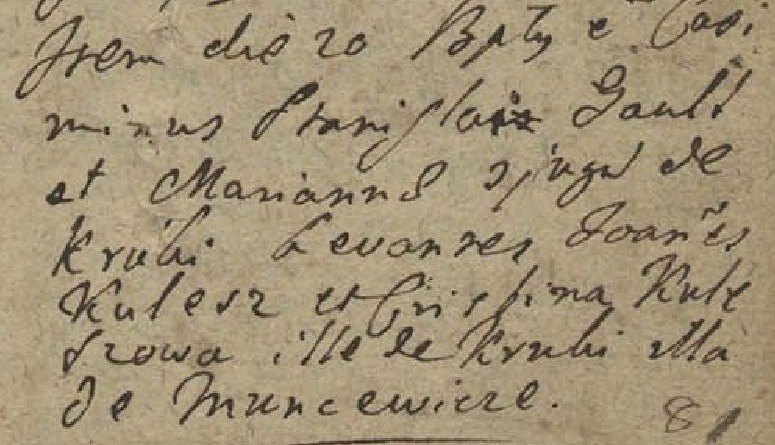
Original text (Latin, abbreviations expanded)
Anno 1732 Januarij. Item die 20 Baptisatus est Casimirus Stanislai Gaull et Mariannae Conjugum de Kruki. Levantes Joannes Kulesz et Cristina Kuleszowa, ille de Kruki, illa de Muncewicze. 81.
In English
In the year 1732, in January. Also on the 20th was baptised Kazimierz, son of Stanisław Gaul with Marianna, spouses from Kruki. The godparents were Jan Kulesz with Krystyna Kuleszowa, he from Kruki, she from Muncewicze. Entry 81.
Archive reference
National Library of Belarus in Minsk, manuscript 091/224К, baptism register of Komaje parish for 1715 to 1746, entry 81 of 1732.
We find the records for your chain
We search scanned parish and civil registers for the birth and marriage records of your ancestors. For each record you receive a clipping, the original text, an English translation and the full archive reference.
One record costs 175 USD and is ready within 10 working days. A chain of records for two to three generations costs 590 USD and is ready within 20 working days. For each person in the chain we explain why the record belongs to your family.
Our representative in Poland can also order a copy from a Polish register office under your power of attorney. This costs 120 USD with the official fees. An apostille for use abroad costs 40 USD extra.
The first assessment is free. Send your ancestor's name, the place as your family remembers it and the approximate years.