Records for a citizenship case
My ancestor left Poland before 1920. Where are the records?
Many families have an ancestor who left before the First World War, when the Polish lands were divided between Russia, Prussia and Austria. The Polish state dates from 1918 and its first citizenship law from 1920.
Whether an emigration date before 1920 matters for your case is a legal question. A lawyer who handles citizenship cases looks at it first. Our part is the documents: we find where your ancestor was born and married and what the records say.
Which records exist for that time
Before 1920 births, marriages and deaths were written down by the parish. In the Kingdom of Poland, the Russian partition, the parish priest also kept the civil register. From 1868 he wrote it in Russian. In the Prussian partition civil register offices kept their own books from 1874. In Galicia, the Austrian partition, the parish register served as the civil record.
What usually stands in the way
- The emigrant's papers give the place in an old form, in English spelling or only the county.
- The surname was written differently in each language: Kowalski, Kovalsky, Ковальский.
- The age given at emigration is often approximate, so the birth year can be off by several years.
- Some registers burned or were lost. Then the yearly transcript the parish priest sent to the church authorities can survive in their place.
How we handle it
We start from what the family has: a ship manifest, a naturalisation paper, a gravestone, a letter. From the place name we find the parish, then check which of its registers are scanned online and for which years.
We read the register year by year around the expected date, not only through an index, because many registers have none. For each record we explain why it is your ancestor and not a namesake.
What a record looks like in our report
Marriage of Tadeusz Markowicz to Urszula Puciata, 2 July 1840
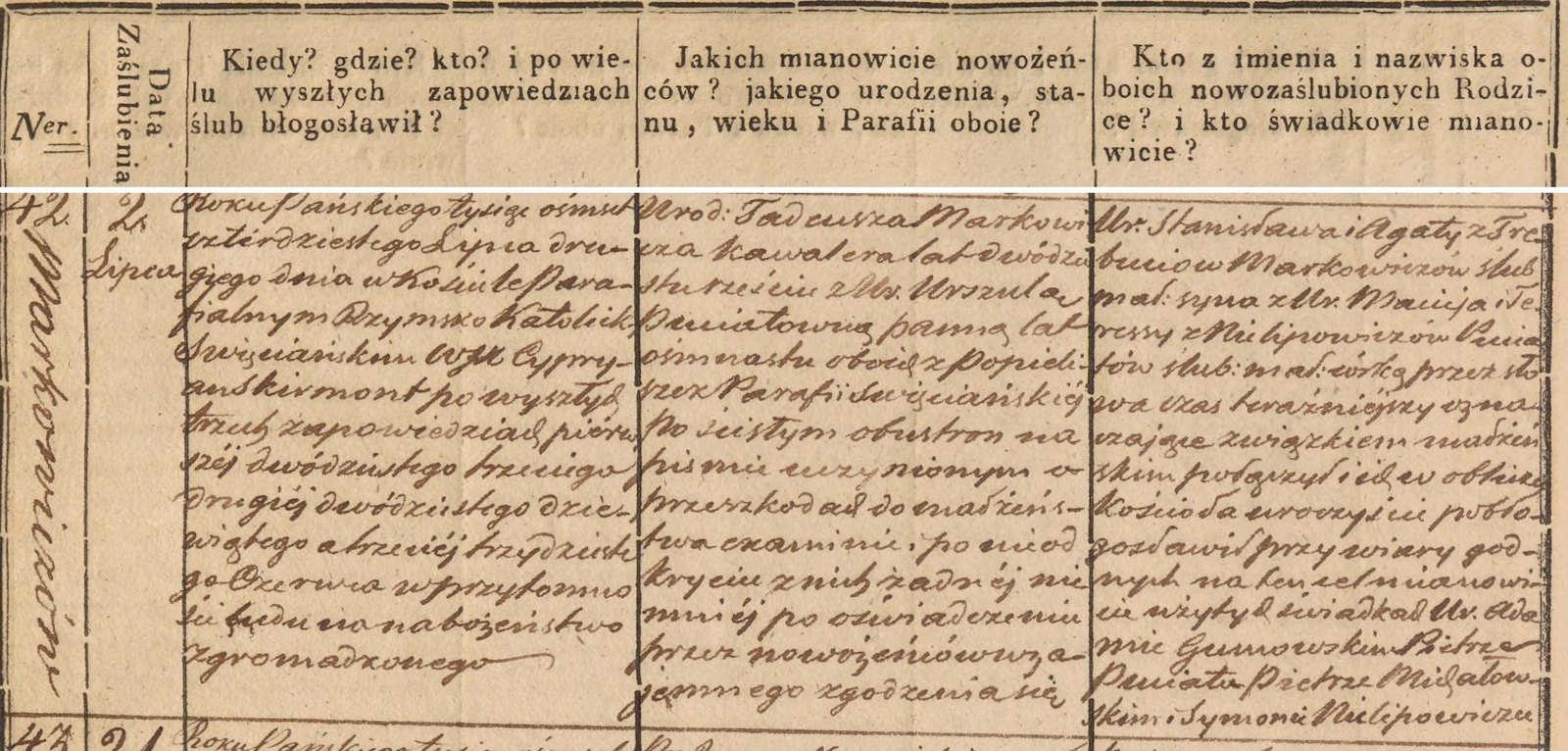
Original text (Polish, with omissions)
Roku Pańskiego tysiąc ośmset czterdziestego Lipca drugiego dnia w Kościele Parafialnym Rzymsko Katolickim Swiecianskim W. X. Cypryan Skirmont po wyszłych trzech zapowiedziach, pierwszej dwódziestego trzeciego, drugiej dwódziestego dziewiątego a trzeciej trzydziestego Czerwca […] Urod: Tadeusza Markowicza kawalera lat dwódziestu sześciu z Ur. Urszulą Puciatowną panną lat ośmnastu, obojż z Popieliszek Parafii Swiecianskiej […] Ur. Stanisława i Agaty z Trebuciow Markowiczow ślub: mał: syna z Ur. Macieja i Teressy z Neilipowiczow Puciatów ślub: mał: córką […] przy świadkach Ur. Adamie Gumowskim, Piotrze Puciacie, Piotrze Michałowskim i Symonie Nielipowiczu.
In English
In the year of Our Lord 1840, on the 2nd of July, in the Roman Catholic parish church of Święciany, the Reverend Cyprian Skirmont, after three banns (the first on 23 June, the second on 29 June, the third on 30 June), blessed the marriage of the well-born Tadeusz Markowicz, a bachelor aged twenty-six, to the well-born Urszula Puciata, a maiden aged eighteen, both from Popieliszki in Święciany parish. He is the son of the well-born Stanisław with Agata née Trabuć, the lawful spouses Markowicz. She is the daughter of the well-born Maciej with Teresa née Nielipowicz, the lawful spouses Puciata. The witnesses were the well-born Adam Gumowski, Piotr Puciata, Piotr Michałowski, Szymon Nielipowicz. In records of that time the word translated here as well-born marked a member of the nobility.
Archive reference
LVIA, fond 604, inventory 37, file 57, Święciany parish, record 42 of 1840.
Tell us who emigrated and from where
Send your ancestor's name, the place as your family remembers it and the approximate year of emigration. The first assessment is free.