How to read a Polish birth record in Latin, Polish and Russian
Most old Polish birth records follow one of a few fixed forms. Once you know which form you are looking at, you know where to find the child, the parents and the godparents, even before you can read every word.
Below are the forms by period, the words you need and the traps that catch most people. The two longer examples are records we read on the scans and published on our parish pages for Chmielno and Chełmica.
1. First work out the language
Before 1918 Polish lands were divided between Russia, Prussia and Austria. The language of the records followed the border.
Notes in the margin were often added years later and can be in a different language from the record itself.
- 1784Galicia: parishes must keep their registers in columns, in Latin
- 1808Duchy of Warsaw: civil registers, usually kept by the parish priest
- 1826Kingdom of Poland: civil-religious registers that open with “Działo się”
- 1868Kingdom of Poland: registers switch to Russian, in some parishes later
- 1874Prussian lands: civil register offices (Standesamt) on German forms
- 1915 to 1918Central Poland: registers return to Polish, at different dates in different parishes
- Russian partition (central Poland with Warsaw, Łódź and Lublin): Polish from 1808, Russian from 1868 until about 1915 to 1918, depending on the parish. Many parishes switched to Russian late.
- Prussian partition (Poznań, Pomerania, Silesia): church books mostly in Latin or German. From 1874 also German civil register forms.
- Austrian partition (Galicia): Latin column registers, from the late 19th century often in Polish.
- Vilnius region and Lithuania: Latin, then Polish, then Russian, changing at different dates in different parishes.
2. A Latin baptism
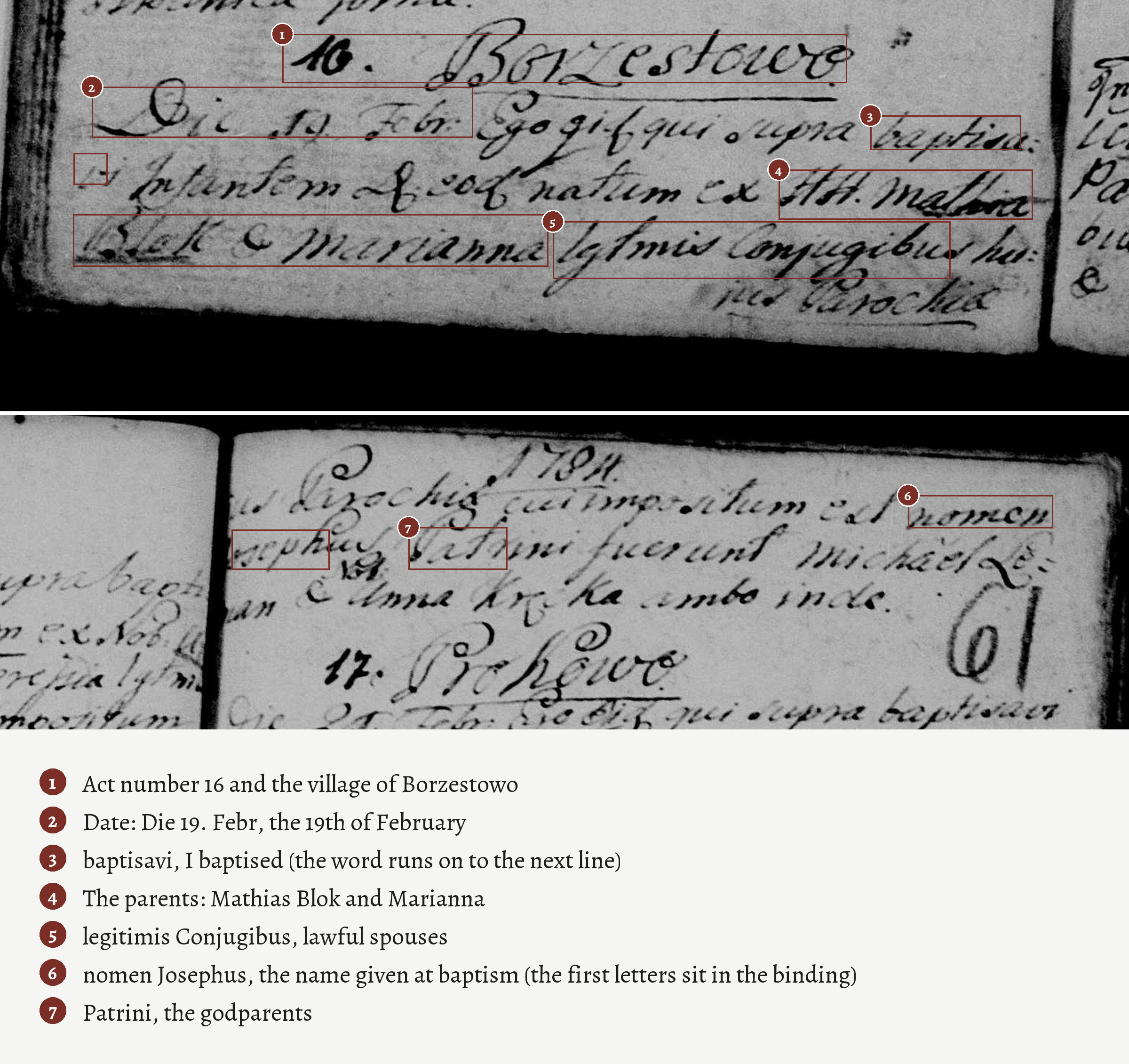
A Latin entry is short and usually keeps this order: record number and village in the margin, the date, the priest saying he baptised (baptizavi, often spelt baptisavi as in our example), the child, the parents with the words “lawful spouses” (legitimis conjugibus), the name given and the godparents (patrini or levantes).
Our example is record 16 of 1784 from the parish of Chmielno in Kashubia: “16. Borzestowo. Die 19. Febr: Ego q[ui] s[upra] baptisavi Infantem d[ie] eod[em] natum ex HH. Mathia Blok & Marianna l[e]g[iti]mis Conjugibus hujus Parochiae cui impositum est nomen Josephus.” In English: on 19 February I, the same priest as above, baptised a child born the same day to the honest Maciej Blok and Marianna, lawful spouses of this parish, who was given the name Józef.
Two things to notice. The name stands near the end, not at the start. The Latin first names are not the ones the family used: Josephus is Józef, Mathias is Maciej.
In Latin dates the months September to December are often written with numbers: 7ber is September, 8ber October, 9ber November and 10ber or Xber December. 7ber is not July.
3. A Polish record from central Poland, 1808 to 1867
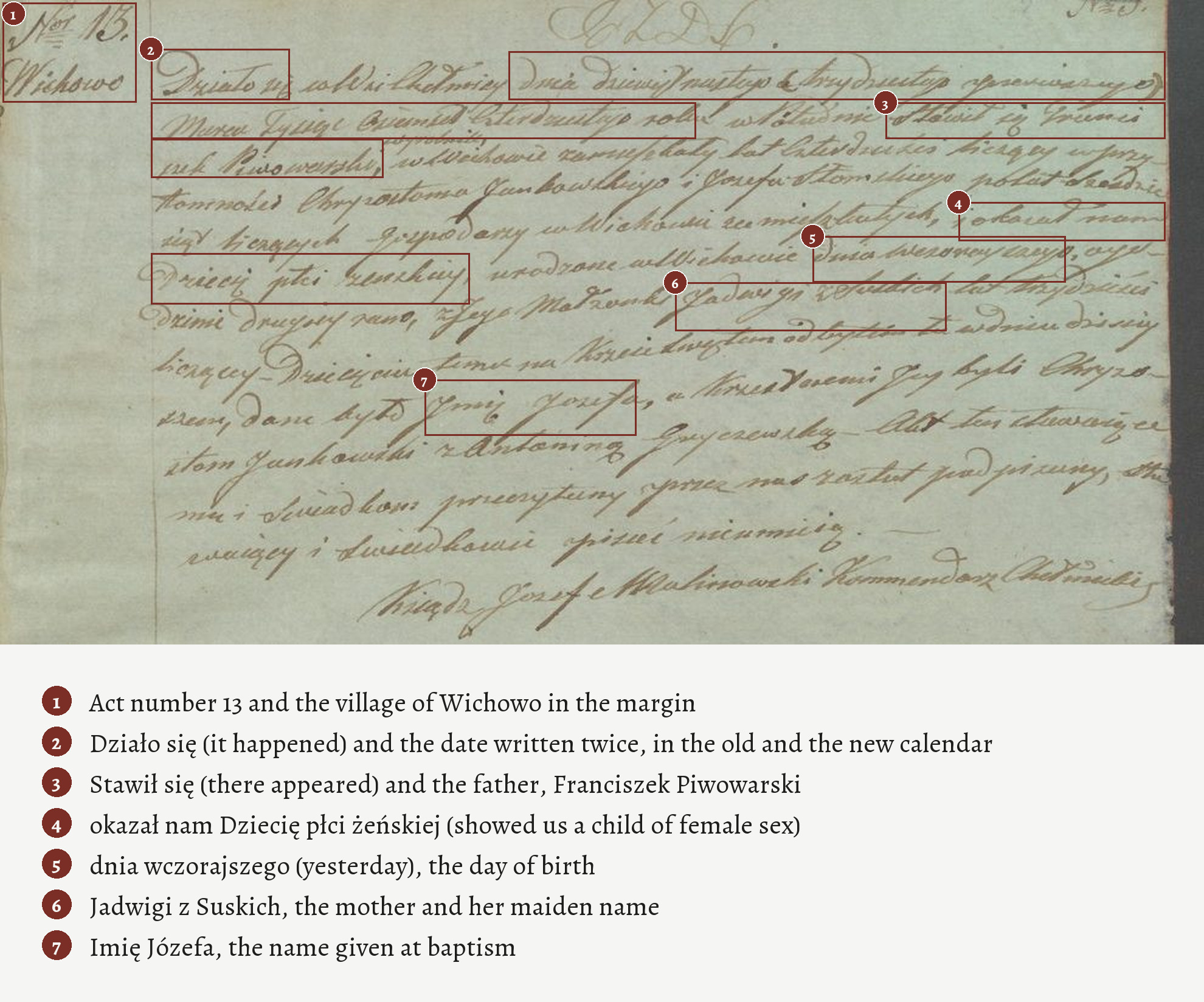
From 1808 the parish priest in central Poland wrote every birth as a short report in a fixed order. From 1826 it opens with “Działo się”, the place, the date and the hour, then the father who came to the priest, two witnesses, the child, the mother, the name and the godparents.
Our example is record 13 of 1840 from the parish of Chełmica. It opens: “Działo się w Wsi Chełmicy dnia dziewiętnastego (trzydziestego pierwszego) Marca Tysiąc Ośmset Czterdziestego roku w Południe.” That is: it happened in the village of Chełmica on the nineteenth (thirty-first) of March 1840 at noon.
Then come the fixed phrases. “Stawił się” (appeared) introduces the father, Franciszek Piwowarski, with his age and work. “okazał nam Dziecię płci żeńskiej” (showed us a child of the female sex) introduces the child. The child was born “dnia wczorajszego”, yesterday, so the birth date is one day before the date at the top. The mother is “Jadwigi z Suskich”, which means Jadwiga née Suska. The name given was Józefa.
Ages of the parents and witnesses are given, but not their birth dates.
4. A Russian record from central Poland, from 1868
From 1868 the same report was written in Russian, in the same order. Once you know the Polish form, you know the Russian one.
The key words to look for, in the old spelling you will see on the scan: состоялось (it happened) at the start, явился (appeared) before the father, младенца мужескаго or мужскаго пола and женскаго пола (an infant of the male or female sex), дано имя (was given the name) and воспріемниками (the godparents were). The mother's maiden name follows the word изъ with the family name in the plural, like z Suskich in Polish.
The spelling is older than today's Russian. Words often end in ъ and you will see the letters ѣ and і, which were dropped in the spelling reform of 1917 and 1918.
5. Two dates at the top
Records from central Poland often give two dates, like our Chełmica record: the nineteenth (thirty-first) of March. The first is by the old Julian calendar used in Russia, the second by ours. The gap is 12 days until February 1900 and 13 days after that.
The pair can fall in different years: a child registered in the last days of December by the Julian date was registered in January of the next year by ours. People later used either date, so a family date that is 12 days off is usually the same event.
6. A German civil register, Prussian partition from 1874
From 1874 births in the Prussian lands were reported to a civil register office, the Standesamt, on printed German forms. The form gives the child's name, sex, date and place of birth and the parents' names. Sometimes it also gives the father's occupation and the parents' ages.
The law allowed a week to report a birth. The father, the midwife or another person present came to the office. Later corrections were written in the margin, sometimes years afterwards.
7. A column register
From 1784 Galician parishes kept Latin registers in columns, at first ruled by hand and later on printed forms: date of birth and baptism, house number, name, religion, sex, legitimate or not, parents, godparents. From the late 19th century many are in Polish. Read the headings at the top of the page first.
The house number has its own column, which helps tell apart two families of the same name in one village. Column registers were also used in the Vilnius region in the 19th century.
8. Traps
These catch most people who read Polish records for the first time.
- Women's surnames change their ending. A man Grala, an unmarried daughter Gralówna, a wife Gralowa. In Latin entries the Polish form often stays: “de Domo Paszukowna” is née Paszuk. It is still one family.
- Names change with grammar. “Z Suskich” is née Suska and “Antoniego Grabowskiego” is Antoni Grabowski. Write every name down in its basic form.
- First names are in Latin or Russian. Joannes is Jan, Adalbertus is Wojciech, Laurentius is Wawrzyniec.
- An age is not a birth date. Ages in records, especially at death, can be several years off. Treat them as a range.
- “Yesterday” is a date. Born “dnia wczorajszego” means one day before the date at the top.
- “The same” points back. Ibidem, eodem die, qui supra and tamże mean the same place, the same day or the same priest as in the entry above, so read that entry too.
- “Urodzony” is not always “born”. Before a name it is a title meaning well-born, used for the gentry.
- The index and the record can spell the name differently. Always open the record itself.
Key words
- baptizavi (Latin)
- I baptised
- natus, nata (Latin)
- born (boy, girl)
- legitimis conjugibus (Latin)
- of lawful spouses
- patrini, levantes (Latin)
- godparents
- de domo (Latin)
- née, maiden name
- Działo się (Polish)
- it happened, the opening words
- stawił się (Polish)
- appeared
- płci męskiej, płci żeńskiej (Polish)
- of the male sex, of the female sex
- z domu, z + family name (Polish)
- née
- prawego łoża, nieprawego łoża (Polish)
- legitimate, illegitimate
- wyrobnik, gospodarz (Polish)
- labourer, farmer
- состоялось (Russian)
- it happened
- явился (Russian)
- appeared
- дано имя (Russian)
- was given the name
- воспріемники (Russian)
- godparents
- крестьянин (Russian)
- peasant
- geboren, geb. (German)
- born, née
- ehelich, unehelich (German)
- legitimate, illegitimate
Can't read your record?
Send us the name, the parish and the year. A link to the scan helps too. The first assessment is free. We send the text in the original language, an English translation and a note on anything that is uncertain.